
 Worksheets
EOC Biology
Total questions: 25
Worksheet time: 25mins
Which best summarizes the role of DNA in the production of proteins?
DNA moves to the cytoplasm to build proteins
DNA transports amino acids to the ribosomes to make proteins
DNA contains the instructions used to make proteins
DNA breaks hydrogen bonds between amino acids
A student noticed that the freshwater plant, Elodea, produced bubbles when placed in direct light. What could the student most likely conclude?
Bubbles of carbon dioxide were produced as a result of photosynthesis.
Bubbles of oxygen were produced as a result of photosynthesis.
Bubbles of carbon dioxide were produced as a result of cellular respiration
Bubbles of oxygen were produced as a a result of cellular respiration
Plant cells are able to produce their own food. This process happens in which structure?
cell wall
chloroplast
mitochondrion
vacuole

These diagrams show a variety of cells from the same organism. How can cells from the same organism have such different shapes and functions?
As each cell differentiates, the DNA changes so that each type of cell has different DNA once it reaches maturity.
Mutations in the cells' nuclei lead to new combinations of DNA, resulting in different shapes and functions in the different types of cells.
During differentiation, different parts of the DNA in each type of cell are activated, resulting in the different structure and function of the cells.
During differentiation, different types of cells produce proteins which destroy the nonactive DNA, leading to cell specialization.
Which of the following best describes the flow of genetic information in a cell?
DNA to RNA to Protein
RNA to DNA to Protein
Protein to RNA to DNA
DNA to Protein to RNA
Develop a comprehensive plan to investigate how genetic variations affect traits in a population over several generations.
Conduct a pedigree analysis of a family for genetic diseases.
Perform a cross-breeding experiment in fruit flies to observe trait inheritance.
Use CRISPR technology to edit genes and observe phenotypic changes in mice.
All of the above
What is the term for a change in the DNA sequence?
Mutation
Meiosis
Mitosis
Recombination
What is the term used to describe the movement of alleles between populations?
Genetic drift
Gene flow
Natural selection
Mutation
Which statement best explains how sweating during exercise maintains homeostasis?
It regulates mineral concentrations in cells.
It regulates body temperature.
It maintains water balance.
It maintains sugar balance in cells.
The chemical colchicine disrupts cell division. Which cell process would most likely stop if colchicine were added to a culture of human liver cells?
mitosis
meiosis
crossing over
active transport
Which statement best explains why animals are considered heterotrophic?
They are able to produce food through the process of photosynthesis.
They are able to produce food through the process of respiration.
They are able to obtain nutrients by decomposing plant and animal tissue.
They are able to obtain nutrients by consuming other organisms or their products.
Which effect could a mutation in mRNA have on the production of proteins?
The protein produced will have a different identity.
The protein produced will have a coiled shape.
The protein produced will produce excess nitrogen.
The protein produced will produce excess water.
What carries the instructions for making amino acids in a protein?
the nitrogen base on the tRNA
the hydrogen bonding between nitrogen bases
the sequence of nitrogen bases on the mRNA
the nitrogen base bonding on the DNA molecule
Which word equation best represents the process of cellular respiration?
carbon dioxide + glucose --> oxygen + water
carbon dioxide + water --> glucose + oxygen
glucose + oxygen ---> carbon dioxide + water
oxygen + water ---> carbon dioxide + glucose
How mitosis and meiosis similar?
both have two cell divisions
both require DNA replication
both produce gametes
both involve crossing over

An offspring will receive how many alleles from each parent to determine a specific trait?
one
two
three
five

A heterozygous long-tusked elephant is crossed with a homozygous recessive short-tusked elephant. What is the probability of the offspring having short tusks?
0%
25%
50%
75%
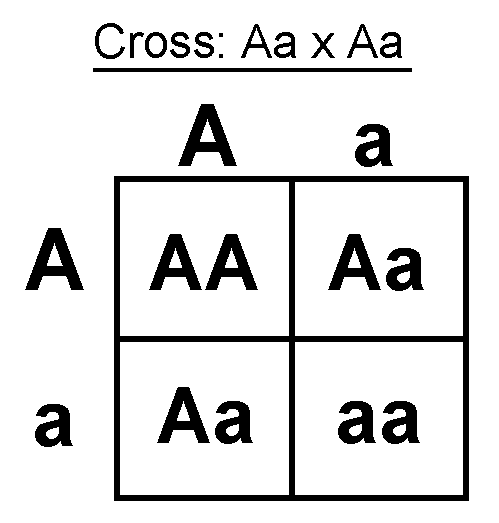
What is the genotypic ratio of the offspring?
3:1
1:3
1:2:1
2:2
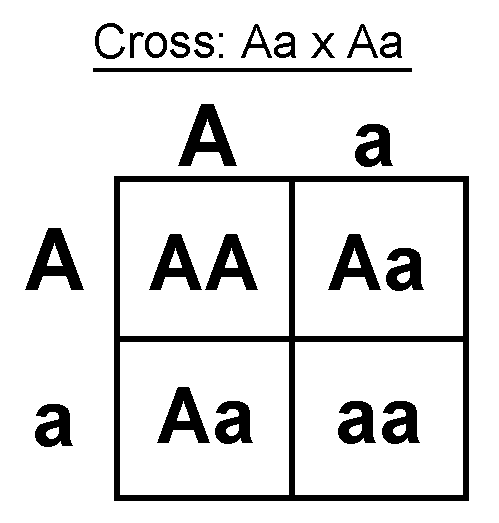
What are the phenotype percentages of the offspring?
50 % Brown fur and 50% White fur
25 % Brown fur and 75% White fur
75 % Brown fur and 25% White fur
0% Brown fur and 100% White fur

What are the possible genotypes for this cross?
(Click the picture to see it without the text)
TT = 25% Tt= 50% tt=25%
all tall
TT= 75% tt = 25%
Tt = 100%

In rabbits, black fur (B) is dominant over brown fur (b). If a rabbit has brown fur, what can you conclude about its genotype?
It is BB.
It is Bb
It is brown
It is bb.
Which process is primarily responsible for the conversion of solar energy into chemical energy in plants?
Photosynthesis
Respiration
Transpiration
Fermentation
What is the primary function of the mitochondria in eukaryotic cells?
Protein synthesis
Energy production
Photosynthesis
Cell division
In a genetic cross, what is the expected phenotypic ratio of a monohybrid cross between two heterozygous individuals?
1:1
3:1
9:3:3:1
1:2:1
Which of the following best describes the role of enzymes in biological reactions?
They increase the activation energy required for the reaction.
They decrease the activation energy required for the reaction.
They are consumed in the reaction.
They are produced as a byproduct of the reaction.

