
 Worksheets
Phylogeny
Total questions: 25
Worksheet time: 25mins
Phylogeny is...
The study of classification of different species
The study of the evolutionary history of a species
The study of prehistoric life
The study of the distribution of different species
Phylogenetic trees show...
Evolutionary relationships between different species
How one species has evolved through time
Which species has evolved the most
Which species have evolved from other species
According to maximum parsimony...
The simpler your phylogenetic tree, the better
Phylogenetic trees should have many branches
All organisms in a phylogenetic tree must descend from a common ancestor
Phylogenetic trees must show all traits
The groups in a phylogenetic tree are called...
Taxa
Nodes
Roots
Branches
Select the area on the cladogram that identifies the MOST RECENT common ancestor?

An analysis of DNA and RNA sequences can be used to classify organisms. Which statement is best supported by the information in this dendrogram?
Lesser pandas are more genetically similar to giant pandas than they are to raccoons.
Brown bears are more genetically similar to giant pandas than they are to sun bears.
Lesser pandas are more genetically similar to raccoons than they are to giant pandas.
The bear species are all more genetically similar to dogs than they are to giant pandas.

I will review how to read a phylogenetic tree!
Yes
No
Maybe

Five new species of bacteria were discovered in Antarctic ice core samples. The nucleotide (base) sequences of rRNA subunits were determined for the new species. The table below shows the number of nucleotide differences between the species.


(a) is a branching diagram showing relationships among groups of clades while a (b) is a branching diagram that shows the inferred relationships between various species.
cladogram
phylogenic tree
Places on a phylogenetic tree where organisms share a common ancestor are called...
Nodes
Branches
Taxa
Species
Starfish (Sea stars), Sea urchins, Sea cucumbers
Echinodermata
Annelida
Arthropoda
Ikidnaea
Living marine sponges
Porifera
Protista
Phyla
Ctenophora
Flatworms
Platyhelminthes
Nematoda
Annelida
Arthropoda

According to this image, which two domains of life are most related?
Bacteria & Archaea
Archaea & Eukarya
Eukarya & Bacteria

Phylogeny is usually represented by a tree diagram called a _________ - _____
Genetic Line
Phylogenetic Tree
Photographic Queue
Future Babies

What is the common ancestor of Letters A, B, C, D, E?
1
2
3
4
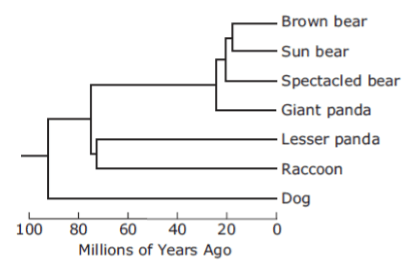
Who is the closest relative to the brown bear?
Giant panda
Dog
Lesser panda
Sun bear

Which organism is the most distantly related to all the others?
Raccoon
Dog
Giant Panda
Sun Bear
Which of the following organisms are LEAST closely related?
organisms that share a domain
organisms that share a family
organisms that share a genus
organisms that share a species

Based on the data given in the table, which two are most closely related?
Human & Gorilla
Gorilla & Orangutan
Human & Chimpanzee
Chimpanzee & Orangutan

Based on the given cladogram, which organism is the outgroup?
human
chimpanzee
gorilla
orangutan
gibbon

Based on the figure, which organism is most closely related to the polar bear?
black bear
european brown bear
western north american brown bear
asian brown bear

In a phylogenetic tree, the branching points represent common ancestors.
True
False
On a phylogenetic tree, what do the branch lengths represent?
The age of the organisms
amount of genetic change since divergence
amount of genetic change since convergence
The age of divergence
Which of the following best describes a monophyletic group in phylogeny?
A group that includes all descendants of a common ancestor
A group that includes species with similar traits but different ancestors
A group that excludes some descendants of a common ancestor
A group that includes species from different evolutionary branches

