
 Worksheets
Refraction
Total questions: 15
Worksheet time: 15mins

The pictures shows what a student observed when he looked through a hand lens at a penny.
What happens to light passing through a hand lens that makes the image of the penny appear larger? The light is-
absorbed
reflected
refracted
stopped

A student placed a pencil in a cup of water. The pencil appears broken because light-
always travels in a straight line
bends when it passes through water
makes the water in the glass evaporate
reflects the pencil on the water's surface
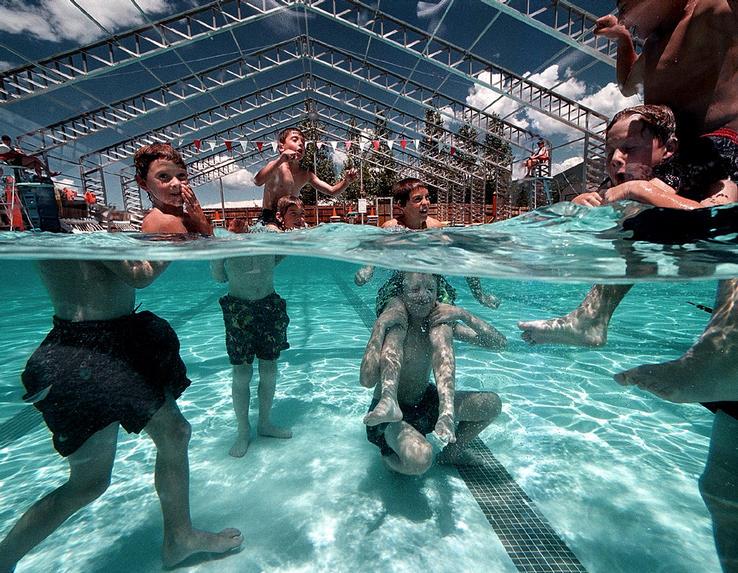
Why does the lower part of the child appear so much different in size from the upper part?
The light rays that travel through water and then into air are refracted.
The light rays that travel through water and then into air are enlarged.
The light rays that travel through air and then into water are reflected.
The light rays that travel through air and then into water are reduced.

What do we call this tool that separates white light into the colors of the Visible Spectrum?
tuning fork
prism
microscope
graduated cylinder

Is a convex lens thicker or thinner in the middle?
Thicker
Thinner
When light waves move from passing through air to passing through a glass lens when happens to them?
They slow down and change direction
They speed up and change direction
They maintain the same speed and change direction
They maintain their same speed and direction

On the diagram A is :
The angle of incidence
The reflection ray
The incidence ray
The refraction ray

On the diagram, B is:
The refraction ray
The normal
The angle of incidence
The incidence ray

C is :
The angle of incidence
The angle of reflection
The angle of refraction
The normal

On the diagram, D is:
The reflected ray
The incidence ray
The normal
The refracted ray

E is:
The angle of incidence
The normal
The angle of reflection
The angle of refraction
What happens to a light ray when it passes from water into air?
It speeds up and bends away from the normal
It slows down and bends towards the normal
It maintains the same speed and direction
It speeds up and bends towards the normal
Which of the following is the correct formula for Snell's Law?
n1sinθ1=n2sinθ2
n1cosθ1=n2cosθ2
n1tanθ1=n2tanθ2
n1cotθ1=n2cotθ2
In an experiment, a beam of light passes through a glass prism and emerges on the other side. What is the phenomenon observed at the boundary of the prism?
Reflection
Refraction
Diffraction
Dispersion
Why do objects appear bent when partially submerged in water?
Due to reflection of light
Due to refraction of light
Due to diffraction of light
Due to absorption of light

