
 Worksheets
8 L 4 1
Total questions: 25
Worksheet time: 25mins
Some scientists think that all life evolved from a common ancestor. Which provides evidence that this may be true?
analogous structures of organisms
homologous structures of organisms
extinction of many varieties of plant species
existence of many varieties of bacteria species
Which best supports the idea of continental drift?
Coastlines are constantly changing shape due to erosion.
Earthquakes are frequently felt in many regions of the world.
Glaciers currently exist in areas considered too warm for glaciers to form.
Fossilized remains of the same plants and animals are found on different continents.
Which best explains why species living in Australia are found nowhere else on Earth?
Australia has an ecosystem different from any other area on Earth.
Humans have genetically altered many Australian species in laboratories.
Australian species were genetically altered after a comet hit the landmass.
Australia separated from other continents and species there evolved independently.
Two organisms have homologous structures. Which can most likely be concluded about the two organisms?
They are unrelated.
They are the same organism.
They share a common ancestor.
They evolved in a similar environment.
List the steps of the scientific method
Conduct experiment
Form a hypothesis
Draw conclusions
Communicate results
Ask a question
Analyze results
Based on the fossil record, which organisms were most likely to have existed first?
plants
insects
jellyfish
bacteria
It is possible to hypothesize how a particular group of organisms evolved by arranging fossils in a chronological sequence. Where would the oldest fossils be found?
the deepest rock layer
the most shallow rock layer
the rock layer with the greatest variety of fossils
the rock layer containing fossils with the most complex structures
Which best helps scientists explore the relationship between modern organisms and ancestral species to create a system of biological classification?
volcanic ash
fossils
DNA evidence
igneous rock layers
Throughout fossil records, many species appearing in lower layers of rock disappear in higher layers of rock. Which best explains their disappearance?
The species became extinct.
The species moved to another geographic location.
The fossil remains were disrupted by an earthquake.
Environmental conditions were not suitable for fossil formation.
Which evidence found in fossils supports that an ice age occurred during a particular time period?
fern fossils
glacial sediments
high oxygen levels
Which term refers to the classification of organisms in an ordered system that indicates natural relationships?
taxonomy
tectonics
geology
biology
Which best explains the separate evolution of African and Asian elephants?
overhunting
volcanic activity
splitting of Pangea
extinction of dinosaurs
A new type of plant was discovered on a newly-formed volcanic island. The island is hundreds of miles away from the mainland. Which hypothesis best explains how the plant arrived?
It spontaneously generated.
It was carried there by humans.
It was carried there by wind or waves.
It was already present in volcanic materials.
Which would provide evidence of lithospheric plate movement over time?
fossils of tropical plants found near the equator
fossils of tropical fish found in a warm climate area
fossils of tropical plants found in a cold climate area
fossils of tropical fish found at the bottom of an ocean
Which best describes the similar function of wings in birds and butterflies?
embryological structures
homologous structures
analogous structures
vestigial structures
What do scientists most often use to form the basis for biological classification?
dietary habits
population size
geographic location
comparative anatomy
Which organisms are most closely related based on comparison of anatomical structures?
jellyfish and clam
snake and worm
pig and human
bid and bee
Organisms who are evolutionarily closer are most likely found at which taxonomic level?
Kingdom
Phylum
Family
Order
Evolution can best be described as which type of change?
absolute change
extreme change
gradual change
Which is true about fossils?
Fossils provide the evidence for the Law of Gravity.
Fossils provide the evidence for the Laws of Motion.
Fossils provide the evidence for the Theory of Evolution.
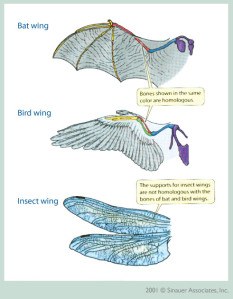
The diagram shows an image of a Pterosaur wing, bat wing, and bird wing. These are all different organisms, but share similar wing structures. If these structures are similar due to common ancestry, which of the following best describes them?
Vestigial Organ
Embryological Similarities
Homologous Structures
Analogous Structures
8 L 4 1
The atomic number of oxygen is 8, and it forms a diatomic molecule with a molecular weight of approximately 32 g/mol.
The atomic number of carbon is 6, and it forms a tetrahedral structure in diamond.
The atomic number of nitrogen is 7, and it forms a triple bond in nitrogen gas.
The atomic number of helium is 2, and it is a noble gas.
8 L 4 1
The speed of light in a vacuum is approximately 3×10⁸ m/s.
The speed of sound in air is approximately 343 m/s.
The speed of light in water is approximately 2.25×10⁸ m/s.
The speed of sound in water is approximately 1482 m/s.
8 L 4 1
The law of conservation of mass states that mass is neither created nor destroyed in a chemical reaction.
The law of conservation of energy states that energy can be converted from one form to another but cannot be created or destroyed.
The law of conservation of momentum states that the total momentum of a closed system is constant.
The law of conservation of charge states that the total electric charge in an isolated system remains constant.
8 L 4 1
The pH of a neutral solution at 25°C is 7.
The pH of a basic solution is less than 7.
The pH of an acidic solution is greater than 7.
The pH of pure water is 8.

