
NEW
Font size
 Worksheets
Missouri Biology EOC
Total questions: 25
Worksheet time: 25mins

The initial steps in gene expression are modeled. Double-stranded DNA first unwinds into two strands. Which process and product are represented in the diagrams?
Process: transcription; product: mRNA
Process: translation; product: protein
Process: replication; product: tRNA
Process: recombination; product: polymerase

The diagram represents one way an enzyme can be inhibited. Which statement explains the effect of an inhibitor on an enzyme?
A substrate will be able to bond with the enzyme.
The enzyme will likely be attacked by immune cells
The enzyme will be unable to produce more enzymes.
A substrate will be unable to attach to the enzyme.

Viruses are considered nonliving because they need a host to reproduce.
True
False
Which of the following best describes the flow of genetic information in a cell?
DNA to RNA to Protein
RNA to DNA to Protein
Protein to RNA to DNA
DNA to Protein to RNA
In genetics, what is the term used for the physical appearance of an organism's trait?
Genotype
Phenotype
Allele
Homozygous
What is the term for a change in the DNA sequence?
Mutation
Meiosis
Mitosis
Recombination
What is the term used to describe the movement of alleles between populations?
Genetic drift
Gene flow
Natural selection
Mutation

A cell _______ in a hypertonic solution because water moves _______ the cell.
shrinks; out
shrinks; in
swells; out
swells; in

Which of the following follows the concentration gradient (high to low) but requires a transport protein?
diffusion
osmosis
facilitated diffusion
active transport

The four butterflies in the illustration represent the offspring in the F1 generation. Which statement is best supported by the phenotypes of these offspring?
The F1 generation is composed only of males.
Two of the offspring in the F1 generation will not be able to reproduce.
The F1 generation is the result of a dihybrid cross.
Two of the offspring in the F1 generation will experience a spontaneous mutation

Name the process in the picture.
transcription
mitosis
translation
replication

Name M.
light dependent cycle
Carbon dioxide
glucose
Calvin cycle

Name B.
phosophate
glucose
deoxyribose
nitrogen base

An analysis of DNA and RNA sequences can be used to classify organisms. A dendrogram, such as the one shown, is based on molecular data. It can be used to represent evolutionary relationships within a group of organisms that are hypothesized to have descended from a common ancestor. Which statement is best supported by the information in this dendrogram?
Lesser pandas are more genetically similar to giant pandas than they are to raccoons.
Brown bears are more genetically similar to giant pandas than they are to sun bears.
Lesser pandas are more genetically similar to raccoons than they are to giant pandas.
The bear species are all more genetically similar to dogs than they are to giant pandas.

Some students used vinegar to dissolve a way the shells of three eggs and used these eggs as models of human red blood cells. The students observed the changes in the eggs when they were placed in different solutions. Which statement best describes the role of the cell membrane in this model?
The cell membrane is an impermeable barrier that prevents water from entering the cell.
The cell membrane allows solutions to enter the cell, which causes the cell to shrink.
The cell membrane allows water to enter and leave the cell.
The cell membrane removes solutes from the environment.
the section of dna has these bases:
TAG CAG TAC
which mRNA sequence is produced from this DNA section
ATC GTC ATG
AUC GUC AUG
AUG CUG AUC
UTC GTC UTG

Passive transport requires ATP while active does not.
True
False

Food webs such as the one shown were first used in 1927 by the animal ecologist Charles Elton. The food web below represents the feeding relationships among organisms in an Alaskan ecosystem. An environmental change that removed which of these organisms from the ecosystem would cause the most instability in the ecosystem?
Auklets
Foxes
Salmon
Zooplankton
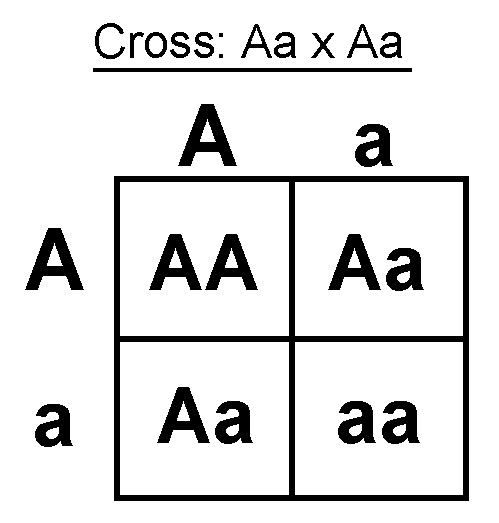
What is the genotypic ratio of the offspring?
3:1
1:3
1:2:1
2:2
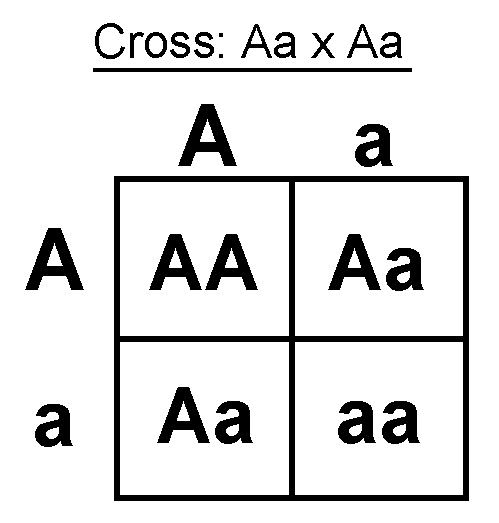
What are the phenotype percentages of the offspring?
50 % Brown fur and 50% White fur
25 % Brown fur and 75% White fur
75 % Brown fur and 25% White fur
0% Brown fur and 100% White fur
Which of the following processes is primarily responsible for the production of ATP in the mitochondria?
A) Glycolysis
B) Krebs Cycle
C) Electron Transport Chain
D) Fermentation
In an experiment, a student wants to test the effect of light on plant growth. What is the independent variable in this experiment?
A) Amount of water
B) Type of plant
C) Amount of light
D) Growth of the plant
Which of the following best explains why a species might become extinct?
A) High genetic diversity
B) Stable environment
C) Inability to adapt to environmental changes
D) Abundance of food resources
What is the primary function of ribosomes in a cell?
A) Energy production
B) Protein synthesis
C) DNA replication
D) Lipid storage
A scientist observes that a certain trait in a population of rabbits is becoming more common over generations. Which process is most likely responsible for this change?
A) Genetic drift
B) Natural selection
C) Gene flow
D) Mutation

