
 Worksheets
Ducks Unlimited
Total questions: 25
Worksheet time: 25mins

When a duck uses its beak to straighten out and clean its feathers it is called...
Grooming
Pickering
Preening
Bathing

Ducks can sleep with both eyes open
True
False

When birds preen, they take a waxy oil and spread it over their feathers to make it waterproof. Where is the gland that produces this oil?
Bottom of the Neck
Base of the tail
Inside the Mouth
Top of the Leg

What is a male duck called?
A drake
A Maleard
A buck
A tom

True or False: Ducks don't get wet when they dive underwater.
True
False

Duck feathers are waterproof because they are
So super thick
Covered with a waxy substance
Covered with a protein
Filled with air

What is generally the top recorded speed of a flying duck?
100 miles per hour
80 miles per hour
60 miles per hour
30 miles per hour

What duck is this?
Blue-Winged Teal
Gadwall
Ruddy Duck
American Coot
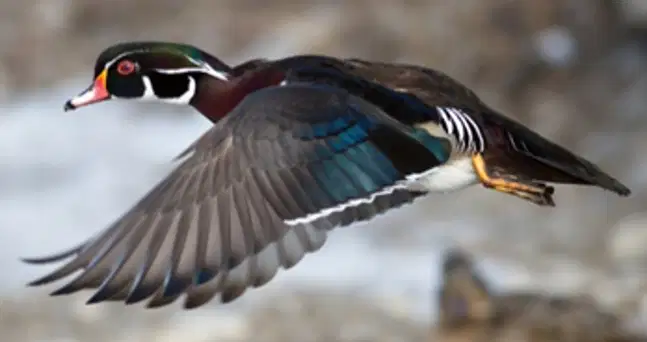
What duck is this?
Mallard
Blue-winged Teal
American Green-winged Teal
Wood Duck
What is the primary focus of Ducks Unlimited in terms of environmental science?
Wetland conservation
Forest preservation
Desert reclamation
Ocean cleanup
Which of the following is a key ecological benefit of wetlands that Ducks Unlimited aims to protect?
Carbon sequestration
Increased soil erosion
Reduced biodiversity
Increased air pollution
Ducks Unlimited often collaborates with scientists to monitor which of the following in wetland ecosystems?
Water quality
Air quality
Soil acidity
Noise pollution
What type of scientific data might Ducks Unlimited collect to assess the health of a wetland?
Water pH levels
Atmospheric CO2 levels
Soil nitrogen content
Wind speed
Which of the following species is most likely to benefit from Ducks Unlimited's conservation efforts?
Mallard duck
Polar bear
Desert tortoise
Great white shark
In terms of biodiversity, why are wetlands important ecosystems that Ducks Unlimited works to preserve?
They support a wide variety of plant and animal species.
They are the least biodiverse ecosystems.
They only support aquatic life.
They are primarily man-made ecosystems.
Ducks Unlimited uses satellite imagery to track changes in wetland areas. What scientific principle does this technology primarily rely on?
Remote sensing
Genetic engineering
Thermodynamics
Quantum mechanics
Which of the following is a potential consequence of wetland loss that Ducks Unlimited aims to prevent?
Increased flooding
Decreased air temperature
Increased mountain formation
Decreased ocean salinity
Ducks Unlimited's conservation efforts can help mitigate climate change by preserving wetlands. How do wetlands contribute to this?
By storing carbon in plant biomass and soil
By releasing large amounts of methane
By increasing solar radiation
By decreasing atmospheric nitrogen
What is a common method used by Ducks Unlimited to restore degraded wetlands?
Reintroducing native plant species
Draining the wetland
Introducing non-native predators
Increasing urban development
Which scientific concept is crucial for understanding the water filtration role of wetlands that Ducks Unlimited protects?
Natural filtration processes
Nuclear fission
Photosynthesis
Magnetic resonance
Ducks Unlimited often educates the public about the importance of wetlands. Which of the following is a key message they might convey?
Wetlands act as natural water filters.
Wetlands are primarily used for urban development.
Wetlands are not important for wildlife.
Wetlands increase soil erosion.
How does Ducks Unlimited contribute to scientific research on migratory patterns of waterfowl?
By tagging and tracking birds
By increasing hunting quotas
By reducing wetland areas
By introducing new predators
Which of the following is a direct impact of Ducks Unlimited's work on local communities?
Improved water quality
Increased industrial pollution
Decreased biodiversity
Increased desertification
What role do wetlands play in the hydrological cycle that Ducks Unlimited aims to protect?
They act as natural sponges, absorbing and releasing water.
They prevent all water evaporation.
They increase the salinity of freshwater.
They eliminate all groundwater.
Ducks Unlimited's efforts in wetland conservation can help protect against which natural disaster?
Flooding
Earthquakes
Volcanic eruptions
Tornadoes

