
 Worksheets
Rate of Reaction
Total questions: 15
Worksheet time: 15mins
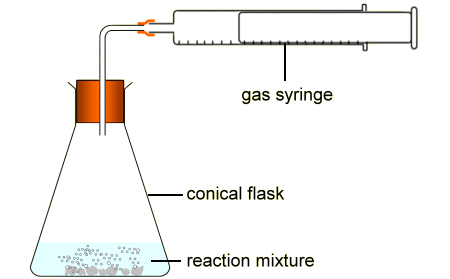
How is this equipment being used to measure the rate of reaction?
The gas syringe measures how much gas is produced in a certain time
The reaction mixture will increase in volume in a certain time
Which unit is correct for the rate of reaction?
g mol-1
g min-1
mol dm-3
kJ mol-1
Which of the following has the lowest rate of reaction?
Combustion of ethanol
Fermentation of glucose
Oxidation of magnesium
Precipitation of silver chloride
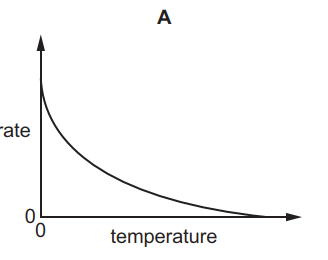
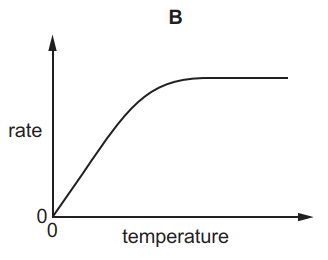
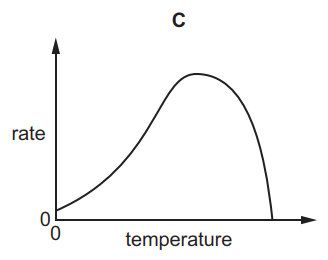
Which graph shows the effect of increasing temperature on the rate of reaction of calcium carbonate with dilute hydrochloric acid?
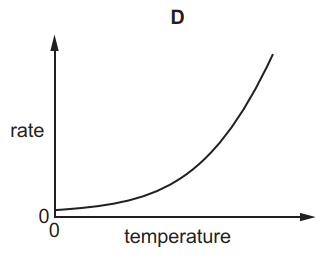

Identify where the reaction has finished
A
B
C
D
Which of the following reactions occurs at the highest rate?
Photosynthesis
Rusting of iron
Combustion of hydrogen in oxygen
Combustion of magnesium in oxygen

Diagram 4 shows the graph of volume of carbon dioxide gas against time when 5 g of marble chips is added to 50 cm3 of 0.2 mol dm-3 hydrochloric acid. At what time the rate of reaction the highest?
t1
t2
t3
t4
Which reactions has the highest rate of reaction?
Rusting of water pipe
Photosynthesis in green plant
Burning of a small piece of charcoal in the air
Formation of stalactites and stalagmites
Which factors affect the rate of a reaction?
temperature
pressure
concentration
catalyst
All of the above
What is the rate of reaction?
How fast a reaction is
How loud a reaction is
How big a reaction is
How much gas a reaction produces
The following equation shows the reaction between calcium carbonate, CaCO3 and hydrochloric acid, HCl:
CaCO3(aq) + 2HCl(aq) → CaCl2(aq) + CO2 (g) + H2O(l)
Which of the following is the suitable method to measure the rate of reaction?
Change in the temperature of the solution with time
Change in the volume of carbon dioxide gas with time
Change in the mass of water with time
Change in the concentration of hydrochloric acid with time
Why does a catalyst increase the rate of reaction?
it produces extra energy for the reactants
it increases the speed of the reactant particles
it increases the frequency of particle collisions
it reduces the activation energy of the reaction
Which factor does not affect the rate of a chemical reaction?
Temperature
Pressure
Color of reactants
Concentration
In an experiment, increasing the concentration of a reactant increases the rate of reaction. What is the most likely reason for this?
More collisions between particles
Higher energy of particles
Larger volume of reactants
Lower activation energy
A student measures the rate of reaction by timing how long it takes for a precipitate to form. Which method is the student using?
Measuring change in mass
Measuring change in color
Measuring change in temperature
Measuring change in turbidity

