
 Worksheets
Polarity and Intermolecular Forces
Total questions: 15
Worksheet time: 15mins

Use your knowledge and electronegativity sheet to predict what the following compound is classified as.
nonpolar covalent
polar covalent
ionic
metallic

When you have Li-O, what is the polarity?
nonpolar
polar
ionic

Polar and nonpolar bonds are both types of _____
Covalent bond
Ionic bond
Metallic bond
Nonmetallic bond
Use your knowledge and electronegativity sheet to predict what the following compound is classified as.
polar covalent
nonpolar covalent
ionic
metallic
What causes a partial charge on a molecule?
unequal sharing of electrons
an electronegativity difference between 0.4 and 1.8.
the shape of the molecule
all of the above
Attractions between polar molecules are Weaker than attractions between nonpolar molecules.
True
False
Which formula represents a nonpolar molecule?
HBr
H2S
CBr4
PCl3

Partial charges like the ones shown here are called:
dipoles
deltas
ions
magnetic poles
Which of the following is a polar molecule?
CH4
Xe
H2O
CO2

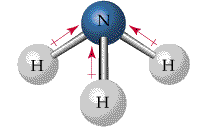
Is this molecule polar or non-polar?
Non-polar
Polar

Will this molecule be polar or nonpolar? H2S
polar
nonpolar
Which type of intermolecular force is the strongest?
Dipole-dipole interactions
Hydrogen bonding
London dispersion forces
Van der Waals forces
What is the main reason water has a high boiling point compared to other molecules of similar size?
Its molecular weight
Hydrogen bonding
Dipole-dipole interactions
London dispersion forces
Which of the following molecules is likely to have the highest polarity?
CO2
CH4
NH3
CCl4
In an experiment, a student observes that oil and water do not mix. What is the primary reason for this observation?
Oil is denser than water
Water is polar and oil is nonpolar
Oil has stronger intermolecular forces
Water has a higher boiling point

