
Font size
 Worksheets
Organic
Total questions: 25
Worksheet time: 25mins
Which of the following is a necessary component of an organic molecule?
Phosphate
Carbon
Nitrogen
Sulfur
Which of the following is NOT one of the four major organic molecules?
Lipids
Nucleic Acids
Amino Acids
Carbohydrates
A ___ is a subunit of an organic molecule.
Monomer
Polymer
Which of the following has the most energy (calorie) per gram?
Lipids
Carbohydrates
Nucleic Acids
Protein
What is the difference between organic, and inorganic matter?
The primary difference between organic vs. inorganic compounds is that organic compounds always contain carbon while most inorganic compounds do not contain carbon.
The primary difference between organic vs. inorganic compounds is that organic compounds always contain steel while most inorganic compounds do not contain steel.
Which element is found in all organic molecules?
Oxygen (O)
Carbon (C)
Hydrogen (H)
Nitrogen (N)
the study of the structure, properties, composition, reactions, and preparation of carbon-containing compounds (a)
Organic chemistry
Catacoustics
Abyssal
Gluon
Very long organic molecules that consist of carbon, oxygen, hydrogen, nitrogen, and phosphorus that would be found in nucleus with DNA.
Nucleic Acid
Carbohydrate
Protein
Lipid
Sugar and cellulose are examples of..
Lipids
Carbohydrates
Nucleic Acids
Proteins
Fats, oils, and waxes are...
Lipids
Carbohydrates
Proteins
Nucleic Acids
Functions include contraction of the muscles, transporting substances in the body, and speeding up chemical reactions (enzymes).
Carbohydrate
Lipid
Nucleic Acid
Protein

Name this compound
2,2-dimethyl-4-ethylhexane
4-ethyl-2,2-dimethylhexane
3-ethyl-5,5-dimethylhexane
4-ethyl-2-methylhexane

Name this organic molecule.
Which of the following compounds is an example of hydrocarbon?
CO2
C2H6
C2H5OH
CH3COOH
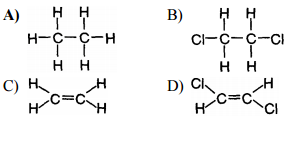
Which formula represents a saturated hydrocarbon?
A
B
C
D

Name the compound.
nonene
2,2-dimethylhept-3-ene
1,1,5-trimethylhex-2-ene
2,6-dimethylhept-3-ene

Name this organic molecule.

Name this organic molecule.
Which compound belongs to the alkene family?
C2H2
C2H4
C6H6
C6H14
Which of the following is a characteristic of organic compounds?
They always contain carbon.
They are always soluble in water.
They are always gases at room temperature.
They always contain nitrogen.
What type of bond is most commonly found in organic molecules?
Ionic bond
Covalent bond
Hydrogen bond
Metallic bond
Which of the following is an example of an organic compound?
H2O
NaCl
CH4
CO2
In organic chemistry, what is the term for compounds with the same molecular formula but different structural formulas?
Isotopes
Isomers
Polymers
Allotropes
Which functional group is present in alcohols?
Carboxyl group
Hydroxyl group
Amino group
Carbonyl group
What is the main source of organic compounds in nature?
Minerals
Petroleum
Water
Air

