
 Worksheets
Heat Temperature and Phase Change Diagrams
Total questions: 15
Worksheet time: 15mins
What is it called when a solid turns directly into a gas?
Sublimation
Condensation
Liquid
All phase changes (changing states) requires energy to be added or taken away.
True
False
Change from gas to liquid...
condensation
evaporation
expansion
movement
Change from Liquid to Solid is call......
fusion
Freezing
sublimation
evaporation
All changes in the state of matter of a substance requires
vibration
water
permission
energy
What happens to particles when they are heated?
They speed up and spread out
They slow down and compress
They stop moving
They move closer together and speed up

The faster molecules move,
the higher the temperature
the less temperature
the same temperature
I don't know
Temperature is a measure of the average _____________ energy of the particles of a substance.
potential
kinetic
gravitational
heat
True or false: melting and freezing occur at the same temperature
True
False
I don't know
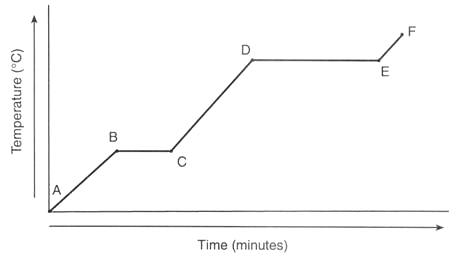
Moving left to right across the diagram, are the particles moving faster or slower as time goes on? (Diagram F)
Faster
Slower
If energy is being added at letter D, what is happening on the phase change graph?
Evaporation of a liquid
Condensation of a gas
Boiling of a liquid
Both A and B
A change of state from a liquid to a solid is called....
Melting
Freezing
Evaporation

The slower molecules move,
the higher the temperature
the less temperature
the same temperature
I don't know
Boiling and evaporation are forms of vaporization
True
False
Heat Temperature and Phase Change Diagrams
A) The temperature remains constant during a phase change.
B) The temperature increases during a phase change.
C) The temperature decreases during a phase change.
D) The temperature fluctuates randomly during a phase change.

