
 Worksheets
Waves and EM Spectrum
Total questions: 25
Worksheet time: 25mins

Select the correct order of waves on the EMS from the longest wavelength to the shortest wavelength
Radio, Micro, Infra, Visible, Ultra, X-ray, Gamma
Gamma, X-ray, Ultra, Vis, Infra, Micro, Radio
Vis, Micro, Infra, Ultra, X-ray, Gamma, Radio
Micro, Radio, Vis, Infra, Ultra, X-ray, Gamma

As the frequency of an electromagnetic wave increases, the amount of energy in that wave...
increases.
stays the same.
decreases.

____________________ is the number of waves that move past one spot in a second
energy
amplitude
wavelength
frequency
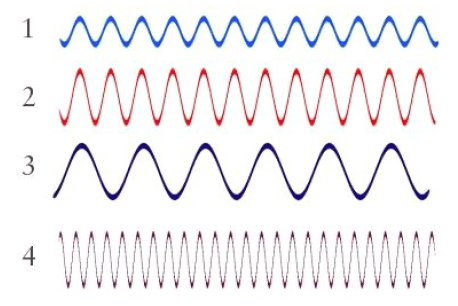
Which wave in the diagram has the greatest wavelength?
1
2
3
4
How does the wavelength of visible light compare to that of ultraviolet light?
Visible light has a longer wavelength than ultraviolet light.
Visible light has a shorter wavelength than ultraviolet light.
Visible light and ultraviolet light have the same wavelength.
Wavelengths of visible light and ultraviolet light cannot be compared.

Which type of waves have the longest wavelength?
Visible light
Radio waves
X-rays
Gamma-Rays
Which of the following electromagnetic waves has the shortest wavelength?
Radio waves
Infrared waves
Ultraviolet waves
Gamma rays
What is the electromagnetic spectrum?
A device used to observe distant objects
The range of all possible waves that transfer energy through an electric and a magnetic field
A type of energy that is visible to the human eye
The distance between two consecutive peaks of a wave
Describe how the energy of electromagnetic waves changes as you move from radio waves to gamma rays in the electromagnetic spectrum.
The energy decreases as you move from radio waves to gamma rays.
The energy remains constant across the spectrum.
The energy increases as you move from radio waves to gamma rays.
The energy first decreases and then increases.
Which of the following correctly lists the electromagnetic spectrum in order of increasing frequency?
Radio waves, microwaves, infrared, visible light, ultraviolet, X-rays, gamma rays.
Gamma rays, X-rays, ultraviolet, visible light, infrared, microwaves, radio waves.
Microwaves, radio waves, infrared, visible light, ultraviolet, X-rays, gamma rays.
Infrared, radio waves, microwaves, visible light, ultraviolet, X-rays, gamma rays.
Which has the LONGEST wavelength and, therefore, the lowest frequency/energy
Gamma Rays
Radio Waves
Visible Light
Infrared rays
Which of the following is a common application of infrared waves?
Sterilizing medical equipment.
Cooking food in a microwave oven.
Remote controls for televisions.
Detecting broken bones in X-ray imaging.

Which wave has the lowest wavelength?
Red
Violet
Orange
Green

Which electromagnetic waves have the highest frequencies and the shortest wavelengths?
microwaves
visible light
gamma rays
x-rays

Which electromagnetic waves are used in ovens and cell phone communications?
microwaves
infrared rays
gamma rays
ultraviolet rays

A wave with a large wavelength will have a ______ frequency and _____ energy
high, low
low, high
high, high
low, low

Which type of waves are used in broadcasting?
infrared rays
X-rays
radio waves
gamma rays

Electromagnetic waves that help your body produce vitamin D are called?
Ultraviolet rays
X-rays
Radio waves
Gamma rays

Which has the SHORTEST wavelength and, therefore, the highest frequency/most energy
Ultraviolet Rays
Radio Waves
Gamma Rays
X-Rays

Which section of the spectrum is the ONLY one we can see?
Ultraviolet Rays
Gamma Rays
X-Rays
Visible Light

Which electromagnetic waves are used in devices such as heat lamps & TV remote controls?
Ultraviolet Rays
Microwaves
Infrared Rays
Gamma Rays
What is the primary difference between mechanical waves and electromagnetic waves?
Mechanical waves require a medium to travel through, while electromagnetic waves do not.
Electromagnetic waves require a medium to travel through, while mechanical waves do not.
Both require a medium to travel through.
Neither require a medium to travel through.
Which of the following is a real-world application of ultraviolet waves?
Used in remote controls for televisions.
Used in sterilizing medical equipment.
Used in cooking food in a microwave oven.
Used in radio broadcasting.
How does the frequency of a wave relate to its energy in the electromagnetic spectrum?
Higher frequency waves have higher energy.
Higher frequency waves have lower energy.
Frequency and energy are not related.
Frequency and energy are inversely related.
Which of the following experiments can demonstrate the wave nature of light?
Double-slit experiment
Photoelectric effect
Measuring the speed of light
Observing a rainbow

