
 Worksheets
Reconstruction Unit PSP Quiz 25
Total questions: 41
Worksheet time: 44mins
an official pardon (forgiveness) for people who have been convicted of crimes
Amnesty
Impeach
Coup d'état
Suffrage
the right to vote
Amnesty
Impeach
Coup d'état
Suffrage
laws that limited the rights of African Americans and enforced racial segregation
Black Codes
Compromise of 1877
Panic of 1873
Reconstruction Act
A political party that mainly consisted of former Confederates who opposed Reconstruction efforts that punished the South.
Radical Republicans
Southern Republicans
Southern Democrats
Radical Democrats
an 1867 federal law that announced southern states would be under U.S. military rule and would have to write new state constitutions, ratify the 14th amendment, and allow African American men to vote
Black Codes
Compromise of 1877
Panic of 1873
Reconstruction Act
an organization that resisted Reconstruction in the South and committed violence against African Americans
Bureau
Jim Crow Laws
Ku Klux Klan
Sharecropping
a type of farming in which families rent small plots of land from a landowner and pay the owner a portion of their crop harvest as rent
Bureau
Jim Crow Laws
Ku Klux Klan
Sharecropping
members of the Republican Party who wanted racial equality in the United States during Reconstruction
Carpetbagger
Coup d'état
Scalawag
Radical Republicans
a compromise that decided the Republican candidate for president would become the next President of the United States, and that the U.S. military would stop enforcing Reconstruction policies in the South.
Compromise of 1877
Freedmen's Bureau
"New South"
Plessy v. Ferguson
a federal agency created to assist freedmen in obtaining medical care, land, jobs, fair treatment, and education after the Civil War
Compromise of 1877
Freedmen's Bureau
"New South"
Plessy v. Ferguson
a movement/ plan to industrialize the South after the Civil War in order to strengthen the Southern economy
Compromise of 1877
Freedmen's Bureau
"New South"
Plessy v. Ferguson
an 1896 court case in which the Supreme Court decided segregation was legal in the United States. Due to this decision, segregation remained legal until 1964
Compromise of 1877
Freedmen's Bureau
"New South"
Plessy v. Ferguson
people who have been freed from slavery
Freedmen
Sharecropping
Impeach
Segregation
a voting law in some states that made men eligible to vote if they or their ancestors (fathers and grandfathers) had been able to vote before 1867
Grandfather Clause
Literacy Test
Poll Taxes
Reconstruction
a tax that must be paid in order to vote in an election
Grandfather Clause
Literacy Test
Poll Taxes
Reconstruction
a test given that must be passed in order to vote in an election
Grandfather Clause
Literacy Test
Poll Taxes
Reconstruction
the period of time from 1865–77 when the U.S. government worked to rebuild the southern states
Grandfather Clause
Literacy Test
Poll Taxes
Reconstruction
an amendment to the U.S. Constitution that officially gave men of all races the right to vote in 1870
Industrialization
13th Amendment
14th Amendment
15th Amendment
an amendment to the U.S. Constitution that gives citizenship to all people born in the U.S., and declared that laws should be applied equally and fairly to people of all races
Industrialization
13th Amendment
14th Amendment
15th Amendment
an amendment to the U.S. Constitution that officially abolished slavery throughout the United States in 1865
Industrialization
13th Amendment
14th Amendment
15th Amendment
the development of industries in a country or region
(ex: the tobacco industry, the textile/clothing industry, the oil industry)
Industrialization
13th Amendment
14th Amendment
15th Amendment
Which region of the U.S. needed to be "reconstructed" after the Civil War?
None
Midwest
South
North
Which of the following best describes why Lincoln's 10% Plan for Reconstruction was replaced by Andrew Johnson's Plan for Reconstruction?
Lincoln was assassinated right at the end of the Civil War and Johnson was his successor.
Lincoln lost the election of 1868 to Andrew Johnson.
Lincoln did not want to Reconstruct the South at all, and Johnson overrode his plans.
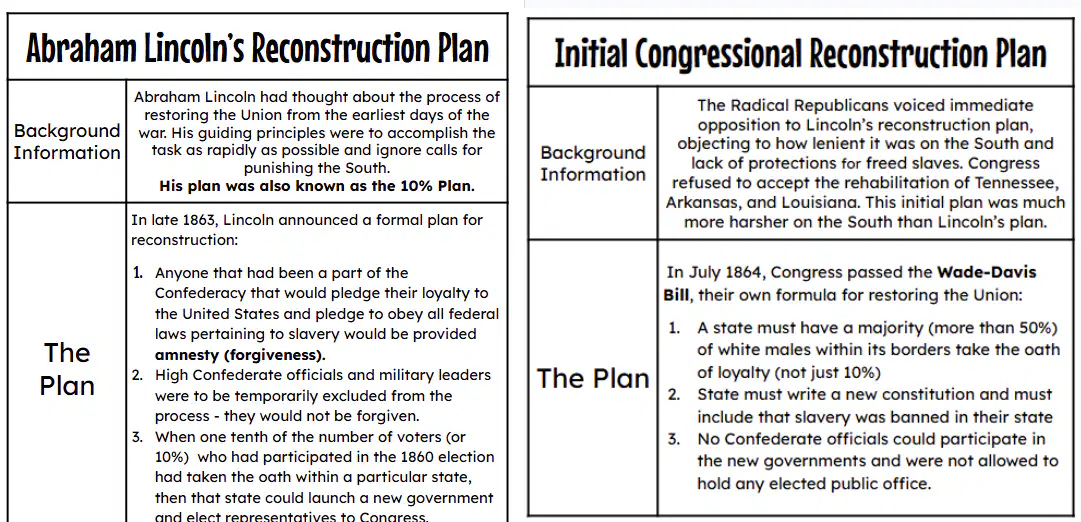
Review the two charts. Which of the following correctly describes a major difference between the two plans?
Lincoln's plan called for 10% of Southerners to take the Oath of Loyalty while Congress's plan called for more than 50%
Lincoln's plan called for 50% of Southerners to take the Oath of Loyalty while Congress's plan called for 10%
Both plans punished Confederate officials in some way.
Lincoln's Plan required states to ratify the 13th Amendment while Congress's Plan punished Confederate soldiers.
Why was the Radical Republicans' Plan considered to be more 'radical' than the other three plans for Reconstruction?
Because it was more extreme and called for the South to be punished more harshly than the other plan.
Because it was supported by the minority of the members of Congress
Because it required more than 50% of the south's population to take an oath of loyalty.

Success or failure of the Freedmen's Bureau? Ensure freedmen received equal treatment in courts
Success
Failure

Success or failure of the Freedmen's Bureau? Providing compensation (payments) to ALL African American veterans
Success
Failure

Success or failure of the Freedmen's Bureau? Increase access to education and literacy for freedmen
Success
Failure

Success or failure of the Freedmen's Bureau? Providing land so that most freedmen became landowners.
Success
Failure

Success or failure of the Freedmen's Bureau? Providing job opportunities to ALL freedmen
Success
Failure

Success or failure of the Freedmen's Bureau? Providing general check-ups and dental hygiene (access to healthcare) to freedmen
Success
Failure
Which of the following was a FAILURE of the 13th Amendment?
Literacy tests and poll taxes prevented men from voting.
Jim Crow laws were passed in the south to support African Americans in obtaining their rights
Black codes were created to unjustly imprison freedmen so they could be used for free labor (Convict Leasing).
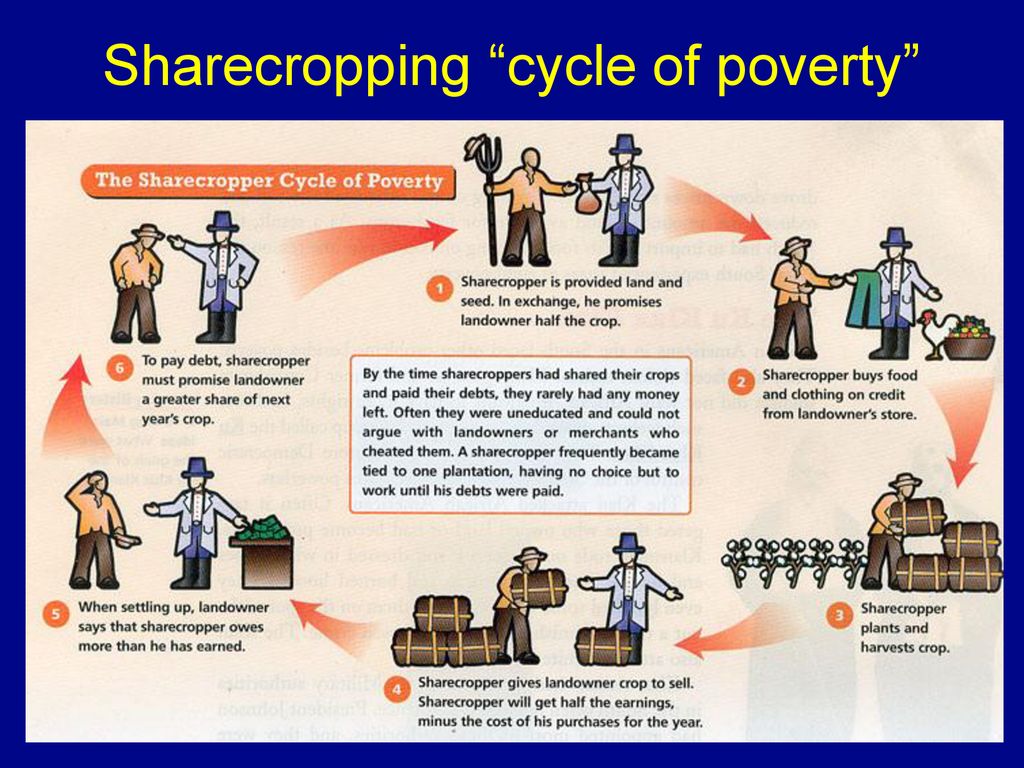
How did sharecropping negatively impact the lives of those that became sharecroppers under landowners?
Sharecroppers went in debt but were quickly able to pay back the landowner after saving money for months.
Sharecroppers were able to make and save a lot of money to eventually buy their own farm.
Sharecroppers often went into debt or made very little money which meant they would likely never be able to save money or buy their own land.
Which of the following best describes how the government attempted to enforce the 14th Amendment in the South?
By arresting newly freed people to further punish them and put them back into slavery.
By sending military forces to hold the South accountable in giving freedmen their rights
By forcing all citizens to take Literacy Tests prior to voting.
Which of the following was a FAILURE of the 15th amendment?
Literacy tests and poll taxes prevented men from voting AND women were excluded from gaining voting rights
Jim Crow laws were passed in the south to limit African Americans' rights
Black codes were created to unjustly imprison freedmen so they could be used for free labor
How did the 15th Amendment resulted in political/government
opportunities for black men?
As a result of the 15th Amendment, many Black men served in Congress and state governments during Reconstruction
As a result of the 15th Amendment, there was no change in representation in Congress
As a result of the 15th Amendment, representation of black men decreased in Congress.
Who was left out of the 15th Amendment?
Women
Men
Elderly
How did the Supreme Court’s decision in Plessy v. Ferguson impact the rights of Americans in the United States?
It banned racial segregation and said that all people are equal under law.
It stated that segregation was constitutional under the idea of "separate but equal".
It funded free public education for all people regardless of their race.
It said racial segregation was legal except for railway stations and trains.
True or False: Hate groups like the KKK and White League often used violence and intimidation to limit the rights of African Americans
False
True
What allowed southern Democrats to regain control of southern state governments and pass Jim Crow Laws after military troops were removed from the South?
The Railroad Crisis of 1868
Compromise of 1877
Plessy v. Ferguson
The 14th Amendment
True or False: Southern Democrats agreed to give Republican candidate Rutherford B. Hayes the presidency as a part of the Compromise of 1877 because they wanted the U.S. military to leave the southern states, and Hayes promised to make that happen.
True
False

