
 Worksheets
DNA, Protein Synthesis, and Mutations Practice
Total questions: 38
Worksheet time: 19mins
Name
Class
Date
1.
1. DNA is copied during a process called ______________ which results in an identical copy of itself.
a)
a) Photosynthesis
b)
b) Transcription
c)
c) Replication
d)
d) Translation
2.
2. Genes in your DNA contain instructions for assembling _______________.
a)
a) Proteins
b)
b) Nucleosomes
c)
c) Pyrimidines
d)
d) Purines
3.
3. DNA replication results in two DNA molecules,
a)
a) each with two new strands.
b)
b) each with one new strand and one original strand.
c)
c) one with two new strands and the other with two original strands.
d)
d) each with two original strands.
4.
4. What do we call DNA replication since new DNA has 1 parent strand and 1 new strand?
a)
a) Conservative
b)
b) Dispersive
c)
c) Semiconservative
5.
5. Unlike DNA, RNA contains...
a)
a) a phosphate group
b)
b) guanine (G)
c)
c) thymine (T)
d)
d) uracil (U)
6.
6. What is produced during transcription? (Hint: DNA helps create _________.)
a)
a) tRNA
b)
b) Protein
c)
c) mRNA
d)
d) DNA
7.
7. The order of nitrogenous bases A,T,C,G in DNA determines the order of ______________ which makes proteins.
a)
a) Phosphates
b)
b) nucleic acids
c)
c) lactic acids
d)
d) amino acids
8.
8. In a portion of a gene, the nitrogenous base sequence is T-C-G-A-A-T in DNA. Which nitrogenous base sequence would normally be found bonded to this section of the gene in DNA? (Hint: Remember the Base pairing rule in DNA, A-T and C-G)
a)
a) A-C-G-T-A-A
b)
b) A-C-G-U-U-A
c)
c) U-G-C-A-A-U
d)
d) A-G-C-T-T-A
9.
9. What happens during the process of translation? (Hint: This happens at the ribosomes)
a)
a) Messenger RNA is made from DNA.
b)
b) Transfer RNA is made from messenger RNA.
c)
c) The cell uses information from messenger RNA to produce proteins.
d)
d) Copies of DNA molecules are made.
10.
10. In eukaryotes, DNA:
a)
a) is found in the nucleus
b)
b) floats freely in the cytoplasm
c)
c) is wrapped within the ribosome
d)
d) is circular
11.
11. DNA strand: TAC-AGG-GTG-CTA-CCC-ACT
What is the peptide/amino acid chain that results from this strand of DNA? (Hint: Needs converted to mRNA first. Remember A-U and C-G).
a)
a) methionine, phenylalanine, histidine, aspartate, glycine
b)
b) methionine, serine, histidine, aspartate, glycine
c)
c) methionine, leucine, histidine, aspartate, glycine
d)
d) methionine, proline, histidine, aspartate, glycine
12.
12. What is the backbone/side of DNA made of?
a)
a) Amino acids
b)
b) Sugar & Phosphate
c)
c) Double Helix
d)
d) Nitrogen bases
13.
13. Which of the following best describes the shape of the DNA molecule?
a)
a) made of amino acids
b)
b) double helix
c)
c) contains ribose
d)
d) contains Uracil
14.
14. Why is DNA important?
a)
a) it is very small and very complicated
b)
b) it serves as the blueprint for traits of all living things
c)
c) because we eat it every day for energy
d)
d) it's in everything, including non-living things
15.
15. What are the three components of a nucleotide? (Hint: A nucleotide is the building block of DNA).
a)
a) sugar, hydrogen, nitrogen base
b)
b) sugar, phosphate, nitrogen base
c)
c) sugar, oxygen, nitrogen base
d)
d) sugar, phosphate, protein
16.
16. Cytosine (Letter C) always pairs with
a)
a) Adenine (A)
b)
b) Thymine (T)
c)
c) Guanine (G)
d)
d) Uracil (U)
17.
17. What is the significance of the sequence (order) of the Nitrogen Bases A,T,C,G in DNA?
a)
a) determines whether an organism is abiotic or biotic.
b)
b) determines the traits that an organism will possess (have).
c)
c) determines the number of chromosomes present in an organism.
d)
d) determines the gender of an organism.
18.
18. Which organelle is the location where proteins are made?
a)
a) Cytoplasm
b)
b) Ribosome
c)
c) Nucleus
d)
d) Nucleotide
19.
19. Which of the following is the complementary mRNA sequence to this DNA strand: A-A-C-T-G-A-A (Hint: Base Pairing Rule, A-U and C-G).
a)
a) A-A-C-T-G-A-A
b)
b) U-U-G-A-C-U-U
c)
c) T-T-G-A-C-T-T
d)
d) A-A-C-U-G-A-A
20.
20. Choose the nucleotide sequence of the RNA strand that would be complementary to the following strand:
G-T-A-G-T-C-A (Hint: Base Pairing Rule, A-U and C-G).
a)
a) C-A-U-C-A-G-U
b)
b) U-A-T-U-A-G-A
c)
c) A-C-G-A-C-T-G
d)
d) C-A-T-C-A-G-T
21.
21. What is the term for a three-nucleotide sequence (group of 3 letters) that codes for an amino acid?
a)
a) serine
b)
b) base
c)
c) amine
d)
d) codon
22.
22. The DNA sequence ATC-AGC-GCT-GGC is part of a gene. how many amino acids are coded for by this message?
a)
a) 4
b)
b) 20
c)
c) 12
d)
d) 8
23.
23. A scientist puts nucleotide chains of UUU-UUU in a test tube under conditions allowing protein synthesis. Soon they are only amino acids chains of phenylalinine. What does the experiment indicate?
a)
a) protein synthesis malfunctions in test tubes
b)
b) UUU codes for phenylalanine
c)
c) proteins contain one kind of amino acids
d)
d) phenylalanine is composed of uracil
24.
24. One human disease is caused by a change in one codon in a gene from GAA to GUA. The disease is a result of _____________.
a)
a) crossing-over
b)
b) a mutation
c)
c) polyploidy
d)
d) a meiosis error
25.
25. What amino acid is represented by the codon UUA?
a)
a) Leucine
b)
b) Tyrosine
c)
c) Phenylalanine
d)
d) Stop codon
26.
26. TRANSLATE this RNA sequence: AUG-CAA-UGA (Hint: You don't need to change any letters here before using your amino acid chart).
a)
a) Thr-Glu-Stop
b)
b) Met-His-Stop
c)
c) Thr-Pro-Stop
d)
d) Met- Gln or Glu - Stop
27.
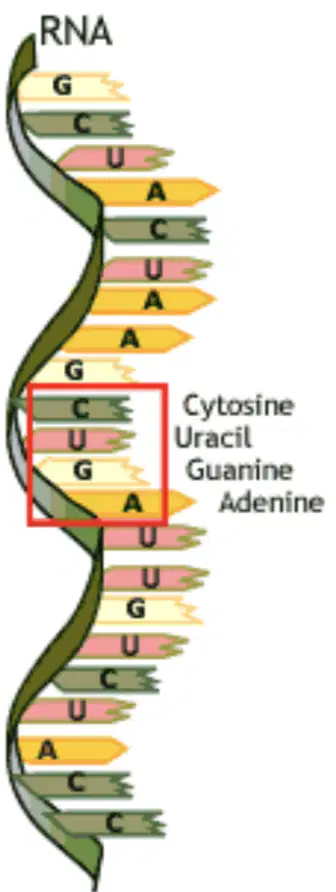
27. In RNA, Uracil pairs with ______. (Hint: Base Pairing Rule, A-U and C-G).
a)
a) adenine
b)
b) cytosine
c)
c) thymine
d)
d) guanine
28.
28. Transcription is the process that makes _______ from _______.
a)
a) RNA, DNA
b)
b) RNA, RNA
c)
c) DNA, RNA
d)
d) DNA, DNA
29.
29. Translation is the process that uses __________ to make a ____________.
a)
a) Ribosome, DNA
b)
b) RNA, Protein (polypeptide)
c)
c) RNA, DNA
d)
d) DNA, RNA
30.
30. Transcribe ATC - CAT - GGC - CTA (Hint: Base Pairing Rule, A-U and C-G).
a)
a) UAG - GUA - CCG - GAU
b)
b) UAG - GUA - CCG - GAT
c)
c) ATC - CAT - GGC - CTA
d)
d) TAG - GTA - CCG - GAT
31.
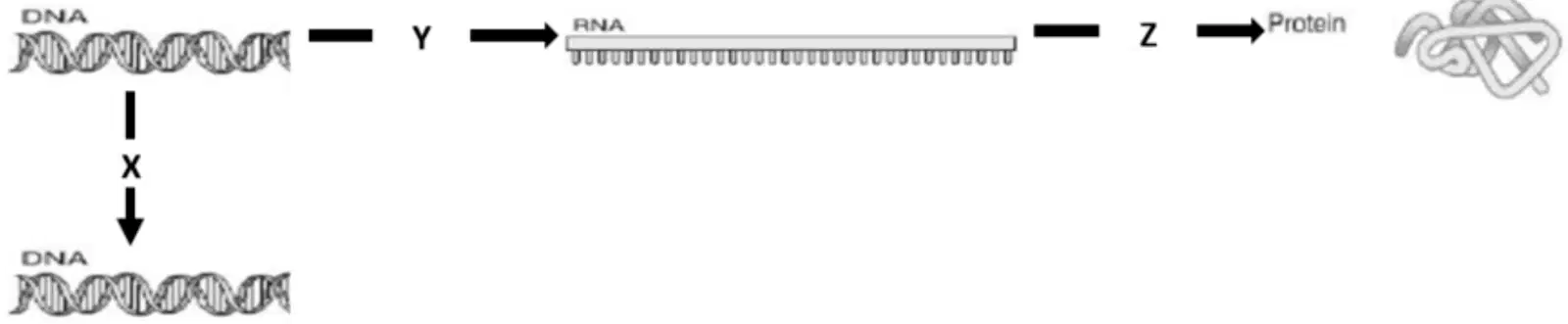
31. Which of the following identifies the processes correctly?
a)
a) X:Replication; Y:Mutation; Z:Translation
b)
b) X;Translation; Y:Replication; Z:Transcription
c)
c) X:Replication; Y:Transcription; Z:Translation
d)
d) X:Transcription; Y:Replication; Z:Mutation
32.
32. Which answer models central dogma? (What is the correct order?)
a)
a) DNA to protein to RNA
b)
b) DNA to RNA to protein
c)
c) protein to RNA to DNA
d)
d) RNA to DNA to protein
33.
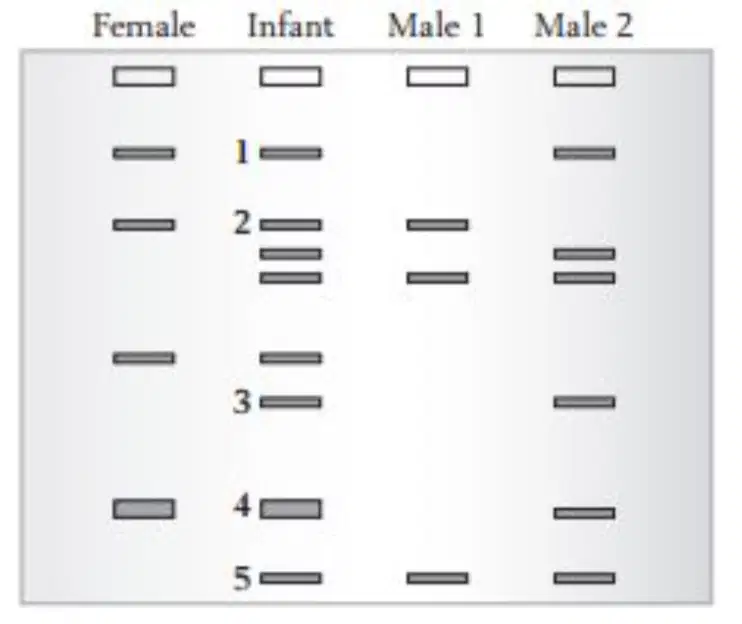
33. Which male is the father of this child? (Hint: Look at the banding patterns and see which ones are most similar to the infant.)
a)
a) Male 2
b)
b) Male 1
c)
c) Neither could be the father
d)
d) Either could be the father
34.
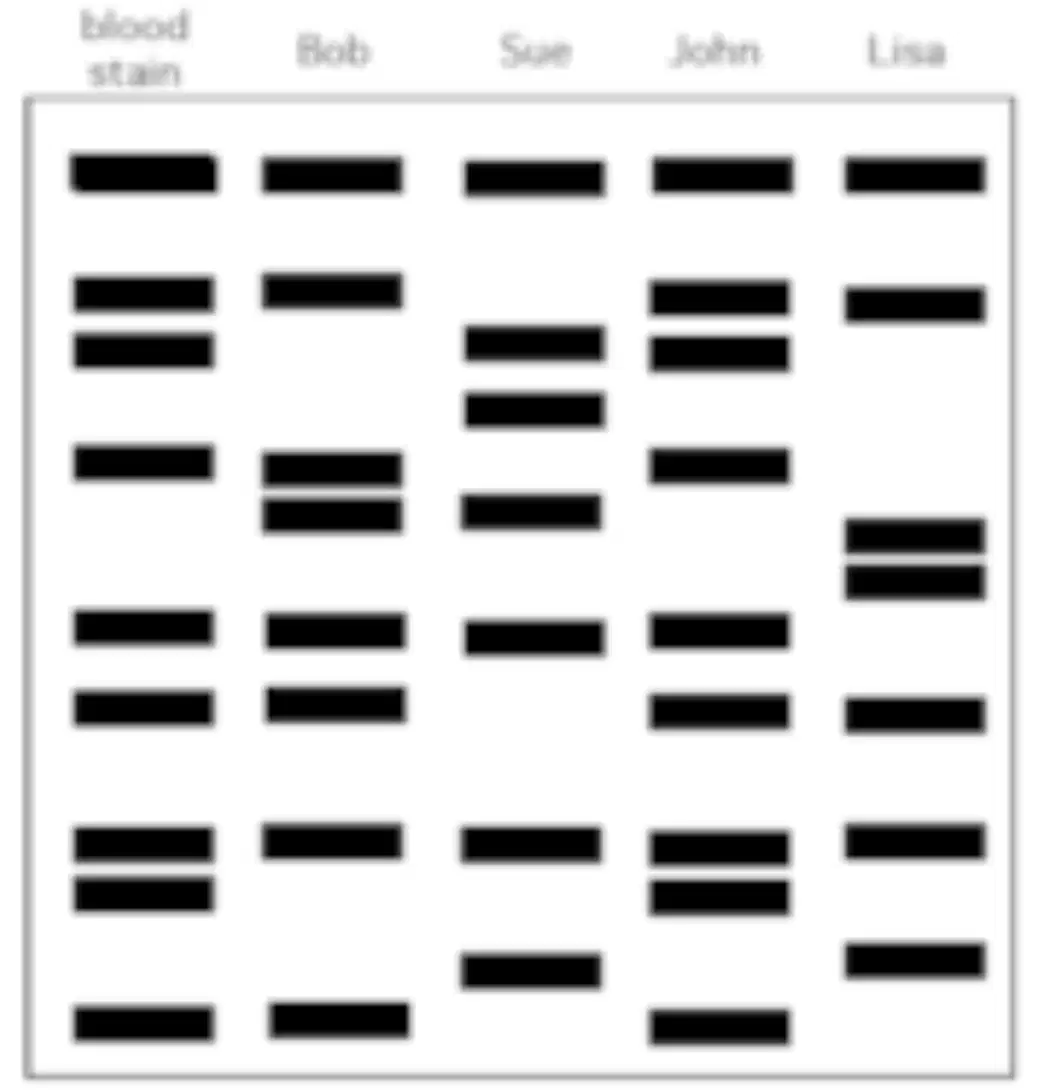
34. Bob was found dead in his home. Crime scene analysis showed signs of a struggle. Blood was collected from the crime scene, the victim, and three suspects. Which suspect likely committed the crime? (Hint: Look at the banding patterns and see which suspects are most similar to the blood stain)
a)
a) None of these
b)
b) John
c)
c) Sue
d)
d) Lisa
35.
35. What mutation has occurred here?
T-G-A-C-C-A
T-G-A-G-C-A
a)
a) Substitution
b)
b) Deletion
c)
c) Insertion
d)
d) Frameshift
36.
36. DNA molecule segment is : T-T-A-C-G-C-A-A-G
The mutated DNA segment is T-T-C-G-C-A-A-G.
This is an example of a ___ mutation.
a)
a) Substitution
b)
b) Deletion
c)
c) Insertion
d)
d) Inversion
37.
37. Why are insertion and deletion (frameshift) mutations so harmful?
a)
a) They change all of the codons from the mutation on down the line, which changes the amino acid sequence
b)
b) They insert things that an organism doesn't need.
c)
c) They often delete things that organisms need.
d)
d) Insertion and deletions are not any more harmful than substitution mutations.
38.

38. Which type of mutation does the model demonstrate?
a)
Deletion
b)
Substitution
c)
Insertion
d)
Translocation
100 %

