
NEW
Font size
 Worksheets
Medical Detectives
Total questions: 25
Worksheet time: 25mins

Several students came to the office with stomach aches and vomiting a few hours after a pancake breakfast. A foodborne illness was suspected for the outbreak, and students were interviewed about the food they ate earlier that day. Given the attack rates shown in Table 1, which food item is the most likely source of the illness that’s causing several students to get sick?
Sausage
Butter
Milk
Juice
What test should she order to confirm the diagnosis?
A brain scan such as a CT scan or MRI
A spinal tap to collect cerebrospinal fluid (CSF)
Electromyography (EMG) tests
Nerve conduction velocity tests

Use the chart to answer the following: A patient comes to the ER complaining of the following symptoms: Coughing (sometimes coughs up blood) Fever Chills Fatigue Weakness Pain in the chest
Common cold
Influenza (Flu)
Pneumococcal Pneumonia
Tuberculosis (TB)

Based on the test results, what is the patient’s diagnosis?
The patient does not have strep throat or influenza.
The patient has both strep throat and influenza.
The patient has influenza and not strep throat.
The patient has strep throat and not influenza.
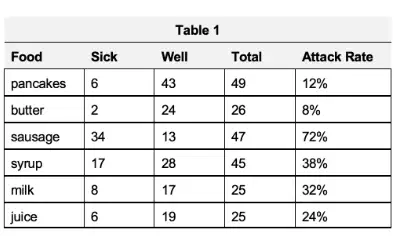
Given the attack rates shown in Table 1, which food item is the most likely source of the illness that's causing several students to get sick?
Milk
Juice
Butter
Sausage
What is the primary role of a medical detective in a hospital setting?
Diagnosing diseases based on symptoms and test results
Performing surgeries on patients
Administering medications to patients
Managing hospital finances
Which of the following is a common tool used by medical detectives to analyze blood samples?
Stethoscope
Microscope
Thermometer
Sphygmomanometer
A patient presents with symptoms of a rare disease. What is the first step a medical detective should take?
Prescribe medication immediately
Order a series of diagnostic tests
Consult with a specialist
Review the patient's medical history
What type of imaging technique is often used by medical detectives to view the internal organs of a patient?
X-ray
Ultrasound
MRI
CT scan
In the context of medical investigation, what does the term 'biopsy' refer to?
A blood test
A surgical procedure to remove tissue for examination
A type of imaging scan
A genetic test
Which of the following diseases can be diagnosed using a lumbar puncture?
Diabetes
Meningitis
Hypertension
Asthma
What is the purpose of a control group in a medical experiment?
To receive the experimental treatment
To provide a baseline for comparison
To ensure all variables are tested
To increase the sample size
Which of the following is a symptom that might prompt a medical detective to test for Lyme disease?
High fever
Bullseye rash
Persistent cough
Severe headache
What is the significance of a double-blind study in medical research?
Neither the participants nor the researchers know who receives the treatment
Only the participants know who receives the treatment
Only the researchers know who receives the treatment
Both participants and researchers know who receives the treatment
Which of the following is a non-invasive diagnostic tool used to monitor heart activity?
Electrocardiogram (ECG)
Biopsy
Endoscopy
Angiogram
What is the role of DNA sequencing in medical detective work?
To identify genetic disorders
To measure blood pressure
To monitor heart rate
To assess lung function
Which of the following is a common symptom of a bacterial infection that a medical detective might investigate?
Rash
Fever
Cough
Nausea
What is the primary purpose of a case-control study in medical research?
To compare patients with a disease to those without
To test new medications
To observe long-term effects of a treatment
To determine the cause of a disease
Which of the following laboratory tests is used to measure the levels of glucose in the blood?
Complete blood count (CBC)
Lipid panel
Blood glucose test
Liver function test
What is the function of an MRI in medical diagnostics?
To measure electrical activity in the brain
To create detailed images of organs and tissues
To assess bone density
To test for allergies
Which of the following is a potential sign of a viral infection that a medical detective might investigate?
High blood pressure
Swollen lymph nodes
Elevated cholesterol
Low blood sugar
What is the role of epidemiology in medical detective work?
To study the distribution and determinants of health-related states
To perform surgeries
To administer vaccines
To prescribe medications
Which of the following is a common method for detecting cancerous cells in the body?
Blood pressure test
Biopsy
Urinalysis
Electrocardiogram (ECG)
What is the significance of a placebo in clinical trials?
To serve as a control to compare against the actual treatment
To enhance the effects of the treatment
To ensure all participants receive some form of treatment
To reduce the cost of the trial
Which of the following is a common symptom that might lead a medical detective to suspect a neurological disorder?
Joint pain
Memory loss
Skin rash
Nausea

