
Font size
 Worksheets
Radioactive Decay and Half-Life
Total questions: 15
Worksheet time: 15mins
After the nucleus of a radioactive element undergoes changes, the element can transform into ...
(a) a different isotope of the same element.
(b) an entirely different element.
Both (a) and (b)
Neither (a) nor (b)
For which of the following problems would a scientist most likely use carbon-14?
to calculate the age of the Earth's oldest rocks
to calculate the age of a piece of bone
to identify the elements that make up a rock
to identify the elements that make up a bone
Which of the following is NOT a reason to use Carbon-14 in dating a mastodont bone?
C-14 decays at a predictable rate
The mastodont bone is less than 50,000 years old
C-14 is used to date recent organic remains
C-14 is used in medical procedures
Identify the element formed when Carbon-14 undergoes radioactive decay.
U-238
N-14
Ru-87
C-14
time taken for the number of undecayed nuclei to be reduced to half of its original value this is also known as
(a)
If 10 mg of iodine 131 is given to a patient, how much is left after 24 days? The half-life of iodine-131 is 8 days.
25mg
25g
10g
10mg
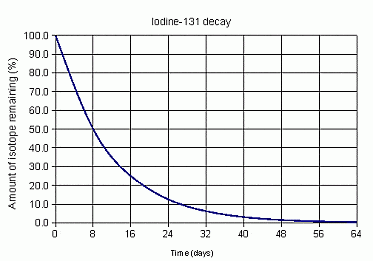
What is the half-life of iodine-131?
32 days
8 days
16 days
24 days
Which of the following are radioactive radiation?
alpha, α
theta, θ
beta, β
gamma, γ
delta, δ
Which of the following are radioactive radiation in the form of particle?
alpha, α
theta, θ
beta, β
gamma, γ
delta, δ
Which of the following are radioactive radiation in the form of radioactive ray?
alpha, α
theta, θ
beta, β
gamma, γ
delta, δ
SI unit for radioactivity
Aq
Bq
Ci
Fahrenheit
Unstable atoms will become stable atoms after undergoing decay and releasing radioactive radiation.
TRUE
FALSE
The scientist that was involved in discovered polonium and radium :
Wilhelm Conrad Roentgen
Antoine Henri Becquerel
Marie Curie
James Watson
What is the half-life of a radioactive substance if it takes 40 days for a 100g sample to decay to 25g?
10 days
20 days
40 days
80 days
Which of the following best describes the process of radioactive decay?
A stable nucleus emits a neutron and becomes unstable.
An unstable nucleus emits radiation and becomes more stable.
A stable nucleus absorbs a proton and becomes unstable.
An unstable nucleus absorbs radiation and becomes more unstable.

