
NEW
Font size
 Worksheets
Radioactivity Review
Total questions: 15
Worksheet time: 15mins
What makes something radioactive?
elements with an atomic number above 81
an unstable nucleus
contaminated sewage
It decays over time
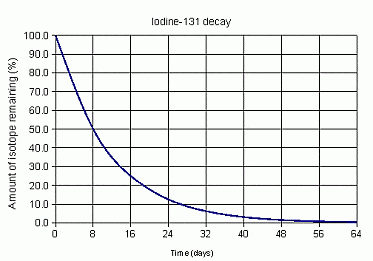
What is the half-life of iodine-131?
32 days
8 days
16 days
24 days
An unstable nuclei will break up in a process called radioactive _______________.
decay
decomposition
emission
reduction
An unstable nuclei will decay ______________.
forever
until it becomes a stable isotope
until there are no neutrons left

Which of the following best describes the process of nuclear fission?
Splitting an atom's nucleus apart
Separating an atom's electrons from its nucleus
Fusing two atomic nuclei together
Splitting an atom's electrons in half
The time needed for half of a radioactive sample to decay is called its __________.
decay period
period
transmutation time
half-life

Which particles make up an alpha particle?
two protons and two electrons
two electrons and two neutrons
one proton and one neutron
two protons and two neutrons
A nucleus that breaks up because there are too many neutrons or protons is known as ________________.
dangerous
fragile
stable
unstable
Splitting a uranium atom is called -
fission
fusion
Nuclear power uses ____ for fuel.
steel
coal
uranium
hydrogen
What is the primary cause of radioactivity in an atom?
A) Excess energy in the nucleus
B) An imbalance of protons and neutrons
C) High atomic mass
D) Presence of electrons
Which type of radiation is the most penetrating?
A) Alpha particles
B) Beta particles
C) Gamma rays
D) Neutrons
In a nuclear reactor, what is the role of control rods?
A) To absorb excess neutrons
B) To increase the rate of fission
C) To cool down the reactor
D) To convert nuclear energy into electricity
What is the unit used to measure radioactive decay?
A) Joule
B) Hertz
C) Becquerel
D) Newton
Which of the following is a real-world application of radioactivity?
A) Solar energy production
B) Carbon dating
C) Wind energy generation
D) Photosynthesis

