
 Worksheets
Cycles in Ecosystems
Total questions: 25
Worksheet time: 25mins
All living things use energy and release gas as a waste product. What cycle explains the curculation of these gases?
Water Cycle
Oxygen-Carbon cycle
Nitrogen cycle
The (a) cycle is a continuous circualtion between the soil, organisms, and the air.
How do animals get nitrogen that is stored in the soil?
They are unable to
Bacteria change the nitrogen into a gas that the animals can breath
Plants absorb the nitrogen from the soil and animals can eat the plants
Animals can eat the soil and absorb the nitrogen through their digestive system
We've learned that plants use sunlight, water, and carbon dioxide to make their own food and release oxygen. How can animals complete the oxygen-carbon cycle?
Animals take in the oxygen, but do not release gas as they use energy
Animals take in carbon dioxide and use it to make food
Animals take in oxygen and release nitrogen as waste
Animals take in oxygen and as they use energy, carbon dioxide is released as waste.
What are the 4 cycles that occur naturally in an ecosystem?
Water Cycle, Nitrogen Cycle, Bicycle, Oxygen Cycle
Spin Cycle, Wash Cycle, Rinse Cycle
Water Cycle, Nitrogen Cycle, Oxygen Cycle, Carbon Dioxide Cycle
Water Cycle, Nitrogen Cycle, Oxygen Cycle, Carbon Monoxide Cycle
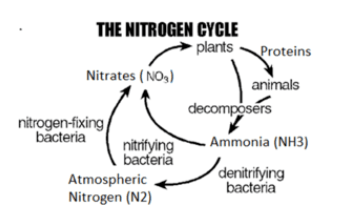
According to this diagram, plants absorb
nitrates
nitrogen fixing bacteria
animals
decomposers
Chemical elements such as carbon, nitrogen, and phosphorus must be (a) to be used again in new organisms.
recycled
Destroyed
Winter
The continuous circulation of nitrogen from air to soil to organisms and back to air or soil
water cycle
oxygen-carbon cycle
nitrogen cycle
bi cycle
The continuous exchange of carbon dioxide and oxygen among living things
uni cycle
water cycle
nitrogen cycle
oxygen-carbon cycle
The continuous movement of water between Earth's surface and the air, changing from liquid into gas into liquid
oxygen-carbon cycle
water cycle
nitrogen cycle
tri cycle

This image shows the _________ cycle.
Carbon
Oxygen
Nitrogen
Water

During the Carbon Cycle...
carbon is stored in the soil.
carbon is stored in plants.
carbon is stored in the atmosphere.
all of the above.
What is the function of bacteria in the Nitrogen Cycle?
They prevent nitrogen from harming the plants.
They remove nitrogen from the soil.
They remove oxygen from the soil.
They return nitrogen to the system.
Which of the following is NOT true about systems that cycle matter?
Living things play a role in the cycling of matter.
Matter is not created as it cycles through the environment.
Some matter is destroyed as it cycles through the environment.
Matter is constantly cycling through the environment.
Mr. Hernandez's science class learned that green plants use sunlight, water, and carbon dioxide to make their own food and release oxygen in the process. How can the class explain how animals complete the oxygen-carbon cycle?
Animals take in the oxygen, but do not release gas as they use energy.
Animals take in carbon dioxide and use it to make food.
Animals take in oxygen and release nitrogen as waste.
Animals take in oxygen and as they use energy, carbon dioxide is released as waste.
What is the primary role of decomposers in the nitrogen cycle?
They convert nitrogen gas into ammonia.
They fix nitrogen into nitrates.
They break down organic matter, returning nitrogen to the soil.
They absorb nitrogen from the atmosphere.
Which process in the water cycle involves the conversion of water vapor into liquid water?
Evaporation
Condensation
Precipitation
Transpiration
In the carbon cycle, which process is responsible for removing carbon dioxide from the atmosphere?
Respiration
Photosynthesis
Combustion
Decomposition
What is the main source of energy that drives the water cycle?
Wind
Sunlight
Gravity
Earth's rotation
Which of the following is a key component of the phosphorus cycle?
Atmospheric fixation
Weathering of rocks
Photosynthesis
Nitrogen fixation
How do plants contribute to the oxygen-carbon cycle?
By releasing carbon dioxide during photosynthesis
By absorbing oxygen during respiration
By releasing oxygen during photosynthesis
By absorbing nitrogen during photosynthesis
What role do animals play in the nitrogen cycle?
They fix atmospheric nitrogen into the soil.
They release nitrogen gas during respiration.
They consume plants and return nitrogen to the soil through waste.
They convert nitrates into nitrogen gas.
Which cycle is primarily responsible for the movement of water from the surface to the atmosphere and back?
Carbon cycle
Nitrogen cycle
Water cycle
Phosphorus cycle
What is the significance of the carbon cycle in ecosystems?
It regulates the flow of water.
It maintains the balance of carbon dioxide and oxygen.
It controls the availability of phosphorus.
It determines the nitrogen levels in the soil.
Which process in the nitrogen cycle involves the conversion of nitrates into nitrogen gas?
Nitrogen fixation
Nitrification
Denitrification
Ammonification

