
NEW
Font size
 Worksheets
Behaviors of Waves
Total questions: 15
Worksheet time: 15mins
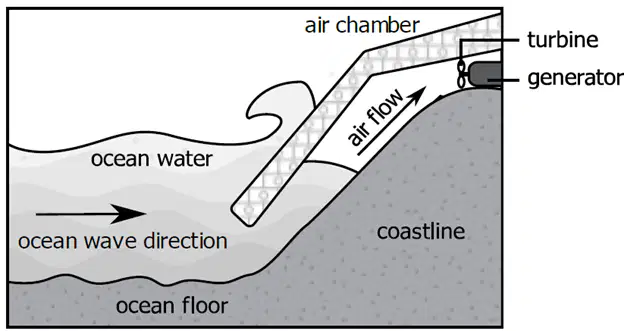
Which statement correctly identifies how the energy is used in the device to produce electricity?
Distance between ocean waves causes gaps in spinning of turbine, which allows production of electrical energy inside the generator.
Speed of ocean waves causes turbine to rotate, which continually produces electrical energy inside the generator.
Amplitude of ocean waves determines how much air column rises the rotates the turbine, which produces electrical energy inside the generator.
Frequency of ocean waves determines how high air column rises that rotates the turbine, which produces electrical energy inside the generator.
When a wave hits a medium and is not absorbed but bounces off the surface.
reflection
refraction
transmission
absorption

What behavior does the picture depict?
reflection
refraction
transmission
absorption
When a wave hits a new medium and slows down.
reflection
refraction
transmission
absorption
When a wave hits a medium and does NOT pass through and is NOT reflected.
reflection
refraction
transmission
absorption
When a wave hits a medium and passes through.
reflection
refraction
transmission
absorption

What behavior does the picture depict?
reflection
refraction
transmission
absorption
In spectroscopy, a spectroscope is used to determine what element a star is made of. What behavior of waves makes this possible?
Transmission
Absorption
Reflection
Refraction

A speaker produces a sound wave that is directed toward an object. The image shows what happens to the sound wave once it touches the object.
What is true about the sound wave?
The sound wave is reflected by the object, causing an echo.
The sound wave is refracted by the object, changing the wave’s direction.
The sound wave is absorbed by the object, increasing the wave’s volume.
The sound wave is transmitted by the object, reducing the volume of the sound.

A beam of light is directed toward two different materials, A and B. The image shows how the beam’s light waves interact with the materials.
What can be concluded about materials A and B?
Materials A and B are transparent.
Materials A and B are translucent.
Material A is transparent, and material B is opaque.
Material A is translucent, and material B is transparent.

A student shines a laser beam on an object (X), as shown.
Which object could represent object X?
glass prism
plane mirror
rubber eraser
wooden plank

The image shows the behavior of three light rays (1, 2, and 3) as they encounter a surface.
Which option correctly identifies the behaviors of the light rays?
Light ray 1 is absorbed, light ray 2 is refracted, and light ray 3 is reflected.
Light ray 1 is reflected, light ray 2 is absorbed, and light ray 3 is refracted.
Light ray 1 is absorbed, light ray 2 is reflected, and light ray 3 is refracted.
Light ray 1 is refracted, light ray 2 is reflected, and light ray 3 is absorbed.
What is the phenomenon called when a wave bends around the edges of an obstacle or opening?
Reflection
Refraction
Diffraction
Absorption
Which of the following experiments can demonstrate the interference of waves?
Young's double-slit experiment
Newton's prism experiment
Galileo's pendulum experiment
Cavendish experiment
When a wave travels from one medium to another and changes speed, what is this behavior called?
Reflection
Refraction
Diffraction
Absorption

