
 Worksheets
AP Biology FRQ Task Verbs
Total questions: 25
Worksheet time: 25mins

What supplies the electrons that are lost in PS I?
the electrons from PS II
water
glucose
oxygen
The light reactions occur in the ________ and the dark reactions take place in the ________.
Chloroplast / thylakoid membrane
stroma / thylakoid
mesophyl / stomata
thylakoid membrane / stroma
Where does the carbon come from that is used to form glucose?
The soil
CO2 in the air
From other carbohydrates
Calvin Cycle
What is the primary function of the light reactions of photosynthesis?
To produce glucose
To produce NADPH and ATP
To use ATP
To produce RuBP
What is the function of NADP+?
It absorbs light
It is an electron carrier
It is a light-reflecting pigment
It acts as long-term energy storage

Which of the following molecules is not needed for the Calvin Cycle?
CO2
ATP
NADPH
H2O
Green plants reflect ________ light.
Red
Green
All
Red and Violet
Where is glucose synthesized
Photosystem II
Photosystem I
Calvin Cycle
Glycolysis
Where does the Calvin cycle take place?
stroma of the chloroplast
thylakoid membrane
outer membrane of the chloroplast
interior of the thylakoid membrane
When oxygen is released as a result of photosynthesis, it is a direct by-product of
reducing NADP+
splitting water molecules
chemiosmosis
electron transfer in photosystem II and I
How many sugar molecules are produced from every six molecules of carbon dioxide that enter the Calvin cycle?
1
3
6
12
The H+ concentration gradient is used to
make NADPH
split a water molecule
generate ATP
form water
Plants use the following reactants for the light reaction
Water and CO2
Water and NADPH
Water and NADP+
NADPH and ATP
Photosynthesis goal is to
convert light energy into glucose energy
use light energy to make oxygen gas
convert sugar energy into ATP
convert sugar energy into oxygen gas
If the proton (H+) pump in the thylakoid was not working which molecule could not be made during the light reaction?
NADPH
ATP
Water
Oxygen gas
The NADP+ is
oxidized during the light reaction
reduced during the light reaction
oxidized during the Calvin cycle
reduced during the Calvin cycle
ATP is made during the light reaction using all of the following EXCEPT
proton pump
hydrogen ion gradient
electron energy from photosystem II
NADPH donating electrons
What is FALSE about the calvin cycle
uses the light reactions products
produces a three carbon sugar (G3P)
produces carbon dioxide
produces NADP+
Which plant would have the most oxygen produced in 1 hour?
plant given red light only
plant given blue light only
plant given white light
plant given green light only

The 5' end of DNA is marked by a(n)
Phosphate Group
Hydroxyl Group
Purine
Pyrimidine
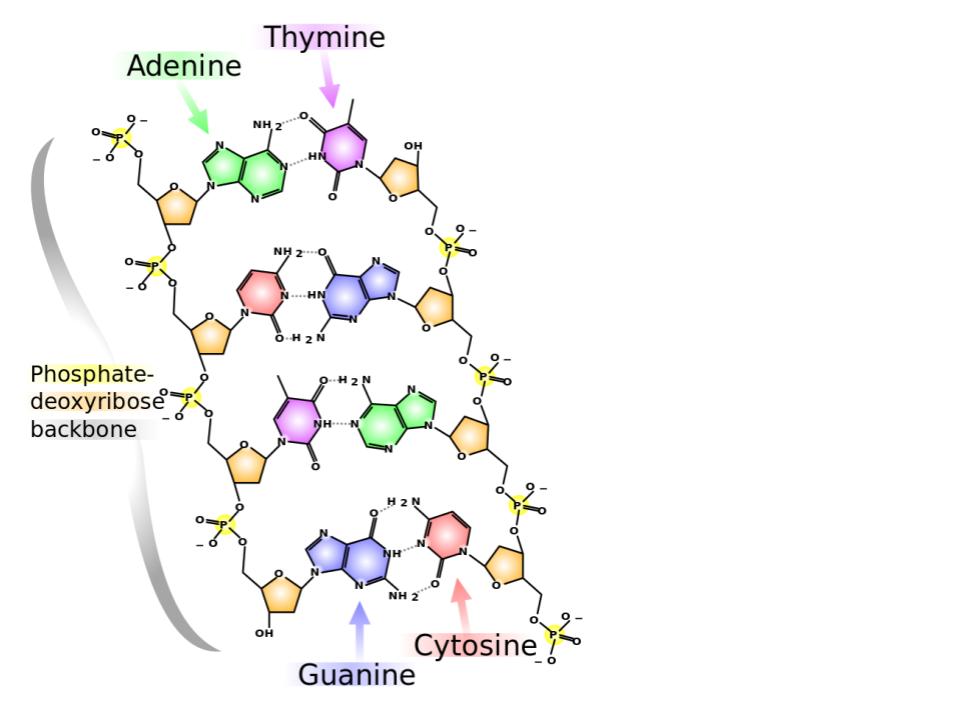
The two strands of DNA are held together by:
Hydrogen Bonds
Phosphodiester Bonds
Glycolsyl Bonds
Glycosidic Linkages

The concept that DNA is made of two strands running in opposite directions is called:
Antiparallel
Isomerism
Enantiomerism
S/R Chirality

The new DNA on the leading strand is synthesized in the _________ direction
5' to 3'
3' to 5'
AP Biology FRQ Task Verbs
A) Describe the process of photosynthesis in detail.
B) Explain how the structure of a chloroplast is related to its function.
C) Compare and contrast the roles of NADPH and ATP in the Calvin cycle.
D) Identify the main stages of cellular respiration and their locations in the cell.

