
 Worksheets
Current and Voltage
Total questions: 25
Worksheet time: 25mins
What is Current?
A stream or flow of electrons in one direction.
The difference in electrical pressure.
Measures how the material reduces the flow of current.
A path in which electrons flow.
What is Voltage?
A stream or flow of electrons in one direction.
The difference in electrical pressure.
Measures how the material reduces the flow of current.
A path in which electrons flow.
Voltage is measure in ________?
Volts
Ohms
Amperes
Current is measure in ________?
Volts
Ohms
Amperes
A flow of electrons through a conductor is called:
A river
A spark
An electron flow
A current
The ____________ is the energy that flows from the battery, through the wire in it’s path through the circuit.
Electric Current
Conductor
Electromagnet
Insulator
An electric current always flows in a closed path, or loop.
True
False
Electricity that flows constantly in one direction on a given path.
current electricity
static electricity
electron pathway
conductor
Find the current I through a resistor of resistance R = 9 Ω if the voltage across the resistor is 36 V.
75
13
20
4
A small light bulb is connected to a 52V battery and draws 4A of current. What is the resistance of the bulb?
75
13
20
4
A motor with an operating resistance of 15Ω is connected to a voltage source. The current in the circuit is 5A. What is the voltage of the source?
75
13
20
4

This series circuit has a 12V cell. How many volts are measured across each individual resistor (assuming they are all the same)?
12V
6V
4V
3V
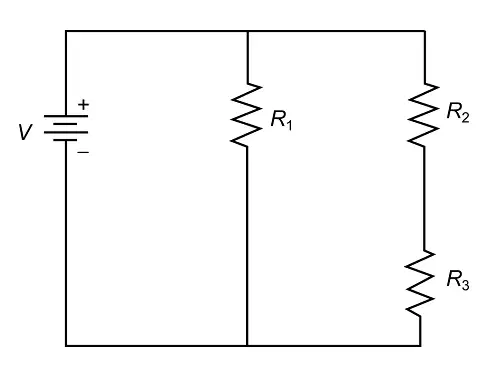
This circuit has a 12V cell. How many volts are measured across R2 (assuming all resistors are the same)?
12V
6V
4V
3V
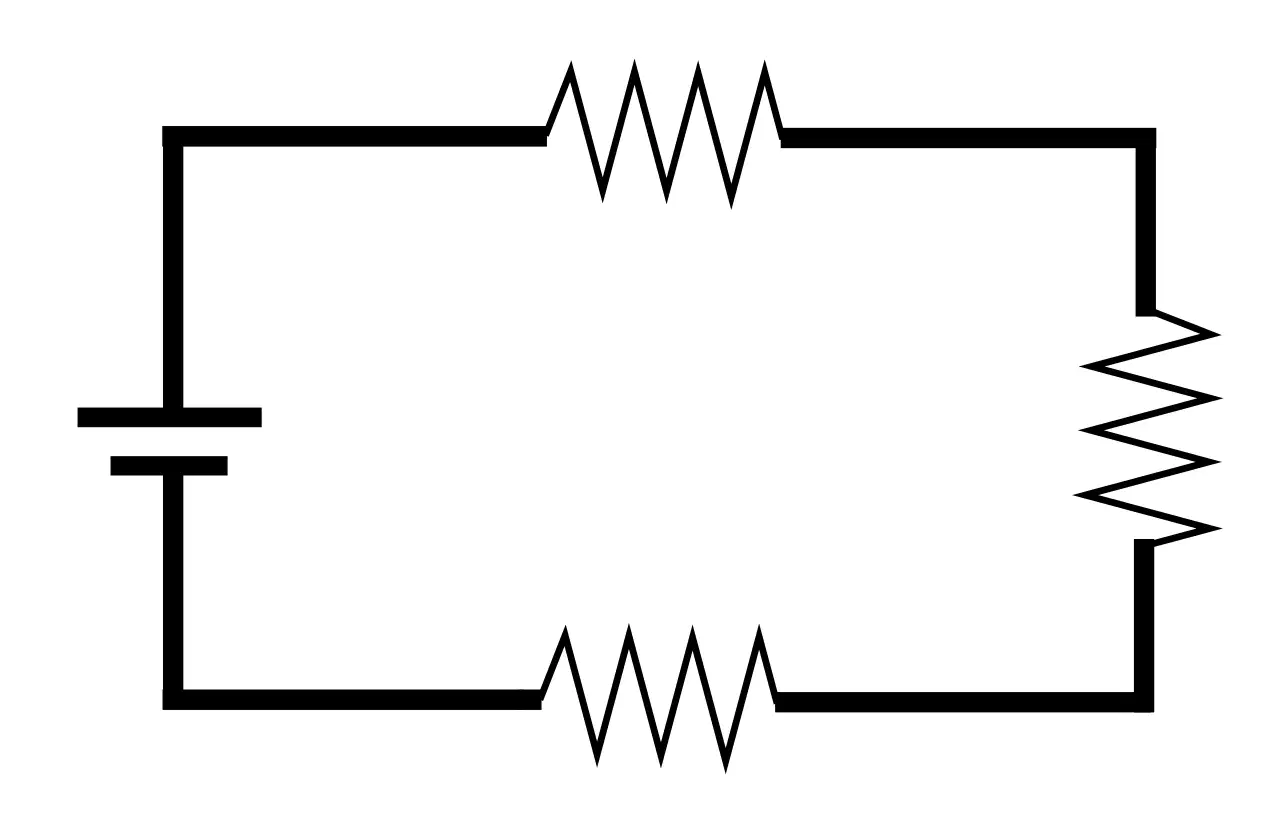
The cell of this series circuit puts out a current of 12A. How many amps pass through each individual resistor (assuming they are all the same)?
12A
6A
4A
3A

This parallel circuit has a 12V cell. How many volts are measured across each individual resistor (assuming they are all the same)?
12V
6V
4V
3V
The cell of this parallel circuit puts out a current of 12A. How many amps pass through each individual resistor (assuming they are all the same)?
12A
6A
4A
3A
The cell of this circuits puts out a current of 12A. How many amps pass through R2 (assuming all the resistors are the same)?
12A
6A
4A
8A
Which formula is correct to calculate Charge?
Q=I*t
Q=I/t
Q = V*E
Q = V/E
How much charge must pass by a point in 10 s for the current to be 0.50 A?
0,05C
5,0C
20C
2,0C
A 3A current flows through a television. How long would it take for 1500C to flow through it?
4500s
500s
50s
450s
The difference in electrical potential energy between two places is called
resistance
charge
current
voltage
The amount of energy flowing through a circuit over a period of time is called...
resistance
charge
current
voltage
How should you put in a Voltmeter?
In Parallel
In Series
What is the voltage of a bulb which produces 20J of energy for 2 Coulombs of charge?
10V
40V
0.1V
15V
Current and Voltage
A) The rate at which electric charge flows through a conductor.
B) The potential difference between two points in a circuit.
C) The resistance offered by a material to the flow of current.
D) The power consumed by an electrical device.

