
 Worksheets
Acid Base Titration
Total questions: 25
Worksheet time: 25mins

What is correct reading in buretter?
બ્યુરેટ મા સાચુ રીડીંગ શુ છે?
22.0 ml
22.3 ml
22.2 ml
22.1 ml
HCl + NaOH =
NaCl = HCl
NaCl + H2O
NaCl
H2O
If it takes 54 mL of 0.1 M NaOH to neutralize 125 mL of an HCl solution, what is the concentration of HCl?
0.043 M
23.148 M
0.231 M

A chemist claimed that in Experiment 2, the pH of the sample solution was greater at a value of 0.2 mL of titrant added than at a value of 1.8 mL of titrant added. Do the results of Experiment 2 support this claim?
No; at a value of 0.2 mL of titrant added, the sample solution was yellow, and at a value of 1.8 mL of titrant added, the sample solution was blue.
No; at a value of 0.2 mL of titrant added, the sample solution was blue, and at a value of 1.8 mL of titrant added, the sample solution was yellow.
Yes; at a value of 0.2 mL of titrant added, the sample solution was yellow, and at a value of 1.8 mL of titrant added, the sample solution was blue.
Yes; at a value of 0.2 mL of titrant added, the sample solution was blue, and at a value of 1.8 mL of titrant added, the sample solution was yellow.
Back
A process used to find the molarity of an acid or base solution.
molarity
titration
endpoint
neutralization
In a titration, what is the purpose of adding an indicator?
To increase the reaction speed
To show the end-point of the reaction
To neutralise the solution
To change the pH of the solution
Which of the following is not an indicator for an acid-base titration?
Sodium chloride
Universal Indicator
Phenolphthalein
Methyl Orange
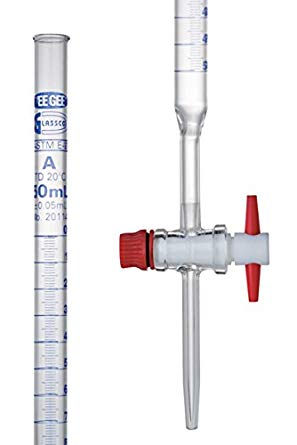
What is this piece of apparatus called
Pipette
Burette
Janette
Cuvette

What is the reading on this burette?
24.0cm3
25.8cm3
24.2cm3
23.9cm3
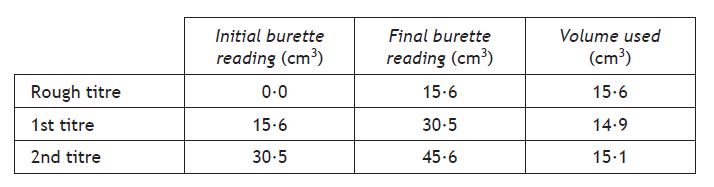
Calculate the average volume of acid needed for this neutralisation
15.2cm3
15.0cm3
35.5cm3
30.1cm3

What is the average titre needed for neutralisation?
25.2cm3
59.7cm3
25.0cm3
25.4cm3
When should you stop a titration?
When you have added equal volumes
When the indicator changes colour
When you run out of solution
When the solution is no longer acidic

This is a...
round-bottomed flask
besselheim tube
measuring bottle
conical flask
For volumes to be considered concordant in terms of titre volume they need to be within _____ of each other?
0.1 cm³
0.3 cm³
0.2 cm³
0.5 cm³
Which equipment is most appropriate for analytical work in volumetric analysis?
Beakers
Measuring cylinders
Burettes, pipettes, and volumetric flasks
Test tubes

what is the reading on this burette?
4.40mL
3.50mL
3.60mL
4.50mL

What is this piece of apparatus called
Pipette
Burette
Janette
Cuvette

This is a...
beaker
besselheim flask
measuring jug
measuring cylinder

This is a...
conical flask
besselheim arrangement
funnel
syringe
What is the pH range of an acidic solution?
Above 7
Below 7
Exactly 7
What is the primary purpose of an acid-base titration?
To determine the concentration of an unknown solution
To change the color of the solution
To produce a gas
To create a buffer solution
During an acid-base titration, what is the role of the indicator?
To speed up the reaction
To indicate the endpoint by changing color
To neutralize the solution
To increase the solution's acidity
If 25 mL of 0.1 M HCl is required to neutralize 50 mL of NaOH, what is the concentration of the NaOH solution?
0.05 M
0.1 M
0.2 M
0.25 M
Which of the following is a common indicator used in acid-base titrations?
Bromothymol blue
Sodium chloride
Copper sulfate
Silver nitrate
In a titration experiment, what does the term 'equivalence point' refer to?
The point at which the solution changes color
The point at which the amount of acid equals the amount of base
The point at which the solution reaches its maximum temperature
The point at which the solution becomes saturated

