
 Worksheets
Amplify Science Unit 4
Total questions: 15
Worksheet time: 15mins

The fishing business manager opens the wave report for today. She creates a sketch to identify the different parts of a wave. She needs to know the amplitude and wavelength of each wave. Write the missing terms in the diagram below.

All mountain birds have a special body part that allows them to make two sounds at one time. What is the name of this body part?
Vocal cords
Lungs
Syrinx
Voice Box

A boat captain is planning a trip across an ocean with 4 guests. To plan a safe trip, he needs to pick the calmest path through the water. He looks at models showing the wavelength and amplitude of the waves along two different paths. Based on the models above, which path would be best for a peaceful boat trip?
Path A would be the best because the wave amplitude is greater than the wavelength. This means the boat will barely be affected by the waves.
Path A would be the best because the wave amplitude is the smallest and weakest. This means that the waves will have the least impact on the boat.
Path B would be the best because the wave amplitude is greater. The waves would be able to move the boat quickly across the ocean.
Path B would be the best because the wave amplitude of 5 feet is about equal to the number of passengers on the boat. This would cancel out the impact of the waves on the boat.
Which of the following statements best describes a wave?
A wave is a pattern of motion that travels away from a source.
A wave is a pattern of motion that travels towards a source.
A wave is a pattern of motion that stays in one place.
A wave is a pattern of motion that continues forever.
Which statement best explains how the nose and the brain work together?
The nose sends oxygen to the brain.
The nose sends signals to the brain about scent information.
The brain sends signals to the nose to breathe out carbon dioxide.
The brain sends signals to the nose about scents of objects.
Which statement best describes what happens during a collision?
During a collision, particles stop moving.
During a collision, particles disappear.
During a collision, particles transfer energy.
During a collision, particles explode.

Dana is studying forces, motions, and collisions in science class. Her sister, Rosa, is learning to play baseball. What happens to the motion of the ball, when Rosa hits it with a bat?
The ball will stop moving.
The bat destroys the energy of the ball.
The bat transfers energy to the ball and the ball will change directions.
A collision occurs, but no energy is transferred.

Maria is at a piano concert with her sister. Which of the following best describes the movement of energy at the concert as soon as the concert begins?
Sound energy moves from the piano to Maria's ears.
Sound energy moves from Maria's ears to the piano.
Sound energy moves from the piano to Maria's brain.
There is no sound energy.
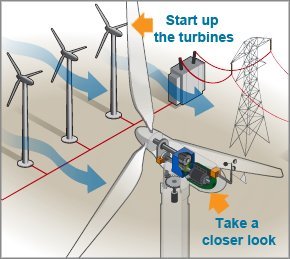
What is the energy conversion when a wind turbine turns to provide energy to a power grid?
electrical to chemical
thermal to motion
motion to electrical
nuclear to heat
What is the primary function of the respiratory system in humans?
To transport nutrients throughout the body
To exchange gases between the body and the environment
To break down food into energy
To protect the body from infections
Which of the following best describes the process of photosynthesis?
Conversion of chemical energy into light energy
Conversion of light energy into chemical energy
Conversion of oxygen into carbon dioxide
Conversion of carbon dioxide into oxygen
In an experiment, a student measures the temperature of a liquid over time. What type of data is the student collecting?
Qualitative data
Quantitative data
Descriptive data
Theoretical data
Which of the following is an example of a chemical change?
Melting of ice
Boiling of water
Rusting of iron
Breaking of glass
What is the role of chlorophyll in plants?
To absorb water from the soil
To absorb sunlight for photosynthesis
To transport nutrients
To protect the plant from herbivores
Which of the following statements best describes Newton's Third Law of Motion?
For every action, there is an equal and opposite reaction
An object in motion stays in motion unless acted upon by an external force
Force equals mass times acceleration
Energy cannot be created or destroyed

