
 Worksheets
Light and Color Review
Total questions: 25
Worksheet time: 25mins
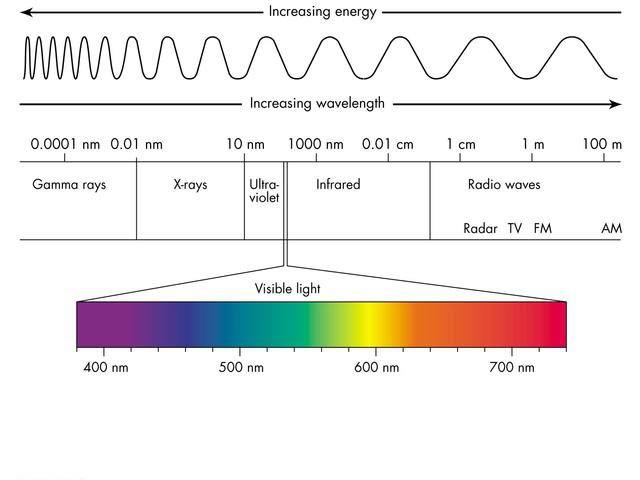
What is the correct order of the visible light spectrum starting with the longer wavelength?
Red, yellow, orange, blue, violet, indigo
Violet, indigo, blue, green, yellow, orange, red
Green, yellow, blue, indigo, red, orange
Red, orange, yellow, green, blue, indigo, violet

A cut piece of clear glass or plastic in the form of a triangle or other geometric shape.
Person
Prison
Prism
Preacher

The bending of waves as they pass from one substance into another.
Reaction
Reflection
Refraction
Repost

A substance through which light travels.
Wavelength
Opaque
Frequency
Medium

After shining green light from a LASER in the simulator, what objects would reflect green light?
A plant
glass
aluminum foil
algae
After shining green light from a LASER in the simulator, what two objects would transmit green light?
A plant
glass
aluminum foil
genetic material

What happens when light hits an object?
Some of the light jumps in different directions
(bounces)
Some of the light gets absorbed by the object.
Some of the light bounces back to your eye
ALL of them.

If you are using a green color filter, what color will you only see?
blue
green
white
red

Which of these provides the best explanation for why the pencil appears broken?
The pencil absorbs the light rays that hit it.
Water reflects light rays away from the pencil.
Light rays are bent by the water in the glass.
The surface of the water reflects the light rays.

Which object refracted the laser beam?
Silver locket
Picture frame
Glass marble
Notebook
Electromagnetic waves that help your body produce vitamin D are called?
ultraviolet rays
x-rays
gamma rays
How much of the electromagnetic spectrum is made up of visible light?
only a small portion
a very l;arge portion
about half

When light strikes an object with a rough surface, photons bounce off at random angles.
Occer
Scope
Scattering
Scattegories

Allows little to no light through.
Transparent
Translucent
Opal
Opaque

The term for any wave that hits a surface and bounces off
Transparent
Translucent
Refraction
Reflection

Blurs light as it passes through
Transparent
Translucent
Opaque
Refraction

Transfer of energy when a wave disappears into a surface
Transparent
Refraction
Reflection
Absorption

Allows most light through
eflection
Refraction
Translucent
Transparent

Light travels on straight lines.
Light Bulb
Sunshine
Light Rays
Frequency
When scientists talk about white light, they areMOST likely referring to light that is
a combination of all of the colors in the visible region of the electromagnetic spectrum.
the unabsorbed refracted light produced by a black light.
the narrow band corresponding to white light in the electromagnetic spectrum.
a combination of all the types of electromagnetic radiation.
Which of these colors of visible light has the shortest wavelength?
red
green
violet
yellow
What is the primary reason the sky appears blue during the day?
A) The scattering of blue light by the atmosphere
B) The absorption of blue light by the ocean
C) The reflection of blue light from the sun
D) The emission of blue light by the atmosphere
Which of the following colors of light has the highest energy?
A) Red
B) Green
C) Blue
D) Violet
In an experiment, a prism is used to split white light into its component colors. What is this process called?
A) Reflection
B) Refraction
C) Dispersion
D) Diffraction
What happens to the speed of light as it passes from air into water?
A) It increases
B) It decreases
C) It remains the same
D) It becomes zero

