
 Worksheets
Released STAAR
Total questions: 25
Worksheet time: 25mins

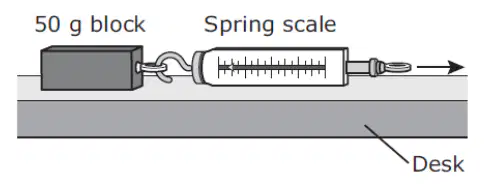
Students design an experiment to determine how much force is needed to move blocks of wood of different masses slowly across a lab table. Which procedure should students include in their design?
Conduct 5 trials, using a different scale to pull each block of wood.
Conduct 5 trials, using a different table for each trial.
Conduct 5 trials, pulling a different side of each block each time.
Conduct 5 trials, pulling each block of wood in the same way for each trial.

The diagram (picture) shows two trials of an experiment in which a spring scale was used to measure force.
This experiment can determine (figure out) -
how mass affects (changes) the force needed to move objects
how force affects (changes) the mass of two objects
how the force used to pull a dictionary affects (changes) the mass of a box of marbles
how the mass of a box of marbles affects (changes) the mass of a dictionary
The diagram (picture) shows two trials of an experiment in which a spring scale was used to measure force.
Which statement is a reasonable conclusion?
It takes more force to pull a load with more mass.
It takes less force to move a load with more mass.
The force needed to move a heavier load is the same as the force needed to move a lighter load.
The mass of the marbles changes the mass of the dictionary.

Students drop the same heavy ball onto identical blocks of soft clay from different heights. For each height they measure the depth of the dent the ball makes in the clay.
Why is the depth of the dent different in each trial?
The size of the ball changes.
The material (type of matter) of the ball changes.
The mass of the ball changes.
The force of the ball when it hits the clay changes.
Students drop the same heavy ball onto identical blocks of soft clay from different heights. For each height they measure the depth of the dent the ball makes in the clay. Which question is the student most likely trying to answer with this investigation?
Does the height of the release affect the force of the impact?
Does the mass of the ball affect the force of the impact?
How does the mass of the ball change?
How does the mass of the ball increase?

A student observes that the craters on the moon are different sizes. The student designs an experiment to study the formation of the craters. The materials for the experiment are marbles and a pan of flour. The student makes a hypothesis that the size of the craters made on the surface of the flour will depend on the height from which the marble is dropped. Some of the steps in the experiment are described in the box. Which of these is most likely Step 3 in the experiment?
Drop the same marble from different heights into the pan of flour.
Drop marbles of different masses from the same height into the pan of flour.
Drop marbles of different sizes from different heights into the pan of four.
Drop a single marble one time into the pan of four.

A student designs an experiment to test the force of a spring launcher and four spheres with the same diameter (same size) but with different masses.
What other piece of equipment would be most useful for this experiment?
(a)
AND how can the hypothesis be tested? (b)
A graduated cylinder
A beaker
A stopwatch
A meterstick or measuring tape
launch each sphere and record the height
launch only one sphere multiple times
change the spring
A student designs an experiment to test the force of a spring launcher and four spheres with the same diameter (same size) but with different masses. Which question is the student most likely trying to answer with this investigation?
How does the mass of an object affect the height reached by that object?
How do different surfaces affect the height reached by an object?
How can you reduce the mass of each object?
Which surface creates the most friction?
How can the student improve the investigation?
Use repeated trials for each surface.
Use different blocks for each of the different surfaces.
Use more than 3 surfaces.
Use a block with more mass.
A student wearing skates rolls down a ramp. What force causes the student to slow down and stop rolling?
gravity, which acts against the direction of motion
friction, which acts against the direction of motion
magnetism, which acts against the direction of motion
mass, which increases with motion
A class is using the setup shown to test this hypothesis:
The higher the ball is held, the greater the impact will be.
What is one piece of equipment needed to test the hypothesis? (a)
AND how can the hypothesis be tested? (b)
a blanace
a graduated cylinder
a tape measure
drop different balls from the same height
change the mass of the ball
change the size of the ball
drop the same ball from different heights

Scientists use telescopes to make distant objects appear closer. Some parts of a telescope are shown below. Which of the following best describes how the objective lens of this telescope helps a scientist observe the moon?
The objective lens produces light.
The objective lens blocks light.
The objective lens reflects light.
The objective lens refracts light.

When light travels through air into a prism, it bends and separates into many colors. In which other situation does light bend?
When light moves through air into water.
When light hits a wall.
When light passes through outer space.
When light hits a mirror.
What is the primary gas found in Earth's atmosphere?
Oxygen
Nitrogen
Carbon Dioxide
Hydrogen
Which of the following is a renewable energy source?
Coal
Natural Gas
Solar
Nuclear
What is the chemical formula for water?
H2O
CO2
O2
H2SO4
Which planet is known as the Red Planet?
Earth
Mars
Jupiter
Venus
What force keeps the planets in orbit around the Sun?
Magnetic Force
Gravitational Force
Nuclear Force
Electromagnetic Force
What is the process by which plants make their food using sunlight?
Respiration
Photosynthesis
Digestion
Transpiration
Which part of the cell contains the genetic material?
Cytoplasm
Nucleus
Cell Membrane
Ribosome
What is the boiling point of water at sea level in Celsius?
0 degrees
50 degrees
100 degrees
150 degrees
Which of the following is an example of a chemical change?
Melting ice
Boiling water
Burning wood
Breaking glass
What is the most abundant element in the universe?
Oxygen
Carbon
Hydrogen
Helium
Which organ in the human body is primarily responsible for detoxification?
Heart
Liver
Kidney
Lung
What is the acceleration due to gravity on Earth?
9.8m/s2
8.9m/s2
10.8m/s2
7.8m/s2

