
Font size
 Worksheets
DNA Molecule
Total questions: 25
Worksheet time: 25mins
What are the basic structural units of a DNA molecule?
glucose molecules
amino acids
lipids
nucleotides
Which scientists developed the double helix model of the DNA molecule?
Watson and Crick
Hardy and Weinberg
Darwin and Lamarck
Weismann and Miller
Watson and Crick described the DNA molecule as a
straight chain
single strand
double helix
branching chain
Match the letter to the part.
Covalent Bond
Hydrogen Bonds
Nitrogen Base
Phosphate
Deoxyribose Sugar
A polymer commonly found in the nucleus of cells is
ATP
hemoglobin
cellulose
DNA
Which molecule has the shape of a double-stranded helix?
NANA
DNA
ADP
ATP
The individuality of an organism is determined by the
sequence of nitrogenous bases in deoxyribonucleic acid
number of amino acids in a cell
position of the ribosomes on the endoplasmic reticulum
number of nitrogenous bases in a codon
Which of the following nucleic acids contains thymine?
DNA, only
Messenger RNA, only
Transfer RNA, only
DNA, messenger RNA, and transfer RNA
DNA is a polymer consisting of repeating units known as
dipeptides
nucleotides
amino acids
organic salts
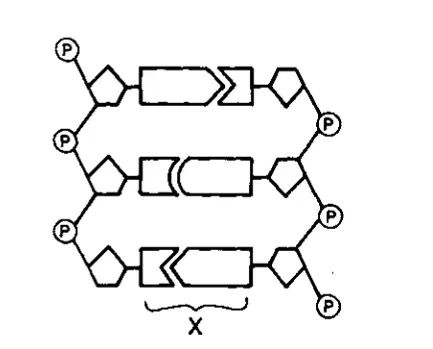
The diagram below represents a portion of a DNA molecule.
The letter X represents two nitrogenous bases that are identical and joined by hydrogen bonds
The letter X represents two nitrogenous bases that are complementary and joined by hydrogen bonds
The letter X represents two nitrogenous bases that are identical and joined by ionic bonds
The letter X represents two nitrogenous bases that are complementary and joined by ionic bonds
The DNA molecule has a ladder-type structural organization. Each rung of this ladder represents
alternating phosphate and glucose molecules
a pair of nitrogenous bases
ribose molecules
a random organization of proteins and lipids
The nitrogen bases found in DNA are represented by the letters
A, U, G, and C
A, T, G, and C
T, A, P, and C
T, U, G, and C
The weakest bonds in a double-stranded molecule of deoxyribonucleic acid exist between the
deoxyribose sugars
phosphate groups
nitrogenous bases
5-carbon sugars
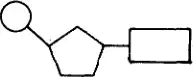
The diagram below represents the building block of a large molecule known as a
protein
fatty acid
carbohydrate
nucleic acid
All nucleotides of DNA and RNA contain a
uracil base
thymine base
ribose sugar
phosphate group

Which of the following best describes a DNA molecule?
double helix
contains ribose
made of amino acids
contains Uracil
Which of the following units are repeatedly joined together to form a strand of DNA? (This is the MONOMER of DNA.)
amino acids
nucleotides
fatty acids
polysaccharides
Why is DNA important?
it is very small and very complicated
it's in everything
it serves as the blueprint for traits of all living things
because we eat it every day for energy
Which 2 molecules forms the sides (backbone) of the DNA ladder?
deoxyribose and adenine
deoxyribose and a hydrogen bond
sugar and the nucleus
deoxyribose (sugar) and phosphate
Which shows the correct complementary base pairing for DNA?
C-A, T-G
A-G, C-T
C-G, U-A
T-A, G-C

In a molecule of double-stranded DNA, the amount of Adenine present is always equal to the amount of
cytosine
guanine
thymine
uracil
What is the primary function of DNA in cells?
To store genetic information
To provide energy for cellular processes
To catalyze biochemical reactions
To transport oxygen
Which component of the DNA molecule is responsible for its negative charge?
Deoxyribose sugar
Phosphate group
Nitrogenous base
Hydrogen bond
In a DNA double helix, the two strands are held together by
Covalent bonds
Ionic bonds
Hydrogen bonds
Metallic bonds
Which of the following best describes the process of DNA replication?
DNA is transcribed into RNA
DNA is duplicated to produce two identical copies
DNA is translated into proteins
DNA is broken down into nucleotides

