
 Worksheets
Practice Science TCAP
Total questions: 25
Worksheet time: 25mins

Which feature most likely helps the building stay standing during an
earthquake?
many windows to prevent the building's walls from breaking during an earthquake
a square shape so that the building will not roll during an earthquake
many metal bars to stop the building from shaking during an earthquake
a tall height so that the building will be far above the ground during an earthquake

Which type of clouds did the teacher see and for which type of weather
should the teacher prepare?
cirrus clouds and sunny weather
detritus clouds and foggy weather
cumulonimbus clouds and stormy weather
cumulus clouds and rainy weather

Which planets from the table are most likely inner planets?
Planets 1 and 2
Planets 2 and 3
Planets 3 and 4
Planets 1 and 4

Which diagram shows the labels that correctly complete the model?


What happens to the particles of a substance when it changes from a solid to a liquid?
The particles move closer together.
The particles move farther apart.
The particles stop moving.
The particles disappear.
In a science experiment, if you mix vinegar and baking soda and observe bubbles forming, what type of change is occurring?
Physical change
Chemical change
State change
No change
Which of the following is NOT a characteristic of matter?
It has mass.
It occupies space.
It is always visible.
It can exist in different states.

Which three solutions will best reduce the threat of landslides for the new neighborhood?
Place pipes under the new neighborhood to drain water away.
Use machines to make the stream flow away from the houses.
Add plants that have wide and deep root systems.
Form a hill at the bottom of the slope.
Build smaller houses.

Which two statements are correct about the graph?
Months J, K, and L are the summer months.
Months Q, R, and S are the winter months.
Months N and O are summer months but Month P is not.
Months M and N are summer months but Month O is not.
Months Q and R are winter months but Month S is not.

Which piece of data best helps determine if a planet is an inner planet?
shape of the orbit
shape of the planet
color of the planet
description of the surface

Based on this evidence, which type of natural disaster caused these changes?
landslide
flood
fire
volcanic eruption

The students must draw a conclusion about the climate of the city. Which climate best describes the city?
temperate
tropical wet
polar
hot desert

The student reports that the weather is good today. Which of these is the best evidence for the student’s report?
There are cumulus clouds in the sky, and the sun is shining.
there are stratus clouds in the sky, and the tree has leaves.
There are cirrus clouds in the sky, and the temperature is cold.
There are cumulonimbus clouds in the sky, and rain I falling.

Which table lists the correct labels for the diagram?


Inner planets are closer to the sun than outer planets are. Inner planets have a smaller orbit around the sun. The table shows orbit data for four planets. Which planets from the table are most likely inner planets?
Planets 1 and 2
Planets 2 and 3
Planets 3 and 4
Planets 1 and 4
How are catch limits good for people?
Catch limits cause the biodiversity in the oceans to go down.
Catch limits cause the price of fish at local stores to go up.
Catch limits allow for invasive species to move into the ecosystem.
Catch limits ensure that there will be a steady food source in the future.

The table lists properties of three different materials.
Which is these is most likely Material 1?
Paper
Air
Juice
Oil
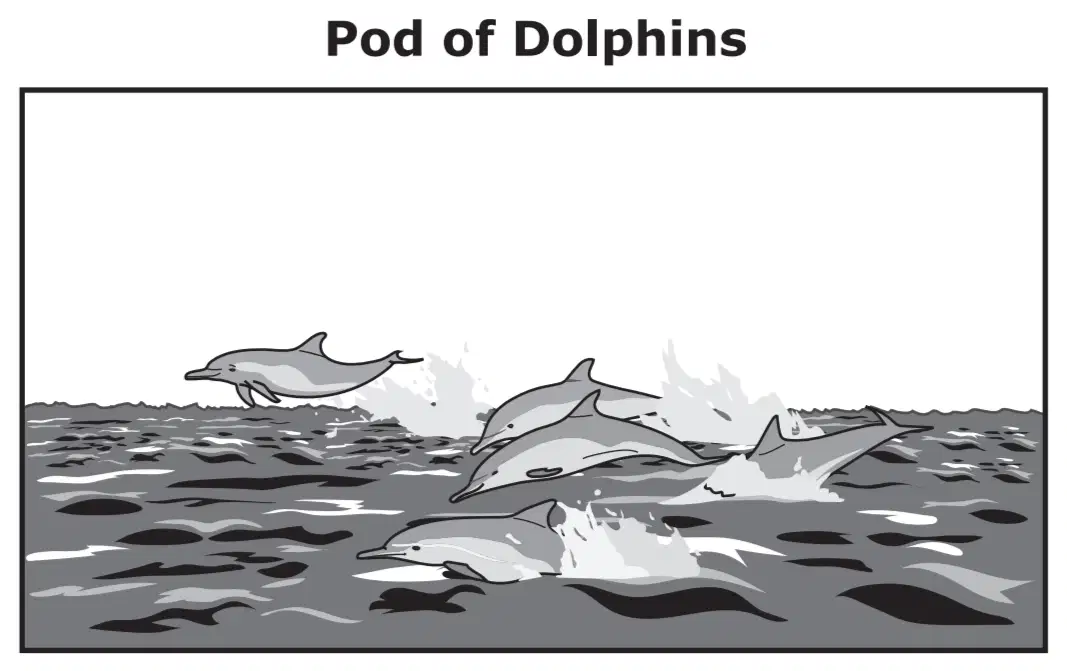
Dolphins are sometimes seen in groups. The groups are called pods.
The picture shows a pod of dolphins.
A student claims that living in pods is better for the dolphins than living alone.
Which TWO activities are easier for dolphins because they live in a pod?
Communicating with different species
Swimming in calm waters
Breathing above the surface
Hunting for prey
Finding a mate

Students place two sets of identical magnets near each other, as shown in the Before diagram. The After diagram shows that the magnets in the first set moved toward each other. The magnets in the second set did not move toward each other. Which statement BEST explains the behavior of one of these sets of magnets?
The magnets in the first set moved toward each other because the opposite poles of the magnets attracted each other.
The magnets in the second set did not move toward each other because the distance between the magnets was too large.
The magnets in the first set moved toward each other because the north pole of each magnet was stronger than its south pole.
The magnets in the second set did not move toward each other because these magnets need electricity to work.

A student rolls a ball down a ramp that has a toy car sitting at the bottom. The ball hits the car at the bottom. The car rolls off the ramp and onto the floor. The student wants to make the car roll farther and faster. In which of these ways can the student give the car more energy?
Use a different ball that weighs less.
Tape a small weight to the top of the car so it is heavier.
Use a taller ramp that raises the ball higher off the ground.
Make the bottom of the ramp longer so the ball has to roll farther before hitting the car.

The water cycle is shown in the diagram.
Which table lists the correct labels for the diagram?


What is the primary gas found in Earth's atmosphere?
Oxygen
Carbon Dioxide
Nitrogen
Hydrogen
Which of the following best describes the process of photosynthesis?
Conversion of chemical energy into light energy
Conversion of light energy into chemical energy
Conversion of thermal energy into mechanical energy
Conversion of electrical energy into thermal energy
In an experiment, a student measures the temperature of a liquid over time and observes that it remains constant even though heat is being added. What is the most likely explanation?
The liquid is undergoing a chemical change.
The liquid is evaporating.
The liquid is at its boiling point.
The liquid is at its freezing point.
Which of the following is an example of a renewable energy source?
Coal
Natural Gas
Solar Energy
Nuclear Energy

