
NEW
Font size
 Worksheets
Waves on a String
Total questions: 15
Worksheet time: 15mins

The highest point on a wave is:
the crest
the trough
the top
the coast

Which wave has a greater frequency?
A
B

What kind of wave is pictured below?
compressional wave
transverse wave
sound wave
mechanical wave
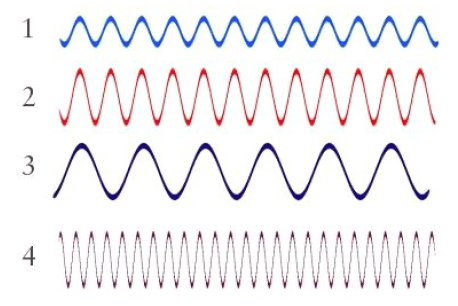
Which wave in the diagram has the greatest wavelength?
1
2
3
4
Examples of this type of waves include water waves, waves on a string/jump rope, and light waves.
transverse
longitudinal
Ms. Harless tightened a string on her guitar. What effect will this have?
the pitch of the string will be lower
the string will vibrate more slowly
the string will make a softer sound
the pitch of the string will be higher
The distance between crests or troughs is called _______________.
frequency
wavelength
amplitude
infrasonic
What type of wave is typically observed on a string when it is plucked?
Transverse wave
Longitudinal wave
Surface wave
Electromagnetic wave
If the tension in a string is increased, what happens to the speed of waves on the string?
The speed decreases
The speed increases
The speed remains the same
The speed becomes zero
Which of the following factors does NOT affect the speed of a wave on a string?
Tension in the string
Mass per unit length of the string
Amplitude of the wave
Length of the string
What is the relationship between frequency (f) and wavelength (λ) for waves on a string?
f∝λ1
f∝λ
f=λ2
f=λ+1
In an experiment, a string is fixed at both ends and vibrates in its fundamental mode. How many nodes are present?
0
1
2
3
What happens to the wavelength of a wave on a string if the frequency is doubled, assuming the speed of the wave remains constant?
The wavelength is halved
The wavelength is doubled
The wavelength remains the same
The wavelength becomes zero
Which of the following describes the energy transfer in a wave traveling along a string?
Energy is transferred perpendicular to the direction of the wave
Energy is transferred parallel to the direction of the wave
Energy is not transferred
Energy is transferred in a circular motion
A string vibrates at a frequency of 440 Hz. If the speed of the wave on the string is 220 m/s, what is the wavelength?
0.5 m
1 m
2 m
4 m

