
 Worksheets
States of Matter and Heating Curves
Total questions: 25
Worksheet time: 25mins

At which letter is the substance changing its state of matter?
A only
A, C, and E
D and E
B and D

What line segment represents only the solid state?
A-B
B-C
C-D
D-E
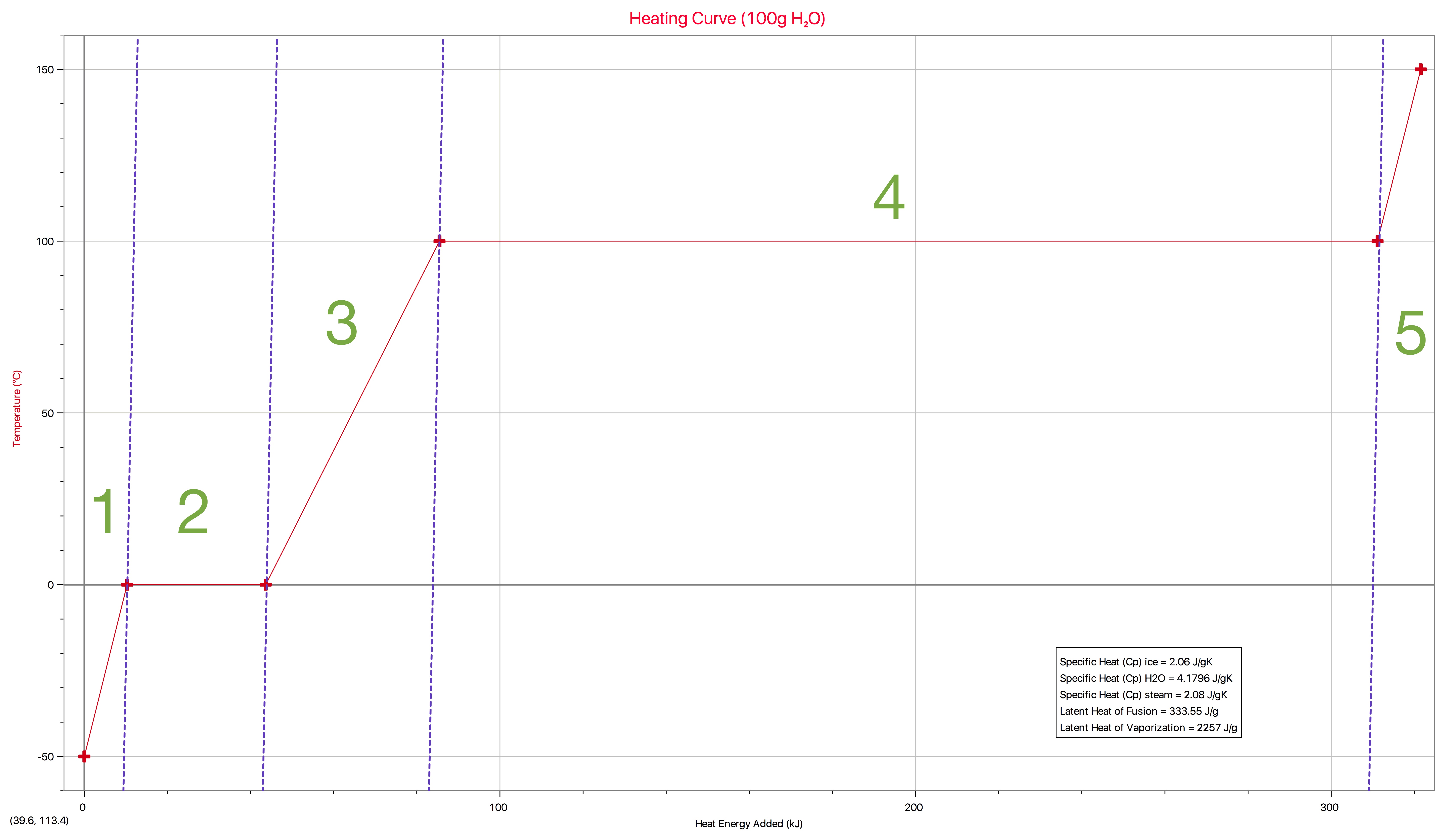
In which region(s) of the graph does boiling take place?
Region 2
Region 3
Region 4
Region 5

Given the heating curve of a solid being heated at a constant rate, what is the boiling point of this substance?
20°C
50°C
110°C
170°C

In what part of the curve would substance X have definite volume but no definite shape?
I
II
III
IV
V

Anika, Samuel, and Henry were conducting an experiment in their chemistry class. They recorded the heating curve of a substance as shown in the graph. Based on their observations, what is the boiling point of the substance?
100 C
60 C
80 C
20 C
Label the following heat curve
Melting
Heat of vaporizaiton
Heat of fusion
Solid
Liquid
Gas
Boiling

NaCl(s) was heated up starting at an initial temperature of 0°C. The heating curve is shown in the picture. What is the melting point of this substance?
0°C
801°C
1000°C
1465°C

Given the heating curve of a solid being heated at a constant rate, how much total time was required to boil this substance after it reached its melting point?
3 minutes
4 minutes
10 minutes
14 minutes

Describe the substance at letter A.
Solid
Liquid
Melting
Evaporating
In a heating curve, diagonal lines indicate temperature is __________, while flat lines indicate temperature is __________.
Constant, changing
Changing, constant

Describe the substance at letters D.
Gas
Liquid
Melting
Evaporating
What line segment represents only the gas state?
B-C
C-D
D-E
E-F
What line segment represents only the liquid state?
B-C
C-D
D-E
E-F

The melting point of the sample is
-60 ºC
20 ºC
60 ºC
100 ºC
The Boiling Point of the sample is
-60 ºC
20 ºC
60 ºC
100 ºC

In which region(s) does temperature increase?
Region C only
Regions B and D
Regions A, C, and E
Regions A and B
In which region(s) of the graph does melting take place?
Region 2
Region 3
Region 4
Region 5

What is the freezing point of the substance?
0oC
60oC
120oC
180oC
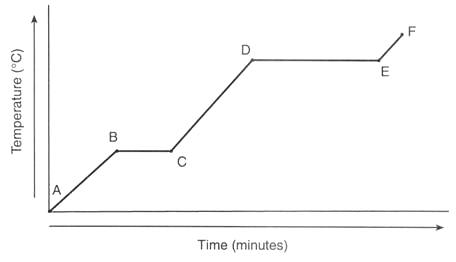
Between which points is the temperature of the substance remaining constant? (a)
A-B only
A-B, C-D, and E-F
B-C only
B-C and D-E
NaCl was heated starting at an initial temperature of 0°C. The heating curve is shown in the picture. What is the melting point of this substance?
0°C
801°C
1000°C
1465°C
Which state of matter has a definite volume but no definite shape?
Solid
Liquid
Gas
Plasma
What happens to the particles of a substance during the flat portions of a heating curve?
They move faster
They change state
They increase in temperature
They decrease in temperature
In a heating curve, what does the slope of the diagonal line represent?
The rate of temperature change
The amount of energy required for a phase change
The specific heat capacity of the substance
The boiling point of the substance
Which of the following best describes the process occurring at the boiling point of a substance in a heating curve?
The temperature increases as the substance absorbs heat
The temperature remains constant as the substance absorbs heat
The temperature decreases as the substance releases heat
The temperature remains constant as the substance releases heat

