
NEW
Font size
 Worksheets
Specific Heat Physics
Total questions: 25
Worksheet time: 25mins

According to the ESRT, which material would require the most heat energy to increase the temperature of 1 gram of the material one Celsius degree?
Ice
Water
Basalt
Granite

Which material would require the greatest amount of heat energy to raise its temperature from 5oC to 10oC? [Refer to the Earth Science Reference Tables.]
Iron
Lead
Granite
Dry Air

If the same amount of heat is added to each sample, the smallest change in temperature will occur in the
Iron
Dry Air
Granite
Water
Why does water heat heat up and cool down VERY SLOWLY?
High Specific Heat
Low Specific Heat
It's solid
It's always cold

Specific Heat
Materials that do not conduct heat well.
A material that conducts heat well,
The amount of energy required to raise the temperature of 1 kilogram of a material by 1 kelvin.
The expansion of matter when it is heated.
The unit for specific heat is
J
J/gC
g
°C
Object A has a specific heat of 4.45 J/g⁰C and object B has a specific heat of 1.82 J/g⁰C. Which object will heat up faster?
Object A, it has a lower specific heat
Object B, it has a lower specific heat
Object A, it has a higher specific heat
Object B, it has a higher specific heat

What would be the effect on the particles if more heat is supplied to the system?
They would slow down
They would stop moving
They would speed up
There would be no effect
A high specific heat means...
It heats up quickly with energy added
It requires more energy to change temperature
Specific Heat is....
The speed of the particles in a substance
The temperature of the substance
How much energy it takes to heat something up
Heat
When heat is absorbed by a substance, what happens to the temperature of the substance?
it increases
it stays the same
it decreases
it depends on the substance
The amount of energy required to raise the temperature 1ºC for every kilogram is called____?
Thermal Energy
Specific Heat
Temperature
Kinetic Energy
What is the symbol for Specific Heat
Q
t
m
C
Water has a specific heat of 4184 J/KgºC. Wood has a specific heat of 1760 J/KgºC. What material needs more energy to raise the temperature 1ºC
Wood
Water
Both are the same
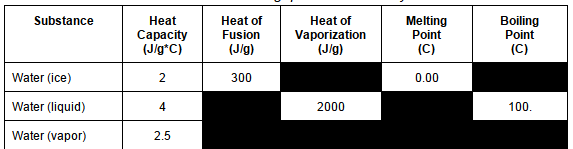
How many Joules of energy are required to change 10 gram of ice at -2 C to water at 20 C?
440 J
880 J
10,140 J
66,000 J
What is the equation to measure change in Thermal Energy?
Q=mc∆t
Q=mc
Q= ∆mct
m=QC

What material would be the coolest after being heated?
Copper
Carbon Steel
Zinc
Stainless Steel
How many Joules of energy are required to change 10 gram of water from 20 C to 90 C?
1400 J
2800 J
210,000 J
1,400,000 J
How many Joules of energy are required to make 100 grams of ice at 0 C completely melt?
200 J
400 J
30,000 J
2,000,000 J

Which will heat up slower?
water
lead
granite
iron
The amount of energy required to raise the temperature 1ºC for every gram is called____?
Thermal Energy
Specific Heat
Temperature
Kinetic Energy
The symbol for specific heat is .......
c
Q
m
t
What is the specific heat capacity of a substance?
The amount of heat required to raise the temperature of 1 gram of the substance by 1°C
The amount of heat required to raise the temperature of 1 kilogram of the substance by 1°C
The amount of heat required to raise the temperature of 1 gram of the substance by 1°F
The amount of heat required to raise the temperature of 1 kilogram of the substance by 1°F
Which of the following substances has the highest specific heat capacity?
Iron
Copper
Water
Aluminum
If two substances are heated with the same amount of energy, which one will have a smaller temperature change?
The one with a higher specific heat capacity
The one with a lower specific heat capacity
Both will have the same temperature change
It depends on the initial temperature

