
NEW
Font size
 Worksheets
Free Fall Concepts
Total questions: 15
Worksheet time: 15mins
A pumpkin is dropped from a 35 m building. What is its initial velocity (vi)?
9.8 m/s2
35 m
0 m/s
9.8 m/s
What is the distance a ball falls after 1,2,3,4,5 seconds (assume g is rounded to 10 m/s2)?
10, 20, 30, 40, 50 m (meters)
5, 20, 45, 80,125 m (meters)
5, 10,15, 20, 25 m (meters)
10, 25, 60, 90,120 m (meters)
What is the velocity of a ball that has been dropped off a cliff after 1 , 2, 3, 4, and 5 seconds? (assume g is rounded to 10 m/s2)?.
10, 20, 30, 40, 50 m/s
5, 10, 15, 20, 25 m/s
5, 20, 45, 80,125 m
10,10,10,10,10 m/s
What is the acceleration of a ball that is dropped off the side of a cliff after 1,2,3,4,5 seconds? (assume g is rounded to 10 m/s2)
5,10,15, 20, 25 m/s2
10, 20, 30, 40, 50 m/s2
5, 20, 45, 80, 125 m/s2
10,10,10,10,10 m/s2
When an object falls in physics world, what happens?
It accelerates at a constant rate until it hits the ground
It accelerates at a non-constant rate until it hits the ground
It accelerates at a constant rate until it reaches terminal velocity
It accelerates at a non-constant rate until it reaches terminal velocity
Which of the following statements applies to the motion of a ball rising and then falling in free fall?
I. The ball has constant acceleration as it moves upward.
II. The ball has constant acceleration at the top of its path.
III. The ball has constant acceleration as it moves downward.
I only
III only
I and III
I, II, and III
If a freely falling object were somehow equipped with a speedometer, its speed reading would increase each second by
about 5 m/s.
about 10 m/s.
about 15 m/s.
a rate that depends on its initial speed.
A ball is thrown upward in the air with an initial velocity of 40 m/s. How long does it take to reach back to the point it was thrown from?
4 seconds
2 seconds
6 seconds
8 seconds
The acceleration of a freely falling body on Earth is
9.8 m/s.
9.8 m.
9.8 m/s2.
9.8 s.
When there is no air resistance, objects of different masses dropped from rest
fall with equal accelerations and with equal displacements.
fall with different accelerations and with different displacements.
fall with equal accelerations and with different displacements.
fall with different accelerations and with equal displacements.
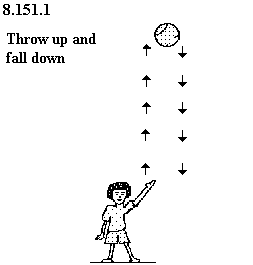
A ball is thrown upwards and caught when it comes back down. In the absence of air resistance, the
when would the ball reach a velocity of 0 m/s?
at the top
at the bottom
in the middle
In a normal environment, why does a bowling ball and feather hit the ground at different times when dropped from the same height?
They don't; they hit the ground at the same time.
One is more dense than the other.
One is heavier than the other.
Air resistance
A stone is dropped from a height of 80 meters. How long does it take to reach the ground? (Assume g = 9.8 m/s^2)
2 seconds
4 seconds
5 seconds
6 seconds
Which of the following statements is true about an object in free fall?
It has a constant velocity.
It has a constant acceleration.
Its acceleration increases over time.
Its velocity decreases over time.
If two objects of different masses are dropped from the same height in a vacuum, what will happen?
The heavier object will hit the ground first.
The lighter object will hit the ground first.
Both objects will hit the ground at the same time.
The objects will not fall.

