
NEW
Font size
 Worksheets
Feedback Homeostasis
Total questions: 23
Worksheet time: 23mins
Homeostasis is
The process by which organisms maintain a relatively stable internal environment
The process by which organisms change their internal environment
The process by which organisms adapt to their external environment
The process by which organisms evolve over time
A Negative Feedback Loop is...
A process that reinforces a system's output
A process that counteracts a system's output
A process that has no effect on a system's output
A process that amplifies a system's output
A Positive Feedback loop is...
A system where the output enhances the original stimulus
A system where the output suppresses the original stimulus
A system where the output has no effect on the original stimulus
A system where the output reverses the original stimulus
During Homeostasis...
The sensor sends a message to the effector
The effector sends a message to the control center
The sensor sends a message to the control center
The control center sends a message to the sensor
Negative feedback loops
Have negative effects on the body
Hurt the body
Help the body
Correct an imbalance in the opposite direction
Positive feedback loops
Are good things
Always heal the body
Increase a change in the body
Are bad
In homeostasis the control center
Sends a message to the effector
Sends a message to the sensor
Causes a change to the environment
Always causes a positive feedback loop

This image shows what kind of feedback loop?
Positive
Negative
Hypotonic
Enzymatic

Look at the picture...which way would the molecules of water move according to osmosis?
From A to B
From B to A

This graph demonstrates a
Positive feedback loop
Negative Feedback Loop
Hyptonic Loop
Phospholipid
What is the point of a feedback loop?
To provide the body with more energy
To provide the body with more food
To make sure the conditions in the body are always changing
To make sure the conditions in the body remain stable
Isotonic solutions...
Increase cell volume
Decrease cell volume
Do not change cell volume
Cause cells to burst
An example of a negative feedback loop is ...
Blood glucose regulation
Blood pressure regulation
Thermoregulation
All of the above
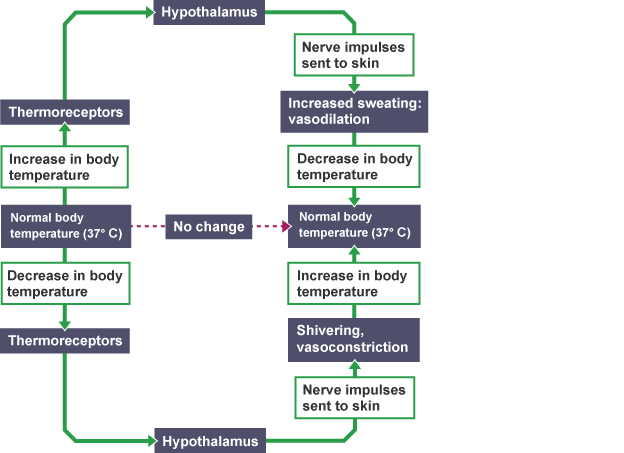
What type of feedback loop is shown?
Positive
Neutral
Negative
Feedback Homeostasis
A) The process by which organisms maintain a relatively stable internal environment
B) The process by which organisms change their internal environment
C) The process by which organisms adapt to their external environment
D) The process by which organisms evolve over time
Feedback Homeostasis
A) A process that reinforces a system's output
B) A process that counteracts a system's output
C) A process that has no effect on a system's output
D) A process that amplifies a system's output
Feedback Homeostasis
A) A system where the output enhances the original stimulus
B) A system where the output suppresses the original stimulus
C) A system where the output has no effect on the original stimulus
D) A system where the output reverses the original stimulus
Feedback Homeostasis
A) The sensor sends a message to the effector
B) The effector sends a message to the control center
C) The sensor sends a message to the control center
D) The control center sends a message to the sensor
Feedback Homeostasis
A) Have negative effects on the body
B) Hurt the body
C) Help the body
D) Correct an imbalance in the opposite direction
Feedback Homeostasis
A) Are good things
B) Always heal the body
C) Increase a change in the body
D) Are bad
Feedback Homeostasis
A) Sends a message to the effector
B) Sends a message to the sensor
C) Causes a change to the environment
D) Always causes a positive feedback loop
Feedback Homeostasis
A) To provide the body with more energy
B) To provide the body with more food
C) To make sure the conditions in the body are always changing
D) To make sure the conditions in the body remain stable
Feedback Homeostasis
A) Blood glucose regulation
B) Blood pressure regulation
C) Thermoregulation
D) All of the above

