
 Worksheets
Circuits and Electricity
Total questions: 25
Worksheet time: 25mins
Electrical lights will not come on unless their electrical circuit is a --
parallel circuit
series circuit
closed circuit
short circuit

A fifth grade class constructed this circuit. Which of these objects most likely made the light glow when connected to points X and Y?
plastic straw
cotton string
aluminum foil
rubber eraser

A class prepared some electrical circuits using battery, connecting wires, and three light bulbs. Which of these circuits can make the three bulbs light?
A
B
C
D

A student constructs the circuit shown for a science demonstration. With the switches in these positions, which lights are on? (a)
All the lights
1 and 2 only
3 and 4 only
none of the lights
In a solid, the moving electric charges are called (a) .
electrons
protons
neutrons
Match the following
Conductor
material that allows energy to flow
Insulator
material that stops or slows energy
Series Circuit
a circuit with only one path
Parallel Circuit
circuit that has multiple pathways
Current
flow of energy
Match the following
Closed Circuit
A completed path that allows electricity to flow through it.
Open Circuit
A path that is broken and won't allow electricity to flow through it.
Power Source
Chemicals that react and give power. Example: batteries
Switch
A device that allows a circuit to be open or closed.

Will the light bulb in this circuit light and why/why not?
yes, because it has two batteries
no, because the switch is open
yes, because it is in a circuit
no, because the bulb is burned out

What type of circuit is represented by the diagram?
closed
series
open
parallel

If bulb 1 burns out, what will occur?
bulbs 2 and 3 will go out
bulbs 2 and 3 receive more volts
bulbs 2 and 3 will stay lit
nothing will happen

This is an example of a _______ circuit
open
series
parallel
square
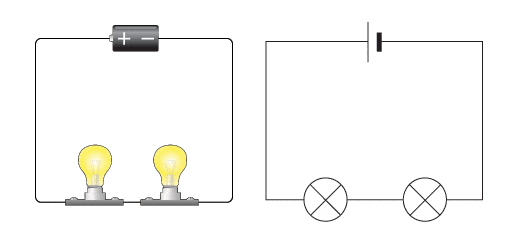
What kind of circuit is this?
Series
Consecutive
Parallel
Training

What kind of circuit is this?
Series
Consecutive
Parallel
Training
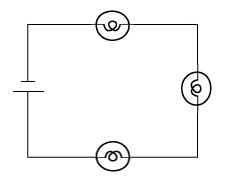
The picture shows an electrical circuit. This circuit is a series circuit because:
It has 3 light bulbs.
The same current flows through all three light bulbs.
It uses a single battery.
The electrical current is divided between the three light bulbs.
What material would be safest to use as an insulator to cover electrical wires?
rubber
tin
aluminum
water
Which of these substances conducts electricity the best?
wood
brick
copper
plastic
A great conductor of energy is:
wood
plastic
metal
cloth
A material in which electrons are able to move easily
Circuit
Insulator
Resistance
Conductor
A material in which electrons are not able to move easily
Circuit
Insulator
Resistance
Conductor
brass is a _____?
insulator
conductor
What is the function of a resistor in an electrical circuit?
To increase the current
To decrease the voltage
To limit the current
To store electrical energy
Which of the following materials is commonly used as a conductor in electrical circuits?
Glass
Copper
Rubber
Wood
In a parallel circuit, if one component fails, what happens to the rest of the components?
They all stop working
They continue to work
They work at half power
They short circuit
What is the unit of electrical resistance?
Ampere
Volt
Ohm
Watt
Which of the following is a real-world application of a series circuit?
Household lighting
Christmas tree lights
Street lighting
Car headlights

