
Font size
 Worksheets
Cell Theory Timeline
Total questions: 25
Worksheet time: 25mins
Which of the following two scientists helped develop the Cell Theory?
Redi
Malpighi
Schleiden
Schwann

(can use your timeline) The first compound microscope was developed about ________ years before the Cell Theory was created.
50
100
200
250
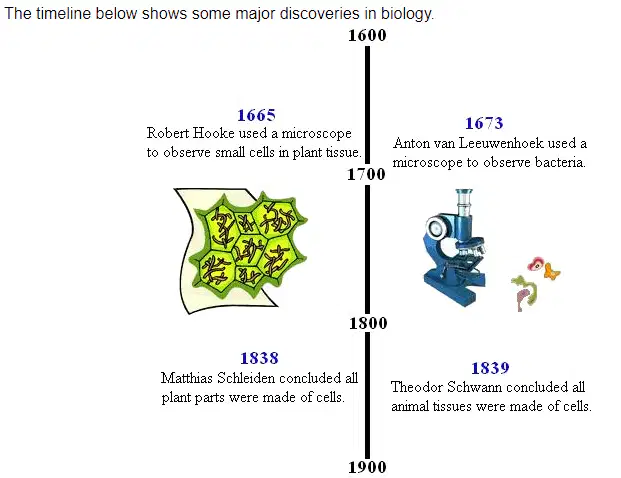
What theory did the scientists in the timeline create?
The microscope theory
The biology theory
The cell theory
The plant part theory
Who first coined the term 'cell' in the context of biology?
Robert Hooke
Anton van Leeuwenhoek
Matthias Schleiden
Theodor Schwann
Which scientist is known for observing the first living cells?
Robert Hooke
Anton van Leeuwenhoek
Rudolf Virchow
Louis Pasteur
What did Matthias Schleiden conclude about plant tissues?
They are composed of cells
They are composed of fibers
They are composed of molecules
They are composed of atoms
Theodor Schwann is credited with concluding that:
All animals are made of cells
All plants are made of cells
Cells arise from pre-existing cells
Cells are the basic unit of life
Who proposed that all cells arise from pre-existing cells?
Rudolf Virchow
Robert Hooke
Theodor Schwann
Matthias Schleiden
Which of the following is NOT a part of the original Cell Theory?
All living things are composed of cells
Cells are the basic unit of life
All cells arise from pre-existing cells
Cells contain a nucleus
In what year did Robert Hooke first describe cells?
1665
1674
1838
1855
What tool did Anton van Leeuwenhoek use to observe living cells?
Microscope
Telescope
Spectrometer
Barometer
Which of the following scientists contributed to the Cell Theory by studying animal tissues?
Theodor Schwann
Matthias Schleiden
Rudolf Virchow
Louis Pasteur
What is the main idea of the Cell Theory?
All living organisms are composed of cells
Cells are only found in plants
Cells can be created from non-living matter
Cells are the smallest unit of matter
Which scientist's work led to the understanding that cells are the basic unit of life?
Theodor Schwann
Robert Hooke
Louis Pasteur
Gregor Mendel
What did Rudolf Virchow add to the Cell Theory?
Cells arise from pre-existing cells
Cells contain a nucleus
Cells are the basic unit of life
Cells are only found in animals
Which of the following best describes the Cell Theory?
It explains the structure and function of cells
It describes the chemical composition of cells
It outlines the genetic makeup of cells
It details the energy processes of cells
What discovery did Robert Hooke make using a microscope?
The cell
The atom
The molecule
The nucleus
Which scientist is known for improving the microscope and observing microorganisms?
Anton van Leeuwenhoek
Robert Hooke
Theodor Schwann
Matthias Schleiden
What did Matthias Schleiden and Theodor Schwann collectively contribute to science?
The Cell Theory
The Germ Theory
The Theory of Evolution
The Theory of Relativity
Which part of the Cell Theory did Rudolf Virchow emphasize?
Cells arise from pre-existing cells
Cells are the basic unit of life
All living things are composed of cells
Cells contain genetic material
What was the significance of the Cell Theory in biology?
It provided a foundation for understanding living organisms
It explained the chemical reactions in cells
It described the genetic code
It outlined the process of photosynthesis
Which of the following is a key concept of the Cell Theory?
All living organisms are composed of cells
Cells can be created from non-living matter
Cells are only found in plants
Cells are the largest unit of life
Who is known for the statement 'Omnis cellula e cellula'?
Rudolf Virchow
Robert Hooke
Theodor Schwann
Matthias Schleiden
What did the development of the Cell Theory help scientists understand?
The structure and function of living organisms
The chemical composition of water
The process of photosynthesis
The genetic code
Which of the following best summarizes the Cell Theory?
All living things are composed of cells, and all cells come from pre-existing cells
Cells are only found in plants and animals
Cells can be created from non-living matter
Cells are the largest unit of life

