
NEW
Font size
 Worksheets
Amplify Science Light and Vision
Total questions: 15
Worksheet time: 15mins
What is VISION?
an object used to shield light from a person's eyes
the ability to see
a physic daydream
vision
an attempt to find out about something
the ability to see
how an animal gets information from its environment
to use any of the five senses to gather
information about something
Scientists are studying two different animals. One animal hunts for prey at night, while the other hunts for prey during the day. Which of the following claims about how they see light is most accurate?
The night hunter has low sensitivity light receptors while the day hunter has high sensitivity receptors.
The night hunter and the day hunter both have low sensitivity light receptors.
The night hunter and the day hunter both have high sensitivity light receptors.
The night hunter has high sensitivity light receptors while the day hunter has low sensitivity receptors.
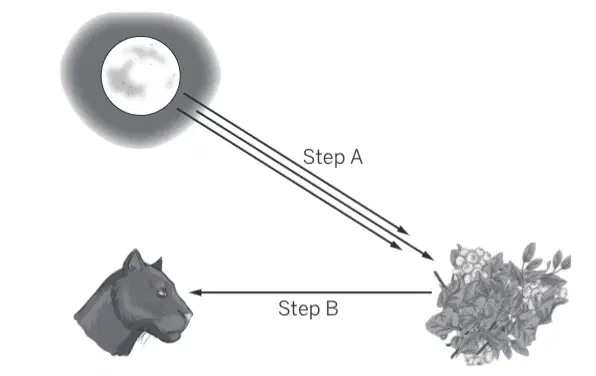
Animals that are awake at night also need to rely some on their sight to find food. The diagram below shows how light travels to allow the animal in the picture to see the bush at night. What does the arrow in Step B represent?
reflected light from the sun shining on the bush
reflected light from the animal’s eyes traveling to the bush
reflected light from the bush shining on the moon
reflected light from the bush traveling to the animal’s eyes

A student wants to develop a model that shows how the eyes see objects. He creates three possible models. Which model best demonstrates the concept?
Model 1
Model 2
Model 3
All models are accurate.
You want to choose a good place for your imaginary nocturnal animal to live. Which of the following is the best choice?
An area with low light year-round
An area with bright light year-round
An area where the light changes throughout the year
None of the above; light will not affect how well the animal will sense its surroundings
What is the primary function of the human eye's lens?
To detect color
To focus light onto the retina
To protect the eye from dust
To produce tears
Which part of the eye is responsible for detecting light intensity?
Cornea
Iris
Retina
Lens
In an experiment, a beam of light passes through a prism and splits into different colors. What is this phenomenon called?
Reflection
Refraction
Dispersion
Diffraction
Which of the following best explains why objects appear larger when viewed through a magnifying glass?
The glass absorbs light
The glass reflects light
The glass refracts light
The glass disperses light
What is the role of rods in the human eye?
Detecting color
Detecting light intensity
Focusing light
Producing tears
Which of the following materials would be best for making a lens that focuses light?
Opaque plastic
Transparent glass
Translucent paper
Reflective metal
How does the iris of the eye help in vision?
By focusing light onto the retina
By adjusting the size of the pupil
By detecting color
By producing tears
What happens to light when it passes from air into water?
It speeds up
It slows down
It bends away from the normal
It remains unchanged
Which scientific principle explains why we see a rainbow after rain?
Reflection of light
Refraction and dispersion of light
Diffraction of light
Absorption of light

