
 Worksheets
Amplify Science Changing Landforms
Total questions: 25
Worksheet time: 25mins

Dr. Mendoza and his team are studying two plates that are far apart from each other. However, these two plates used to be next to each other. What happened to the gap that was created by the plates moving apart?
Sand and dirt filled in the gap.
Magma from underneath the plates rose and hardened, adding new solid rock.
A new plate from underneath filled in the gap.
Ocean water filled in the gap.

The plate boundary shown in the image is a ______ boundary because...
Convergent; the plates are moving away from each other.
Convergent; the plates are moving towards each other.
Divergent; the plates are moving towards each other.
Divergent; the plates are moving away from each other.

The plate boundary shown is ______________ . This means that _____ .
Divergent; one plate will be pushed into the mantle and the other will experience uplift.
Divergent; the plates will separate, and magma from the mantle will create new rock on the edges of the plates over time.
Convergent; the plates will collide, and one plate will subduct into the mantle.
Convergent; the plates will separate and water will fill the gap between them over time.

At this boundary, what will happen to locations A and B over time?
A and B move away from each other over time.
A and B will stay in the same area over time.
A and B will move towards each other over time.

What is this landform?
delta
canyon
valley
sand dune

At this boundary, what will happen to locations A and B over time?
A and B move away from each other over time.
A and B will stay in the same area over time.
A and B will move towards each other over time.
Which statement best describes Earth's outer layer?
Earth's outer layer is made up of a soft solid material.
Earth's outer layer is made up of hard, solid rock.
Earth's outer layer is a combination of hard, solid rock and a soft, solid material.
Earth's outer layer is made up of hard, solid rock or water; it depends on where you go.

Which statement best describes what Earth's outer layer is like underneath the soil and water in the image?
Underneath both the soil and the ocean, Earth’s outer layer is made of sand and water.
Underneath both the soil and the ocean, Earth’s outer layer is made of hard, solid rock.
Underneath the soil, Earth’s outer layer is made of hard, solid rock. Underneath the ocean, Earth’s outer layer is made of sand.
Underneath both the soil and the ocean, Earth's outer layer is made of water.

The team is drilling underground at sites 1 and 2. Where will the team find hard, solid rock?
They will find hard, solid rock below site 1. At site 2, they will find water and sand.
They will find hard, solid rock below site 2. At site 1, they will find plants and soil.
They will find hard, solid rock below both sites.
They will find hard solid rock at neither of these sites; they will find water below both of them.

Which diagram shows what happens at a convergent plate boundary?
A
B
A and B
None of the above
A mid-ocean ridge is...
A range of mountains formed when plates collide
Any underwater landform found near a boundary
An underwater volcanic range formed when plates move apart
Caused by earthquakes that happen underwater

A __________ is the place where two plates meet.
Tectonic Plate
Plate Boundary
Convergent Zone
Trench
The South American and African plates are diverging at a rate of about _________ per year.
18.5 cm
1 cm
3 cm
50 cm
_____ is the technology scientists use to measure how fast the plates move.
RNS
GPS
Infrared waves
Pencil and paper
Dr. Mendoza and his team are studying two plates that are far apart from each other. However, these two plates used to be next to each other. What happened to the gap that was created by the plates moving apart?
Sand and dirt filled in the gap.
Soft, solid rock from underneath the plates rose and hardened, adding new solid rock.
A new plate from underneath filled in the gap.
Ocean water filled in the gap.
At this Convergent boundary, what will happen to locations A and B over time?
A and B move away from each other over time.
A and B will stay in the same area over time.
A and B will move towards each other over time.
A and B will slide past each other without ever actually touching
At this Divergent boundary, what will happen to locations A and B over time?
A and B move away from each other over time.
A and B will stay in the same area over time.
A and B will move towards each other over time.
A will sink underneath B
Which one of the following is NOT a type of plate boundary?
transform boundary
convergent boundary
divergent boundary
surface boundary
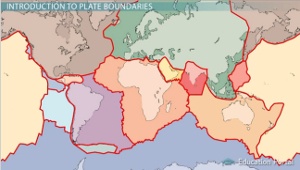
Plate Boundary
The place where two plates meet; most volcanoes and earthquakes occur here.
The location where the food falls onto the table.
Where one country ends and another begins.
The edge of your patella.
What is a plate boundary?
The single point where Earth's plates have motion.
The place along which two plates meet.
Long lines on the ground that cause the plates to move.
The only location on Earth where earthquakes are possible.
What is the primary cause of landform changes on Earth?
Erosion and weathering
Volcanic eruptions
Tectonic plate movements
Human activities
Which process is responsible for the formation of mountains?
Erosion
Sedimentation
Tectonic plate collision
Weathering
How do scientists measure the movement of tectonic plates?
Seismographs
GPS technology
Satellite imagery
Sonar mapping
What landform is created when two tectonic plates move apart?
Mountain range
Mid-ocean ridge
Trench
Volcanic island
Which of the following is a real-world application of understanding changing landforms?
Predicting weather patterns
Designing earthquake-resistant structures
Improving agricultural yield
Developing new mining techniques

