
 Worksheets
Cladograms and Phylogeny
Total questions: 25
Worksheet time: 25mins

Who is most closely related to Taxidea taxus?
Lutra lutra
Panthera pardus
Canis latrans
Canis lupus

Which group of animals on this tree are most closely related to birds?
Saurischian dinosaurs
Ornithischian dinosaurs
Crocodiles
None of these are related to birds

Two organisms that are closely related would have
very similar DNA sequence
exactly the same DNA sequences
no proteins in common
completely different DNA sequence
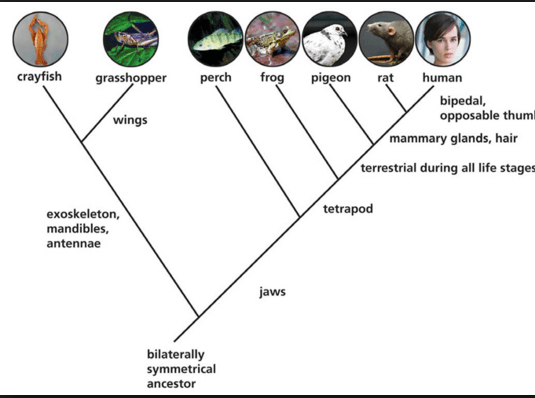
According to the cladogram, which organism is most distantly related to the human?
crayfish
grasshopper
perch
frog
A biologist sequences a gene shared by five different species. The percentage of sequence similarity for four different gene segments, A, B, C, and D, are shown in the table. Using the data in the table, move the species labels into the blank boxes of the cladogram to show the relationships among the species.
5
1
2
3
4
A biologist sequences a gene shared by five different species. The percentage of sequence similarity for four different gene segments, A, B, C, and D, are shown in the table. Using the data in the table, move the species labels into the blank boxes of the cladogram to show the relationships among the species.
5
1
2
3
4
Each node on a cladogram represents...
the last point at which two groups shared a common ancestor.
the point at which one or more species became extinct.
the most recent point at which a trait was lost in a certain clade.
the point at which two clades joined and became monophyletic.

The cladogram shown is a model used by scientists to represent the order in which they hypothesize organisms descended from a common ancestor based on the appearance of derived characteristics.
Which of the following traits do the salamander and the lizard share?
Jaws only
Jaws and Lungs
Claws or nails
Jaws, Lungs, and Claws or nails

The phylogenetic tree was constructed using derived traits of organisms A, B, C, D, and E. Based on the tree, which two organisms share the most derived traits?
C and D because they share one common branch.
C and D because they are closest to the end of the tree next to each other.
A and B because they share the most branch points.
A and B because they are the pair closest to the center.
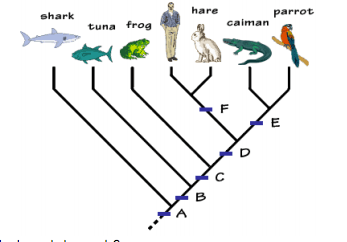
On the cladogram, which organism is the closest relative of the parrot?
Frog
Hare
Caiman
Parrot

Which organism is the most distantly related to all the others?
Raccoon
Dog
Giant Panda
Sun Bear
According to paragraphs 6 and 7, we know that the phylogeny system —
groups organisms together into units called clades
has phylogenetic or evolutionary trees and cladograms that demonstrate the same pattern
traces the relatedness of organisms according to their evolutionary history
all of the above are true
In a cladogram -
the most ancient organisms, called the origin, are found at the very base of the tree diagram.
the closer the branch point is to an organism, the more distantly related those organisms are
neither A nor B are true
both A and B are true
What is the main aim of the study of systematics?
to calculate how many organisms there are on Earth
to understand the evolutionary relationship of biological organisms
to create a naming system for biological organisms
none of the above

According to this tree, which of these animal phyla are most closely related?
Arthropoda & Mollusca
Arthropoda & Chordata
Chordata & Mollusca

Where is the alligator and T. rex's common ancestor?
Point A
Point B
Point C
Point D

What do you call the traits shown on phylogenetic trees, such as "four limbs" or "vertebrae"?
Derived characteristics
Speedy Lambofeeties
Branching elements
Harmonious changes
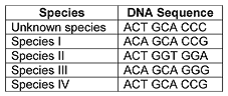
According to this data, the unknown bacterial species is most closely related to:
Species I
Species II
Species III
Species IV

Some organisms that share a common ancestor have features that have different functions, but similar structures. These are known as
vestigial structures
analogous structures
homologous structures
fossil structures
In a cladogram, what does a branch point represent?
A common ancestor shared by the descendant groups
The extinction of a species
The introduction of a new trait
The divergence of a species into two
Which of the following best describes a phylogenetic tree?
A diagram showing evolutionary relationships among species
A chart of species population sizes
A map of species geographic distribution
A timeline of species extinction events
What is the primary purpose of using cladograms in evolutionary biology?
To illustrate the evolutionary pathways and relationships between species
To measure the genetic differences between species
To track the population growth of species
To identify the geographic origin of species
How can molecular data be used in constructing phylogenies?
By comparing DNA sequences to determine evolutionary relationships
By measuring the physical traits of organisms
By analyzing the geographic distribution of species
By studying the fossil record
Which of the following is a real-world application of phylogenetic analysis?
Tracing the origin and spread of infectious diseases
Predicting weather patterns
Mapping the distribution of minerals
Calculating the age of the Earth
What does the term 'monophyletic group' refer to in phylogenetics?
A group of organisms that includes an ancestor and all its descendants
A group of organisms that share similar physical traits
A group of organisms that live in the same habitat
A group of organisms that have the same number of chromosomes

