
 Worksheets
Using Absolute and Relative Age
Total questions: 15
Worksheet time: 15mins
What is the difference between relative age and absolute age?
Relative is the age of a rock/fossil in relation to the rock layers around it, absolute age is the exact age of the rock/fossil.
Absolute age is the age of an object in relation to objects around it, relative age is the exact age of the object.
Relative age only applies to fossils, Absolute age only applies to rocks.
Absolute age only applies to fossils, Relative age only applies to rocks.
Average numerical age, in years of a rock or object.
Absolute Age
Relative Age
Half-life
Law of Universality
Two geologists were conducting a dig in a set of horizontal, undisturbed rock layers. They both discovered fossils in the same area, however, they would like to determine the exact age of their fossils. What is the BEST method for them to use to determine a more precise age of their fossils?
The Law of Superposition is the best way to determine the age of the fossil because whoever dug deeper into the Earth obtained the older fossil.
Using an index fossil is the best way to determine the age of the fossil because all fossils of the same species will be the same age.
Radiocarbon dating is the best way to determine the age of the fossils because it shows the amount of carbon decay in an organism that was once alive.
Using the fossil record is the best way to determine the age of the fossils because the fossil record has not changed over time.
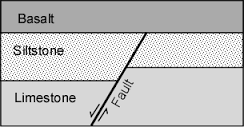
What are the relative ages of the features in order from oldest to youngest?
Limestone, Basalt, Fault, Siltstone
Siltstone, Fault, Basalt, Limestone
Limestone, Fault, Basalt, Siltstone
Limestone, Siltstone, Fault, Basalt

Which rock layer in the diagram seems to be the oldest?
F
E
B
A

Which of the following correctly lists the layers in order from oldest to youngest?
A, B, C, D, E
E, B, C, D, A
E, D, C, B, A
C, B, A, D, E

Which is the youngest?
Layer B
Intrusion A
Layer C
Layer D
The age of rocks and geologic features compared with other rocks and features nearby.
Relative Age
Absolute Age
Law of Universality
Law of Oldness
Radioactive dating is a method used by geologists to determine the _____ age of rocks.
absolute
relative
general
The age of a rock compared to the ages of other rocks.
absolute age
relative age
half-life
radioactive decay
Which statement best describes one rule for determining the relative age of a rock layer?
A fault is always younger than the rock it cuts through.
An extrusion is always older than the rocks below it.
An index fossil is always younger than the rock layer is occurs in.
An intrusion is always older than the rock layers around it.
Using Absolute and Relative Age
Absolute age is determined by radiometric dating, while relative age is determined by the position of rock layers.
Absolute age is determined by the position of rock layers, while relative age is determined by radiometric dating.
Absolute age is determined by the color of the rock, while relative age is determined by the type of rock.
Absolute age is determined by the type of rock, while relative age is determined by the color of the rock.
Using Absolute and Relative Age
Radiometric dating is used to determine the absolute age of rocks by measuring the decay of radioactive isotopes.
Radiometric dating is used to determine the relative age of rocks by measuring the decay of radioactive isotopes.
Radiometric dating is used to determine the absolute age of rocks by measuring the color change in rocks.
Radiometric dating is used to determine the relative age of rocks by measuring the color change in rocks.
Using Absolute and Relative Age
The Law of Superposition helps determine the relative age of rock layers by stating that in undisturbed layers, the oldest layer is at the bottom.
The Law of Superposition helps determine the absolute age of rock layers by stating that in undisturbed layers, the oldest layer is at the bottom.
The Law of Superposition helps determine the relative age of rock layers by stating that in undisturbed layers, the youngest layer is at the bottom.
The Law of Superposition helps determine the absolute age of rock layers by stating that in undisturbed layers, the youngest layer is at the bottom.
Using Absolute and Relative Age
Index fossils are used to determine the relative age of rock layers because they are widespread and existed for a short period.
Index fossils are used to determine the absolute age of rock layers because they are widespread and existed for a short period.
Index fossils are used to determine the relative age of rock layers because they are rare and existed for a long period.
Index fossils are used to determine the absolute age of rock layers because they are rare and existed for a long period.

