Worksheets
Free Trade and Protectionsim
Total questions: 11
Worksheet time: 10mins
Which of the following is a key reason governments impose trade protection?
To increase consumer surplus
To protect domestic employment
To ensure cheaper imports
To encourage globalization
What is the "infant industry" argument in favor of protectionism?
Protection should be permanent for all domestic industries
New industries need temporary protection to develop economies of scale
Developed economies should restrict trade with developing economies
Large firms should be protected from competition
How does trade protection help maintain national security?
By reducing reliance on imports for essential goods
By allowing firms to maximize profits globally
By increasing exports to allied nations
By reducing tariffs on technology imports
Which protectionist measure directly restricts the quantity of an imported good?
Tariff
Subsidy
Quota
Exchange rate controls
Which argument in favor of protectionism is primarily concerned with preventing unfair competition?
National security
Dumping prevention
Balance of payments improvement
Environmental protection
What is a potential long-term downside of protecting declining domestic industries?
They become more innovative
They may become inefficient and reliant on government support
They increase consumer welfare
They improve international trade relations
Define protectionism and provide one example of a trade protection measure.
(a)
Explain how trade protection helps reduce structural unemployment.
(a)
Describe how tariffs protect domestic producers.
(a)
Why might trade protection be justified for environmental reasons?
(a)
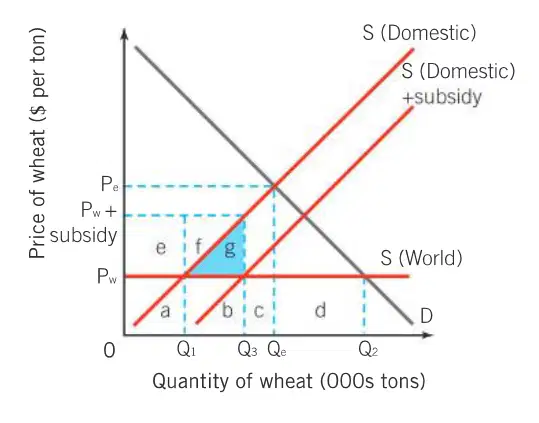
Draw a diagram that illustrates the following:
"Before the subsidy, OQ₂ tons of wheat were being consumed at a price of P_w. Domestic production was OQ₁ and imports were Q₁Q₂. When the subsidy is granted, S (Domestic) shifts downwards by the amount of the subsidy to S (Domestic)+subsidy. The market price stays at P_w and so demand remains at OQ₂.
However, domestic producers increase production to OQ₃ because they are now receiving P_w+subsidy per unit that they produce. This means that their revenue increases from a to a + b + e + f + g. Foreign producers supply the rest, which is now Q₃Q₂. Thus their revenue falls from b + c + d to only c + d. The government pays the subsidy, which is shown by the area e + f + g in total.
As with a tariff, Q₁Q₃ tons of wheat are now produced by relatively inefficient domestic farmers, as opposed to more efficient foreign farmers. The foreign farmers would produce this quantity for a minimum revenue of b, whereas the domestic producers need minimum revenue of b + g. Thus g represents the inefficiency of the domestic producers and a misallocation of the world’s resources, since more of the world’s resources are being used to produce the wheat than are necessary. This is another dead-weight loss of welfare.
There is no loss of consumer surplus, because the price of the wheat does not change. However, consumers are indirectly affected as governments will use tax revenues to fund the subsidies. This may mean higher tax payments and also involves an opportunity cost in terms of reduced government spending on other things."