
 Worksheets
Exam 1 Review Pt 2
Total questions: 17
Worksheet time: 9mins
What does Km represent in enzyme kinetics?
The maximum rate of the enzyme-catalyzed reaction
The concentration of substrate at half-maximum enzyme velocity
The rate at which the enzyme reaches equilibrium
The amount of enzyme required to catalyze a reaction
Which of the following conditions would result in the observation of Vmax?
When the substrate concentration is extremely high
When the enzyme is saturated with substrate
When the enzyme concentration is very low
When the temperature is the enzyme's optimal temperature
Which of the following statements about the Michaelis-Menten equation is correct?
It assumes that the enzyme-substrate complex reaches a steady-state.
It describes the relationship between reaction velocity and enzyme concentration.
It assumes that the formation of the enzyme-substrate complex is irreversible.
It applies only to allosteric enzymes.
Which of the following would be considered a cofactor rather than a coenzyme?
Magnesium ion (Mg2+)
Thiamine pyrophosphate (TPP)
Nicotinamide adenine dinucleotide (NAD+)
Coenzyme A
Which of the following enzymes binds to its substrate more often than the other enzymes listed?
Enzyme A (Km = 6.4 mM)
Enzyme B (Km = 5.2 mM)
Enzyme C (Km = 9.1 mM)
Enzyme D (Km = 2.8 mM)
In enzyme kinetics, when substrate concentration is low, the equation for the reaction rate is ________, and when substrate concentration is high, the equation for the reaction rate is ________.
Zero-order kinetics; first-order kinetics
First-order kinetics; second order kinetics
Second-order kinetics; first-order kinetics
First-order kinetics; zero-order kinetics
Which ratio defines the catalytic efficiency of an enzyme?
Km/Kcat
Kcat/Km
Vmax/Km
Kcat/Vmax
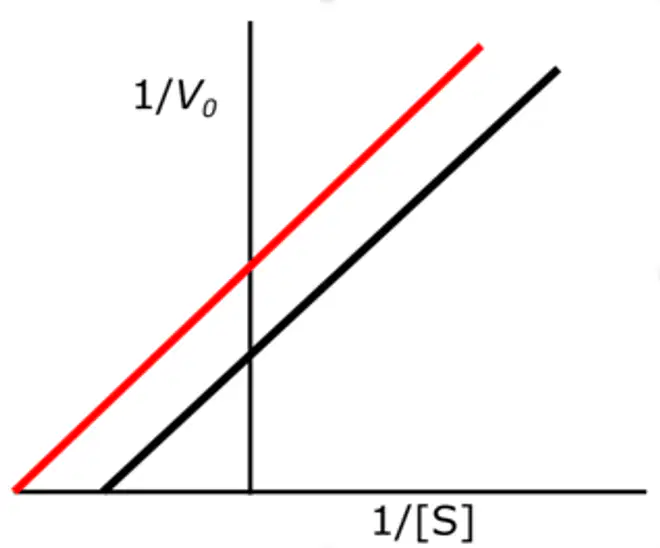
Which type of inhibition is represented on this plot?
uncompetitive inhibition
noncompetitive inhibition
competitive inhibition
mixed inhibition
A scientist is studying a biochemical reaction and determines that it has a negative Gibbs free energy (ΔG). What can she conclude about the reaction?
The reaction is at equilibrium and will not proceed in either direction.
The reaction is spontaneous and will proceed forward under standard conditions.
The reaction requires an input of energy to proceed.
The reaction has a high activation energy and will not occur without an enzyme.
What is the enthalpy change (ΔH) when chemical bonds are broken?
ΔH is negative because energy is released.
ΔH is zero because bond breaking does not require energy.
ΔH is positive because energy is absorbed.
ΔH depends on the type of bond but is usually negative.
You are boiling a pot of water to make tea. As the water transitions from liquid to gas, what happens to the entropy of the system?
Entropy increases because gas molecules have more freedom of movement than liquid molecules.
Entropy decreases because the gas molecules become more disordered.
Entropy remains the same because the amount of water does not change.
Entropy decreases because heat is added to the system.
How does ATP enable the coupling of exergonic reactions to endergonic reactions in cells?
By hydrolyzing its phosphate groups, releasing energy to drive endergonic reactions.
By storing electrons to directly transfer energy to endergonic reactions.
By stabilizing reactants to decrease the activation energy of endergonic reactions.
By serving as a reactant in all cellular reactions, ensuring they are exergonic.
What happens to the entropy of the system if you were to pour a few drops of olive oil in a glass of water?
Entropy increases because water molecules become more disordered around the oil.
Entropy fluctuates depending on the amount of the oil poured into the glass.
Entropy remains unchanged as olive oil would not affect water structure.
Entropy decreases because water molecules become more ordered around the olive oil.
Cells must carefully regulate osmotic pressure to prevent damage. Why do animal cells store glucose in the form of glycogen instead of as free glucose molecules?
Storing glucose as glycogen reduces osmotic pressure by decreasing the number of individual solute particles in the cell.
Glycogen is more soluble in water, which helps balance osmotic pressure.
Free glucose molecules are too large to cross the cell membrane, so storing them as glycogen prevents water loss.
Glycogen storage increases osmotic pressure, helping the cell absorb more water.
Which of the following is considered a strong electrolyte?
C₆H₁₂O₆ (glucose)
Na2SO4 (sodium sulfate)
CH₃COOH (acetic acid)
NH₃ (ammonia)
Which of the following would be considered an effective buffer at pH 4?
Compound A with a pKa of 6.76
Compound B with a pKa of 7
Compound C with a pKa of 9.25
Compound D with a pKa of 3.15
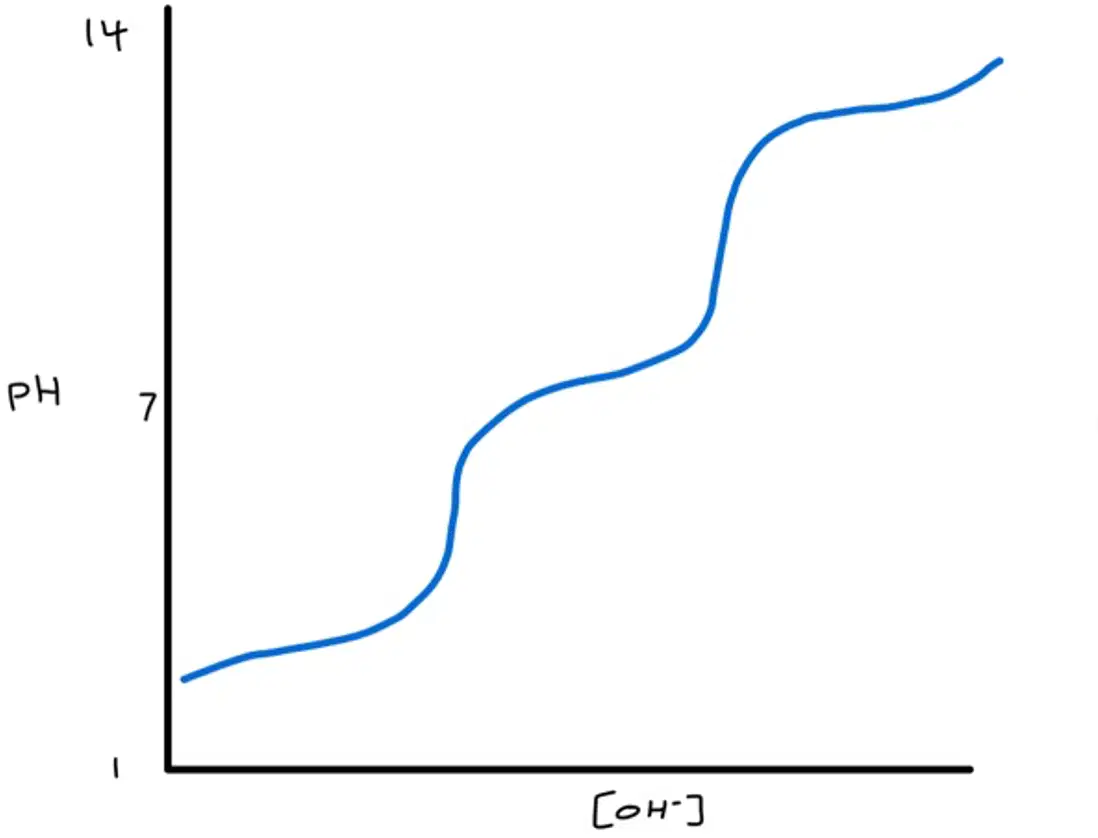
How many dissociable H⁺ ions does this buffer system contain?
1
2
3
4

