
 Worksheets
Dead Poets Society
Total questions: 25
Worksheet time: 25mins
The novel "Dead Poets Society" was created
after the film
before the film
by an Australian author
By Mr Keating
Mr Keating ´s name is derived from
a British novelist
an American poet
an English poet
an American novelist
The new English teacher has been employed because
the former English teacher was expelled
the former English teacher had retired
Welton needed a second English teacher
Mr Keating knew the headmaster
The Dead Poets Society is
a foundation dedicated to maintain dead poets´ verses
a club of students reciting poetry
the revival of an old poetry club at Welton
an online platform for creating poetry

Before the boys met Mr. Keating, they did not know how to
use their academic skill
be individuals
be disciplined
conform

Which of these boys betrayed the Dead Poets Society?
Neil Perry
Todd Anderson
Richard Cameron
Stephen Meeks
Charlie Dalton

Describe Mr. Keating using the acronym STEAL. Use specific examples from the movie for each category!
*You do NOT need to use complete sentences for this question!
S: speech
T: thoughts
E: effect on others
A: actions
L: looks
Describe Mr. Keating using the acronym STEAL. Use specific examples from the movie for each category!
*You do NOT need to use complete sentences for this question!
S: speech
T: thoughts
E: emotions
A: actions
L: looks

Carpe Diem means _ _ _ _ _ the day.
(a)
Mr Keating can be characterised as outstanding
due to his excellent knowledge of English literature
because he does care about his students
as he supports his students in all subjects
because he teaches differently

Knox is madly obsessed with
Girls
Living up to expectations
A specific girl
Mr Keating

By the end of the film Todd's character becomes more
like his brother
into study poetry
of an extrovert
shy

Who was in love with Chris Noel?
Gerald Pitts
Knox Overstreet
Richard Cameron
Neil Perry
What happens to Neil?
He takes his own life.
He leaves Welton Academy and all his friends.
He runs away from home.
He joins the army.
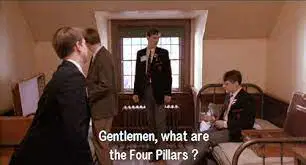
Complete the four pillars: Tradition, Honor, Discipline, _ _ _ _ _ _ _ _ _ _.
(a)
Girls are usually not allowed at Welton but
they can come over for the dance lessons with the boys
they can join the Dead Poets´cave meetings
they are permitted to take part in Mr Keating´s lessons
are invited to visit the drama club
Mr Keating tells the class that they
are food for worms.
to seize the day
should make their lives extraordinary
can call him "O Captain! My Captain!"
Which activity is not part of Keating´s lessons?
whistling
marching
reciting poems
kicking
Who wrote the introduction that Mr. Keating had his students rip out?
J. Evans Pritchard, PhD
Ethan Hawke
Walt Whitman
Dr. Henry Hemsworth
Who played Knox?
Gale Hansen
Robert Sean Leonard
Ethan Hawke
Josh Charles
What is the primary theme of 'Dead Poets Society'?
Conformity vs. individuality
Love and friendship
War and peace
Technology and society
Which character in 'Dead Poets Society' is known for the phrase 'Carpe Diem'?
Neil Perry
Todd Anderson
Mr. Keating
Charlie Dalton
In 'Dead Poets Society', what subject does Mr. Keating teach?
History
Mathematics
English
Science
What is the setting of 'Dead Poets Society'?
A public high school
A military academy
A private boys' school
A university
Which poet's work is prominently featured in 'Dead Poets Society'?
Robert Frost
Walt Whitman
Emily Dickinson
T.S. Eliot

