
 Worksheets
Exiled Poem
Total questions: 25
Worksheet time: 25mins
How do lines 1 through 16 (the first two stanzas) contribute to the structure of the poem?
They introduce the conflict the speaker feels about her opportunities in different places.
They contrast the speaker’s experiences and feelings about living in different places.
They compare phases in the speaker’s life when she wanted to be in a different place.
They show the causes and effects of the speaker deciding to live in a different place.
Which lines best support a theme of the poem?
“Searching my heart for its true sorrow, / This is the thing I find to be: / That I am weary of words and people, / Sick of the city, wanting the sea;” (lines 1–4)
“If I could hear the green piles groaning / Under the windy, wooden piers, / See once again the bobbing barrels, / And the black sticks that fence the weirs;” (lines 17–20)
“If I could see the weedy mussels / Crusting the wrecked and rotting hulls, / Hear once again the hungry crying / Overhead, of the wheeling gulls.” (lines 21–24)
“Feel once again the shanty straining / Under the turning of the tide, / Fear once again the rising freshet, / Dread the bell in the fog outside,” (lines 25–28)
Which phrase best states the speaker’s problem in the poem?
“Wanting the loud sound and the so sound” (line 7)
“Crusting the wrecked and rotting hulls,” (line 22)
“Fear once again the rising freshet,” (line 27)
“I am too long away from the water;” (line 35)
How does the use of the word "mother" in the phrase "mother of exiles" affect the tone of the phrase?
It causes the tone to be more negative and oppressive
It affects the tone by making the phrase more welcoming for immigrants.
It creates a loving and nurturing tone.
"Mother" does not affect the tone.
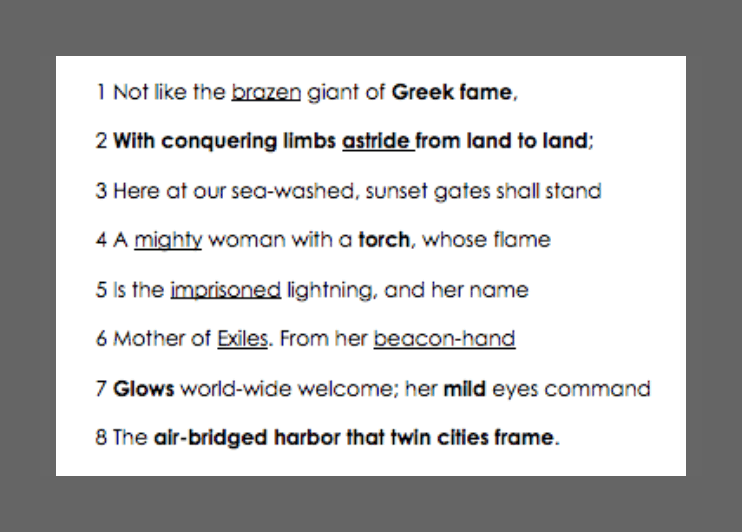
The following is an example of what in poetry?
Stanza
Line
Paragraph
The poem, what does the Mother of Exiles allude to or symbolize?
Ellis Island
the Statue of Liberty
Manhattan, NY
Which of the following lines best supports the answer to Part A?
"Not like the brazen giant of Greek fame, / With conquering limbs astride" (Lines 1-2)
"Here at our sea-washed, sunset gates shall stand / A mighty woman with a torch, whose flame / Is the imprisoned lightning" (Lines 3-5)
"her mild eyes command / The air-bridged harbor that twin cities frame" (Lines 7-8)
"'Give me your tired, your poor, / Your huddled masses yearning to breathe free, / The wretched refuse of your teeming shore.'" (Lines 10-12)
Which quote from the poem best supports the answer to Part A?
"Not like the brazen giant of Greek fame, / With conquering limbs astride" (Lines 1-2)
"Here at our sea-washed, sunset gates shall stand / A mighty woman with a torch" (Lines 3-4)
"From her beacon-hand / Glows world-wide welcome"
(Lines 6-7)
"her mild eyes command / The air-bridged harbor that twin cities frame." (Lines 7-8)
Where is the setting of the poem "Exile"?
Puerto Rico and San Francisco, 1930
Cuba and Los Angeles, 1950
Jamaica and Miami, 1960
Ciudad Trujillo and New York City, 1960
What is the theme of the poem?
Exile is like being stranded on an island in the middle of the ocean.
The greatest honor one can receive is to be exiled.
Leaving your homeland can be as easy as a trip to the beach.
Exile can create feelings of eagerness along with fear and anxiety.
Why is "Exile" considered a narrative poem?
rhymes
has no characters
uses imagery and metaphors to touch emotions and capture imagination
has a strict meter
What is the primary theme of the poem 'Exiled'?
A) The struggle of adapting to a new environment.
B) The joy of discovering new cultures.
C) The beauty of nature in foreign lands.
D) The excitement of traveling.
Which literary device is predominantly used in the poem 'Exiled'?
A) Simile
B) Metaphor
C) Alliteration
D) Personification
How does the speaker in 'Exiled' feel about their homeland?
A) Indifferent
B) Nostalgic
C) Resentful
D) Joyful
What is the tone of the poem 'Exiled'?
A) Optimistic
B) Melancholic
C) Humorous
D) Angry
Which line from 'Exiled' best illustrates the speaker's sense of loss?
A) 'The sun sets on foreign shores.'
B) 'Memories linger like shadows.'
C) 'New paths unfold before me.'
D) 'The world is vast and inviting.'
What does the 'sea' symbolize in the poem 'Exiled'?
A) Freedom
B) Isolation
C) Adventure
D) Danger
In 'Exiled', what is the speaker's attitude towards their new surroundings?
A) Enthusiastic
B) Apprehensive
C) Indifferent
D) Hostile
Which of the following best describes the structure of the poem 'Exiled'?
A) Free verse
B) Sonnet
C) Haiku
D) Limerick
What is the effect of the imagery used in 'Exiled'?
A) It creates a sense of chaos.
B) It evokes a feeling of tranquility.
C) It highlights the beauty of the landscape.
D) It emphasizes the speaker's isolation.
Which word best describes the speaker's journey in 'Exiled'?
A) Exciting
B) Transformative
C) Mundane
D) Predictable
How does the poem 'Exiled' end?
A) With a sense of hope
B) With a feeling of despair
C) With a resolution
D) With a question
What is the significance of the title 'Exiled'?
A) It refers to the speaker's voluntary journey.
B) It highlights the involuntary nature of the speaker's displacement.
C) It suggests a temporary separation.
D) It implies a joyful adventure.
Which emotion is most prominently expressed in 'Exiled'?
A) Joy
B) Anger
C) Sadness
D) Fear
What literary period does the poem 'Exiled' belong to?
A) Romantic
B) Modernist
C) Victorian
D) Postmodern

