
 Worksheets
Impact of Colonization on Africans
Total questions: 27
Worksheet time: 43mins
How were enslaved Africans viewed by their captors?
As property
As equals
As friends
As family
What were Africans subjected to during the Middle Passage?
Freedom and education
Captured or bought
Voluntary migration
Paid employment
What was the role of ship captains in the Middle Passage?
To educate Africans
To trade or sell Africans
To entertain Africans
To free Africans
What did Africans become covered in during the Middle Passage?
Water and mud
Sweat, vomit, and human waste
Sand and dust
Oil and grease
What spread quickly among Africans during the Middle Passage?
Happiness
Disease
Wealth
Knowledge
What was a common cause of death during the Middle Passage due to lack of food?
Drowning
Starvation
Disease
Overcrowding
What tasks were some Africans forced to complete?
Military service
Domestic tasks and artisan skills
Teaching
Medical work
Where did Africans who were indentured servants arrive in 1619?
Jamestown
New York
Georgia
Rhode Island
What replaced indentured servitude in the colonies?
Slavery
Freedom
Indentured labor
Apprenticeship
By 1750, what was the status of slavery in the colonies?
It was in all colonies
It was abolished
It was only in the South
It was only in the North
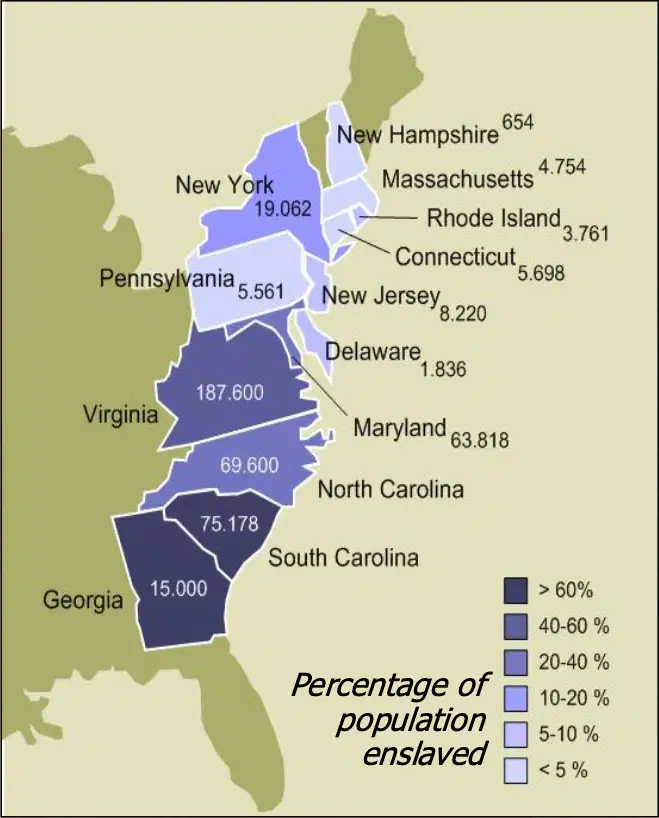
Which colony had 63,818 enslaved people according to the map?
Maryland
New Jersey
Connecticut
Rhode Island
What did the Virginia law of 1661 state about the children of enslaved people?
They would be enslaved
They would be freed
They would be educated
They would be sent to England
What did enslaved Africans still try to do after the Stono Rebellion?
Negotiate peace
Escape
Form a new rebellion
Return to Africa
What type of dance is mentioned in the document as part of African-American culture?
Ballet
Jigs
Salsa
Tango
What was the Middle Passage?
A journey taken by enslaved people from the Americas to Europe
A journey taken by European merchants to Africa
A journey taken by enslaved people from Africa to the Americas
A trade route between Africa and the Americas
The Middle Passage passes through the (a)
What was the reason that the Europeans felt that Africans would make the ideal slave?
If the enslaved Africans had children, what would happen to their children?
The children were free to come and go as they pleased
The children would become property of the slave owner just as their parents
The children ad a choice if they wanted to stay with their parents but be slaves or leave their parents to be free
The children would be sent away until they were old enough to work because no one had time to take care of them
The Triangular Trade was a trade route connecting the following locations in a triangular shaped pattern:
Asia, Europe, Africa
America (including the West Indies & the colonies), Europe and Africa
Asia, America and South America
New York, New Jersey, and Connecticut
Describe the conditions on the ships that the African people traveled in.
90% of the enslaved Africans would be made to work in the fields while the remaining 10% were made to
work in local shops and restaurants
complete domestic tasks like working in the master's home or as skilled labor like blacksmiths or carpenters
work on the docks
sail back to Africa to look for more potential slaves
Slave Codes were created as a means of
keeping count of enslaved people
helping to locate farms or plantations where slaves were kept
keeping count of how many children were born
keeping tight control of the enslaved people and preventing uprisings
Discuss some of the rules of the Slave Codes:
what were slaves not allowed to do?
read and write
eat
drink
help eachother
Choose the codes that slaves had. There are three.
no voting
no food
no learning to read and write
no travel without permission
Describe why the indigenous people were difficult to enslave in the colonies.

