
Font size
 Worksheets
Probability, Counting Principles, Auto Insurance Reveiw
Total questions: 40
Worksheet time: 2hrs 41mins
What kind of coverage pays for damages to your car if you are at fault?
Collision
Comprehensive
Under-insured Motorist
Uninsured Motorist
What kind of insurance pays for physical damages to your car from acts of nature such as fire?
Property Damage
Medical Payments
Collision
Comprehensive
Which of the following is a way to lower your insurance premium?
have a good driving record
be involved in sports
have a parent with you at all times
buy a sports car
Who needs auto insurance?
Nobody
People that think they will get into an accident.
All people who drive cars.
People who can afford it.
Why should you never drive without auto insurance?
It increases fuel efficiency
Cars cannot operate without insurance
It's required for parking in public areas
It's illegal in most states
Charlie's current insurance plan has a premium of $152.72 per month. He found a new insurance plan for the price of $1868.40 per year. Which plan is cheaper?
Old Plan
New Plan
If your policy covers $100,000 of Bodily Damage and you cause $234,000 of Bodily Damage what happens?
The insurance company will cover all of it
You pay $134,000 out of pocket
The company will pay you $134,000 after you pay out of pocket.
The insurance company will cover none of it.
Car B is not insured, what is one way Car A can have the damages paid for.
If car A has liability coverage
If car A has Under-insured Motorist coverage
If car A has Uninsured Motorists coverage
If car A has Comprehensive coverage
A higher deductible results in
a lower premium
a higher premium
a lower claim
a higher claim

A regular 6-sided die is to be rolled one time. What is the probability that the number 5 is rolled?
1/5
5/6
1/6
6/5

What is the probability of the spin stopping on yellow?
1/4
.25
50%
75%
A box has 3 limes, 5 grapes, and 2 oranges.
P (NOT lime)
3/10
30%
7/10
Answer Not Here
An event with a probability of equally likely as unlikely would be...
0
1/2
2/3
1


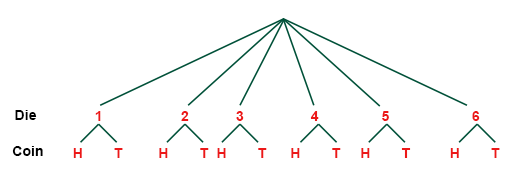
How many total outcomes are there?

The letters A, B, C, and D are used to form four-letter passwords for entering a computer file. How many passwords are possible if letters can be repeated?
4 x 4 x 4 x 4 = 256
4 x 3 x 2 x 1 = 24
4 + 4 + 4 + 4 = 16
4 + 3 + 2 + 1 = 10
A restaurant serves 5 main dishes, 3 salads, and 4 desserts. How many different meals could be ordered if each has a main dish, a salad, and a dessert?
5 x 3 x 4 = 60
5 + 3 + 4 = 12
The fundamental counting principle
Tells you the probability of an event.
Tells you how many different possible outcomes there are.
Helps you convert a fraction into a percent.
Shows you the outcomes that don't appear in a tree diagram.
If I use the fundamental counting principle, how many different outcomes are there if I flip 4 different 2-sided coins?
8, because 4 x 2 = 8
6, because 4 + 2 = 6
16, because 2 x 2 x 2 x 2 = 16
256, because 4 x 4 x 4 x 4 = 256
Marissa brought 8 T-shirts and 6 pairs of shorts to summer camp. How many different outfits consisting of a T-shirt and a pair of shorts does she have?
8 x 6 = 48
8 + 6 = 14
Use the fundamental counting principle to find the total number of possible outcomes for lunch if you can choose from 4 types of sides, 6 types of main entree, and 12 types of drinks.
3, because you are choosing 1 side, 1 entree, and 1 drink.
22, because 4 + 6 + 12 = 22
66, because (4 + 6 + 12) x 3 = 66
288, because 4 x 6 x 12 = 288
There are 45 applicants for three Computer Programmer job positions.
Paying a larger deductible will ___ your premium.
Increase
Decrease
Have no effect on
Identify all of the items below that can reduce the cost of your auto insurance.
Good grades
Driving an older car
Staying on your parents' policy
Safe driving
True or False: You should ALWAYS keep a copy of your insurance card in your car.
True
False
What's an insurance card?
Liability insurance is required by law, and protects you from losses you cause others
True
False

