
 Worksheets
Legislation in Building and Heating Systems part 1
Total questions: 40
Worksheet time: 20mins
Which legislation is concerned with the conservation of fuel and power?
BS EN 12828
BS EN 14336
Building Regulations part L
BS 4422
BS EN 12828 is related to the ______ of water based heating systems.
Design
Installation
Manufacture
Efficiency
Which of the following is covered under Building Regulations part L1a?
In new dwellings
In existing dwellings
In new, other than dwellings
In existing, other than dwellings.
Building Regulations part L2b applies to ______.
In new dwellings
In existing dwellings
In new, other than dwellings
In existing, other than dwellings.
What is the main purpose of central heating?
To provide thermal comfort
To heat only one room
To cool the house
To reduce humidity.
Central heating provides heat in ______.
one room
every room
the kitchen only
the bathroom only
What is the main difference between full central heating and selective central heating?
Full central heating heats all rooms, while selective central heating heats some rooms.
Full central heating is more energy-efficient.
Selective central heating is cheaper.
Full central heating is only for large properties.
In selective central heating, who selects the rooms to be heated?
The customer
The technician
The manufacturer
The government
What is the main basis for installing background central heating?
Comfort
Cost
Efficiency
Speed
Background central heating is classified as such if it cannot achieve the desired comfort temperature when the outside temperature is ____.
0°C
-1°C
5°C
10°C
Which of the following systems replaced the open fire in each room over the past 100 years?
Gravity hot water system
Pumped heating with gravity hot water
Fully pumped system
All of the above.
Central heating is now ______ to an open fire, as it heats up the whole property.
inferior
preferred
similar
unrelated
Which of the following is NOT a type of fuel mentioned for heating systems?
Solid fuel
Gas
petrol
Electricity
The customer will be cost conscious not only at the point of ________, but also with the running costs of the system.
Maintenance
Installation
Performance
Controls
Which of the following is a characteristic of low pressure, open vented systems?
Fed directly from mains cold water
Incorporate an expansion vessel
Fed from a feed and expansion cistern
Use a combination boiler.
Modern domestic central heating systems fall into two categories based on the way the system is filled with water and the _______ that the system operates at.
temperature
pressure
volume
speed
Which of the following is a type of wet central heating system?
Open-vented (low pressure) systems
Sealed (pressurised) systems
Both A and B
None of the above.
Fill in the blank: A system using two two-port motorised valves is a subtype of ______ systems.
Semi-gravity
Fully pumped
System boiler
Microbore
What is the primary method used by gravity or semi-gravity systems to circulate water?
Electric pumps
Convection currents
Manual operation
Hydraulic pressure
Gravity or semi-gravity systems usually have ___ primaries associated with solid fuel boilers.
15mm
22mm
28mm
35mm
What is a characteristic of full gravity systems?
They are commonly installed in new properties.
They use large diameter pipework.
They have a pump for hot water.
They heat up quickly.
Full gravity systems are ___ installed but may be found in older properties.
always
sometimes
no longer
frequently
What is a characteristic of single feed or primatic hot water cylinders?
They have an F&E to fill the primary circuit.
They use a cold feed to the cylinder.
They can be converted to pumped systems.
Inhibitors can be added to them.
Single feed or primatic hot water cylinders cannot be converted to ______ systems.
gravity
pumped
solar
electric
What is a characteristic of the one pipe gravity system?
It uses multiple pipes
It relies on gravity to heat radiators
It is more expensive to install
It does not return to the boiler.
In a one pipe gravity system, the installation cost was ______ due to only one ring pipe being installed.
higher
cheaper
the same
unpredictable
What is the function of the 'Feed and expansion cistern' in a one pipe gravity system?
To heat the water
To store and supply water
To circulate the water
To cool the water
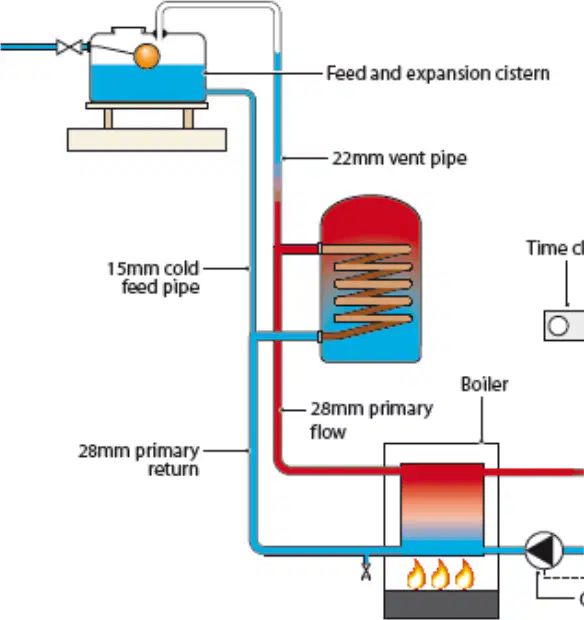
In a one pipe gravity system, the 'Central heating circulating pump' is responsible for ______.
heating the water
cooling the water
circulating the water
storing the water
What is one advantage of the One pipe gravity system?
High efficiency
Cheap to install
Compliant with Building Regulations part L
Controlled room temperature.
Fill in the blank: One disadvantage of the One pipe gravity system is that it is not compliant with Building Regulations part ____.
A) A
B) B
C) L
D) D
What type of circulation does the 'Two pipe semi gravity' system use for the hot water circuit?
Pumped
Gravity
Mixed
None of the above
In a 'Two pipe semi gravity' system, the flow and return waters did not ____.
Mix
Separate
Heat
Cool
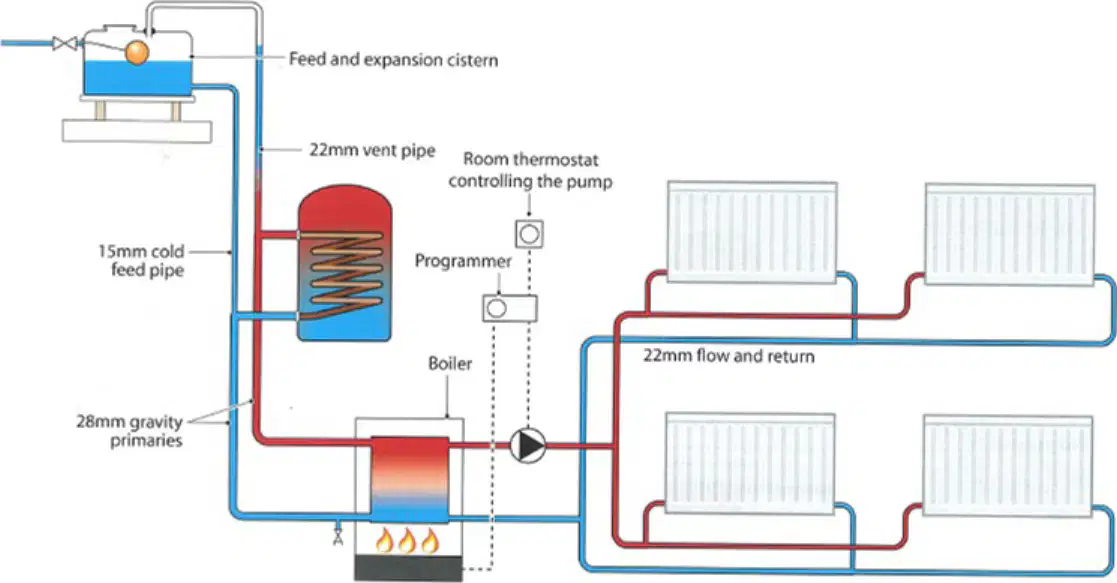
What is the function of the 'Feed and expansion cistern' in a two pipe semi gravity system?
To heat the water
To store excess water and allow for expansion
To control the room temperature
To pump water through the system.
In a two pipe semi gravity system, the '22mm flow and return' pipes are used to ______.
heat the water
store excess water
circulate water to and from the radiators
control the room temperature
Which of the following is an advantage of the two pipe semi gravity system?
Uncontrolled heat
Boiler cycling
Cheaper to run
Low efficiency
Fill in the blank: The two pipe semi gravity system is ______ when heating up.
Slower
Quicker
More expensive
Less efficient
What is included in a C plan two pipe semi gravity system?
Cylinder thermostat and zone control
Room thermostat and TRVs
Both A and B
None of the above.
The C plan plus is the minimum acceptable compliant system with Building Regulations part L1b and the Domestic Heating Compliance Guide, which states the system has to incorporate a ________ mechanical thermostat.
thermo
hydro
electro
bio
What is the function of the motorised valve in a C plan two pipe semi gravity system?
To control the flow of water
To heat the water
To pump the water
To cool the water
In a C plan two pipe semi gravity system, the _______ is responsible for regulating the temperature of the water in the cylinder.
Room thermostat
Cylinder thermostat
Programmer
Pump

