wayground logo

Free Printable Worksheets

Font size

S
M
L
XL
Worksheets

Photosynthesis Review

Total questions: 71

Worksheet time: 36mins

Name
Class
Date
1.

Where do plants get the energy for photosynthesis to take place?

a)

nutrients in the soil

b)

the sun

c)

chlorophyll

d)

bee pollination

2.

What two things are the product (end result) of photosynthesis?

a)

Oxygen

b)

Glucose

c)

Chloroplasts

d)

Carbon Dioxide

3.

Where do the stem and leaves get their green color from?

a)

glucose

b)

carbon dioxide

c)

oxygen

d)

Chlorophyll

4.
What does chlorophyll capture?
a)
Chlorophyll captures water from the air.
b)
Chlorophyll captures carbon dioxide from the air.
c)
Chlorophyll captures the energy of sunlight.
d)
Chlorophyll captures baseballs.
5.
What two materials are needed for photosynthesis?
a)
Water and soil.
b)
Carbon dioxide and water.
c)
Carbon dioxide and chlorophyll.
d)
Peanut butter and jelly.
6.
Which sentence correctly describes photosynthesis. (assume there is enough sunlight)
a)
CO2 and water combine and make O2 and glucose
b)
O2 and water combine to make glucose and CO2
c)
O2 and CO2 combine to make water and glucose
d)
CO2 and glucose combine to make O2 and water
7.

Which of the following is NOT a product of the light reactions?

a)

Oxygen

b)

NADPH

c)

ATP

d)

Glucose (Sugar)

8.
What are the two products of the light reactions that are needed for the calvin cycle?
a)
NAD and NADPH
b)
NADP + and Glucose
c)
NADPH and ATP
d)
Oxygen and NADPH
9.

The Calvin Cycle occurs in the

a)

Thylakoid

b)

Grana

c)

Inner membrane of chloroplast

d)

Stroma

10.
What gas does the process of photosynthesis release into the atmosphere?
a)
oxygen
b)
carbon dioxide
c)
water
d)
nitrogen
11.

Plants are __________, they make their own food.

a)

Heterotrophs

b)

Autotrophs

c)

Mitochondria

d)

A black hole into an intergalactic void

12.
What is the chemical formula for glucose?
a)
C6H12O6
b)
C6H6O12
c)
C12H6O12
d)
C6O2H6
13.

If carbon dioxide is completely removed from a plant’s environment, what would you expect to happen to the plant’s production of Glucose?

a)

Glucose production will increase.

b)

Glucose will not be produced.

c)

The rate of glucose production will decrease .

d)

Fewer glucose will be produced at first, but then the plant will recover.

14.
Where do the light-dependent reactions occur? 
a)
thylakoid membrane
b)
stroma
c)
mesophyll
d)
mitochondria
15.
Where does the Calvin Cycle occur?
a)
thylakoid
b)
stroma
c)
lumen
d)
mitochondria
16.
The fluid like substance found inside the chloroplast is called
a)
Cytoplasm
b)
Stroma
c)
Thykloids
d)
Cell Wall
17.
a)
Stroma
b)
Thylakoid
c)
Skittle
d)
Grana
18.
a)
Flapjack Stack
b)
Grana
c)
Thylakoid
d)
Stroma
19.
a)
Grana
b)
Thylakoid
c)
Stroma
d)
Jelly Filling
20.
Which choice correctly shows the gases that enter and exit plants during photosynthesis?
a)
Enter: Oxygen
Exit: Carbon dioxide
b)
Enter: Water vapor
Exit: Glucose
c)
Enter: Carbon dioxide
Exit: Oxygen
d)
Enter: Light
Exit: Water vapor
21.
Which of the following is an example of an AUTOTROPH?
a)
Appletree
b)
Dog
c)
Mushroom
d)
Human
22.

How does most of the water needed by the plant get into its leaves?

a)

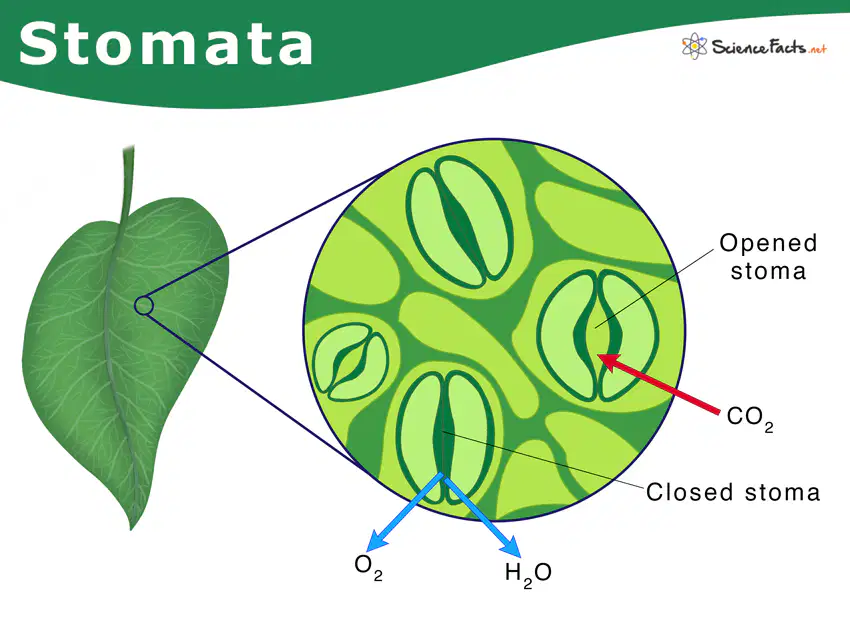
It enters through the stomata

b)

The roots absorb it and then it travels up the stem

c)

It's made during a chemical reaction in the leaf

d)

The flowers capture water and deliver it to the leaves

23.
How does carbon dioxide get into the leaves of a plant?
a)
It's absorbed by the roots
b)
It's made in a chemical reaction in the stem
c)
It enters through the stomata
d)
It goes through the flowers
24.
Which of these conditions would decrease the rate of photosynthesis in a plant?
a)
Above average precipitation
b)
Changing the daylight hours from 14 hrs to 10 hrs
c)
Changing the CO2 concentration from 380 ppm to 410 ppm
d)
All of these choices
25.
Which organisms perform Photosynthesis?
a)
Only Autotrophs
b)
Only Heterotrophs
c)
Autotrophs and Heterotrophs
26.
Another name for the Calvin Cycle is
a)
Light Dependent Reaction
b)
Light Independent Reaction
c)
Cellular Respiration
d)
Cellular Transport
27.

In which part of photosynthesis is water split release Oxygen?

a)

light dependent reactions

b)

light independent reactions

28.

What part of photosynthesis is Carbon Dioxide used to help make glucose?

a)

light dependent reactions

b)

light independent reactions

29.

What are the two molecules synthesized in the light dependent reactions that are carried over to the light independent reactions?

a)

ATP and ADP

b)

NADPH and ATP

c)

Glucose and Carbon Dioxide

30.
What is the function of NADPH and ATP?
a)
They absorb light
b)
They power the light-dependent reactions
c)
They are light-reflecting pigments
d)
They are short term energy carriers
31.
What is the main purpose of the light dependent reactions?
a)
To provide the energy for the calvin cycle
b)
To capture energy and make sugar
c)
To reflect green light
d)
To make sugars
32.

Why are plants usually green?

a)

Because the chlorophyll reflects green light

b)

Because the chlorophyll absorbs green light

c)

Because the accessory pigments combine to make green

d)

Because the accessory pigments only absorb green light

33.
How would the concentration of CO2 in water affect photosynthesis?
a)
The higher the CO2, the greater the rate
b)
The higher the CO2, the lower the rate
c)
CO2 concentration doesn't affect photosynthesis
d)
a greater rate of photosynthesis causes higher CO2 concentrations 
34.
Chlorophyll absorbs ________ light.
a)
red - blue
b)
yellow
c)
green
d)
light greens
35.
After photosynthesis, plants store their energy as _________ .
a)
chlorophyll
b)
pigment
c)
glucose (sugar)
d)
Oxygen
36.
What is the correct equation for photosynthesis?
a)
C6H12O+ 6O--> 6CO2 + 6H2O
b)
6CO2 + 6O--> C6H12O + 6H2O
c)
 6CO+ 6O--> 6H2O + C6H12O6
d)
6CO2 + 6H2O  -->  6O+ C6H12O6
37.

Why do CAM plants grow much slower than other plants?

a)

they live in areas that do not have a lot of sunlight

b)

they live in areas that do not have a lot of water

c)

they can only fix CO2 during the night hours

d)

they can only fix CO2 during the day hours

38.

What do we call an organism that obtains food by consuming other organisms, such as animals?

a)

Respiration

b)

Photosynthesis

c)

Autotroph

d)

Heterotroph

39.

The _____ is a tiny opening on the surface of plant leaves that allows for the exchange of gases during photosynthesis.

a)

Carbon dioxide

b)

Oxygen

c)

Glucose

d)

Stomata

40.
The rate of photosynthesis is affected by all of the following except
a)
the amount of salt.
b)
the availability of water.
c)
light intensity.
d)
temperature (enzymes).
41.
Which of the following is an example of a HETEROTROPH?
a)
Grasses
b)
Algae
c)
Lemon Tree
d)
Bush Mouse
42.
Plants need ________ for photosynthesis
a)
oxygen
b)
soil
c)
carbon dioxide
d)
sugar
43.
Plants need carbon dioxide from their environment to produce glucose during which stage of photosynthesis? 
a)
The light-dependent stage
b)
The light-independent stage (The Calvin Cycle)
c)
The electron transport chain
d)
ATP formation
44.

True or False.   The LIR (calvin cycle) can happen at night.

a)
true
b)
false
45.

TRUE or FALSE.  The LIR (calvin cycle) can happen during the day.

a)
True
b)
false
46.
Chlorophyll is green because
a)
it absorbs green wavelengths of light
b)
it absorbs blue and yellow wavelengths of light
c)
it reflects green wavelengths of light
d)
it is an optical illusion caused by the transmission of light
47.
These are the only types of organisms that go through photosynthesis.
a)
autotrophs
b)
heterotrophs
c)
consumers 
d)
autotrophs and heterotrophs
48.

Where is chlorophyll located?

a)

stroma

b)

cytoplasm

c)

thylakoid membrane

d)

stomata

49.

How does water enter a plant?

a)

roots

b)

stomata

c)

stroma

d)

chlorophyll

50.

Disc-like structures found in the chloroplasts?

a)

thylakoids

b)

stomata

c)

chlorophyll

d)

stroma

51.

The photosynthetic reaction that ends with the production of glucose

a)

Calvin Cycle

b)

Photosynthesis

c)

Light Reaction

d)

Cellular Respiration

52.

The glucose created during photosynthesis comes from the ________ molecules.

a)

Carbon Dioxide

b)

Oxygen

c)

Water

d)

Glucose

53.

Which of the following environmental factors does not affect the rate of photosynthesis?

a)

Light intensity

b)

Carbon dioxide concentration

c)

Temperature

d)

Oxygen concentration

54.

What do pigments do?

a)

Absorb specific wavelengths(color) of visible light for energy.

b)

Absorb CO2 in the Stroma to create sugar.

c)

Transports e- in the electron transport chain.

d)

Transports energy between plant cells.

55.

What are the two main energy carrying molecules used to create glucose?

a)

ADP and ADNH+

b)

ATP and NADPH

c)

Starch and Cellulose

d)

Glucose and Hydrogen

56.

Which gas diffuses through plant leaves to be used for photosynthesis?

a)

hydrogen

b)

oxygen

c)

nitrogen

d)

carbon dioxide

57.

Which of the following best describes photosynthesis?

a)

Photosynthesis converts light energy into chemical energy (glucose).

b)

Photosynthesis produces a variety of carbohydrates.

c)

Plants need oxygen to complete photosythesis

d)

Plants break down their food sources for energy

58.

An organism that can create its own food, such as plants, is known as a(n) _______.

a)

autotroph

b)

hetertroph

c)

carnivore

d)

detritivore

59.

The stroma is the region outside the

a)

chloroplasts

b)

thylakoids

c)

plant cells

d)

all of the above

60.

Which of the following activities happens within the stroma?

a)

Photosystem I absorbs light.

b)

ATP synthase produces ATP.

c)

Electrons move through the electron transport chain.

d)

The Calvin cycle produces sugars.

61.

The Calvin cycle is another name for the...

a)

light-independent reactions.

b)

light-dependent reactions.

c)

photosynthesis reaction.

d)

electron transport chain.

62.
Oxygen is...
a)
needed for photosynthesis to occur
b)
a product of cellular respiration
c)
a product of photosynthesis
d)
deadly to humans
63.

The purpose of photosynthesis is

a)

to make ATP

b)

to make water

c)

to make carbon dioxide

d)

to make glucose

64.

In a cactus, the stomata -

a)

Opens at day and closes at night

b)

Stays close all the time

c)

Stays open all the time

d)

Opens at night and closes during the day

65.

The oxygen gas we breathe comes from the splitting of water during the light reaction

a)

True

b)

False

66.

The carbon dioxide is used by the plant during

a)

the light reaction

b)

the Calvin cycle

67.

Plants use their stomata to obtain

a)

water

b)

carbon dioxide

c)

oxygen gas

68.
What is the chemical formula for carbon dioxide?
a)
H2O
b)
CO2
c)
CHO2
d)
CO2H
69.
What is the chemical formula for oxygen?
a)
H12O2
b)
C6O2
c)
O3
d)
O2
70.
What is the chemical formula for glucose?
a)
C6H12O6
b)
C6H6O12
c)
C12H6O12
d)
C6O2H6
71.

Which of the following pigments reflect orange light?

a)

chlorophyll a

b)

chlorophyll b

c)

caretenoid