
Font size
 Worksheets
U3, Ch3 The City-States of Ancient Greece
Total questions: 10
Worksheet time: 5mins
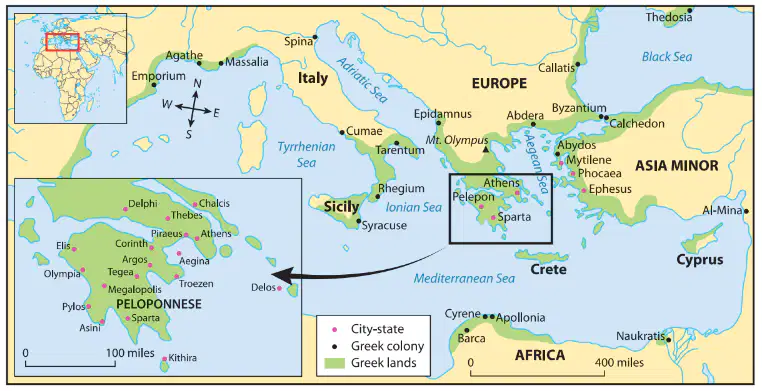
Most of ancient Greece’s territory was located __________.

How did Greece’s geography affect the development of Greek culture? Select the two correct answers.
Mountains and islands made travel difficult, so Greek cities developed apart from each other.
Plateaus and open plains made travel easy, which encouraged sharing among Greek cultures.
Earthquakes and flooding made travel difficult, so Greek cities developed apart from each other.
Abundant rivers and flat coastlines made travel easy, which encouraged sharing among Greek cultures.
Mountainous land made it difficult for outsiders to attack cities as they developed their individual cultures.
In which type of government in ancient Greece was power shared by a large number of male citizens?
democracy
aristocracy
oligarchy
tyranny
Who qualified for citizenship in ancient Athens?
all men
all people
wealthy men
wealthy people
How did education in Sparta differ from education in Athens?
Sparta focused on arts and sciences; Athens focused on physical education.
Sparta focused on citizenship; Athens focused on managing the household.
Sparta focused on military training; Athens focused on producing well-rounded citizens.
Sparta focused on logic, math, and science; Athens focused on reading, writing, and the arts.
Which city-state operated as a military unit?
Athens
Sparta
Minoa
Crete
How did Athens become involved in the Persian Wars?
It defended another Greek city-state against Persian forces.
It allied with the Persians against Spartan forces.
It attacked and captured Persian colonies.
It was attacked by the Persians.
What was a cause of the Peloponnesian War?
Sparta wanted revenge for the destruction caused by the Persian Wars.
Athens thought Sparta’s military power had become too strong.
Sparta wanted to unite all of Greece under a single emperor.
Athens tried to spread democracy to other city-states.
How did Sparta ultimately win the Peloponnesian War?
It cut off the enemy’s food supplies.
It burned Athens to the ground.
It doubled the size of its army.
It trapped the enemy’s ships.
Use the excerpt to answer the question:
“We run our city-state differently than they do in nearby city-states. We prefer to be a model for other communities rather than copy them. Our government is a democracy because many people have a say in how it is run, not just a few. The law makes it so that everyone is treated equally in private disagreements, and we respect every person based on their good character and actions, not on their social class.”
-from Pericles’s Funeral Oration.
Who was Pericles talking to?
the gods
Persians
Spartans
Athenians

