
 Worksheets
Motion in Universe
Total questions: 23
Worksheet time: 15mins
What does the orbital period of a celestial body depend on?
The size of the body
The body's distance from the object it is orbiting
The temperature of the body
The body's color
What is gravitational field strength (g)?
The density of a celestial body
A measure of gravitational acceleration experienced by objects
The speed of light in vacuum
A type of magnetic field
How do the orbits of planets and moons generally appear?
Perfect circles
Random patterns
Elliptical
Straight lines
What is the Universe a large collection of?
Planets
Solar systems
Galaxies
Stars
What is a galaxy a large collection of?
Moons
Asteroids
Planets
Stars
What galaxy is our Solar System in?
Andromeda Galaxy
Whirlpool Galaxy
Milky Way Galaxy
Triangulum Galaxy
What is weight defined as?
The force acting on an object due to gravitational attraction
The mass of an object on a planet
The speed at which an object falls to the ground
The distance an object is from the center of a planet
What is the role of a planet's gravitational field regarding nearby masses?
It repels nearby masses
It has no effect on nearby masses
It attracts nearby masses with a strong gravitational force
It only affects masses that are in direct contact with the planet
According to the IGCSE spec, what is the approximate value of the gravitational field strength on the surface of the Earth?
3.7 N/kg
10 N/kg
24.7 N/kg
11 N/kg
How does the gravitational field strength on Jupiter compare to that on Earth?
It is the same as on Earth.
It is less than on Earth.
It is much greater than on Earth.
It is half the value of Earth's gravitational field strength.
What would be the effect on a person's weight if they were on Jupiter instead of Earth?
Their weight would be unchanged.
Their weight would be much smaller.
Their weight would be much greater.
They would be weightless.
What is the relationship between a planet's distance from the Sun and the time it takes to orbit the Sun?
Closer planets take longer to orbit
Further planets take less time to orbit
Further planets take longer to orbit
Distance from the Sun does not affect orbit time
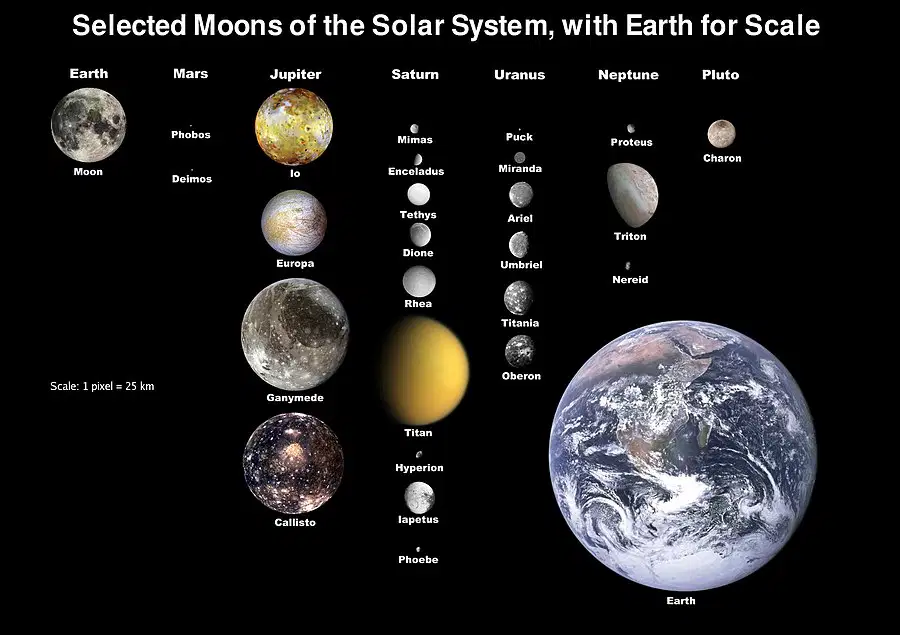
What can be said about the number of moons orbiting planets?
All planets have one moon
Some planets have more than one moon
No planets have moons
All planets have the same number of moons

What shape are the orbits of comets typically described as?
Circular
Triangular
Highly elliptical or hyperbolic
Square
As a comet moves closer to the Sun, what happens to its speed?
It remains constant
It decreases
It increases
It becomes zero
What type of motion do planets have around the Sun or a moon around a planet?
Linear motion
Circular motion
Elliptical motion
Random motion

What is the gravitational field strength on the surface of Jupiter?
9.0 N/kg
24.7 N/kg
9.8 N/kg
3.7 N/kg
Which of the following best describes a galaxy? A galaxy is –
the ending of the life cycle of all super massive stars in the universe.
a massive system of stars, gas, dust, and dark matter bound together by gravitational forces.
a visible body of liquid or frozen crystal droplets suspended above a planetary surface.
the visible path of a meteoroid as it enters Earth’s atmosphere.


Based on the table, which planet in our solar system will have the fastest orbital speed?
Venus
Earth
Saturn
Mercury

The orbital path of a satellite is shown in the sketch. Use the sketch to answer the question.
In which of the positions A through D does the satellite have the least speed ?
A
B
C
D
weight of an object is directly proportional to mass
true
false
if mass is less gravitation will be
more
constant
equal
less

