
 Worksheets
Ecology
Total questions: 25
Worksheet time: 25mins

What might be causing the pattern in these data?
the population's food resources became less abundant
the population's predators became less abundant
the population's habitat became less abundant
the population's competitors became more abundant
Which statement best describes an important difference between plants and animals?
Plants get food from the soil while animals get food by eating other organisms
Animals are alive but plants are not
plants use carbon dioxide from the air and water to make their own food while animals get food by eating other organisms
animals use energy stored in food but plants do not
The role of decomposers in an ecosystem is to:
convert the suns energy into energy stored as food
convert plant matter into matter that can be used by animals
eat other living organisms for energy
break down dead and waste matter
a food web show the flow of ________ through an ecosystem and the cycling of ___________ within an ecosystem
matter, energy
energy. matter
food, waste products
waste products, food
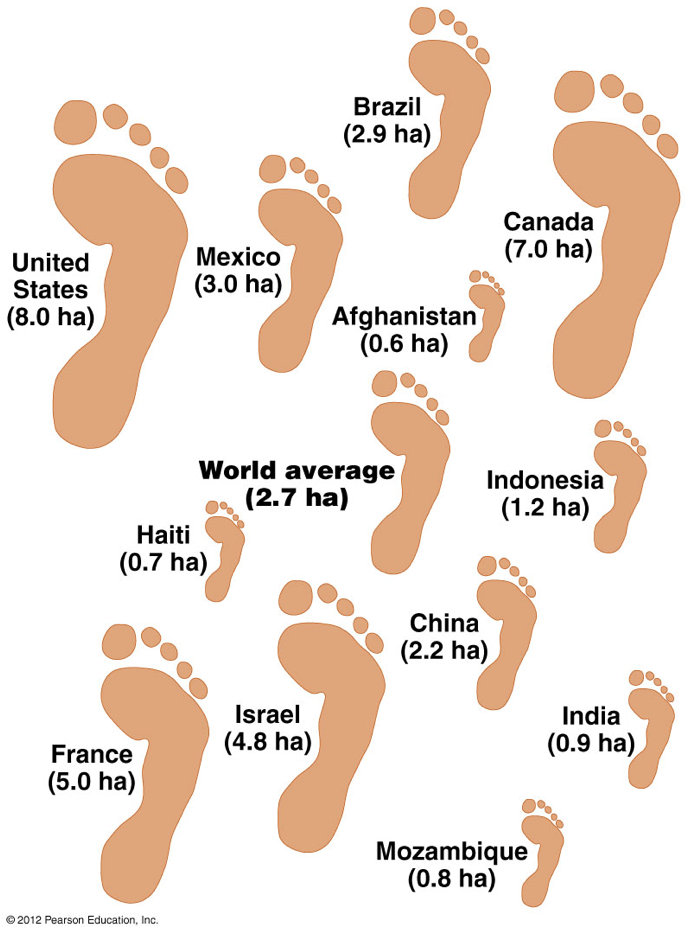
Nearly 50% of the land on our planet is currently used for agriculture, with very little more agriculturally usable land available. If everyone on the planet had an ecological footprint the size of the average citizen of the United States, then ________.
we would be able to provide for everyone without much difficulty, using the other 50% of the land currently not being used
we would have 50% more food to go around
we would need at least two more planet Earths to feed and support everyone
we could support 50% more people on our planet
about 50% of the people would starve
The original source of energy for food web is
soil
the sun
water
nutrients
Which of the following statements about introduced species is TRUE
most were introduced intentially by people
they are more likely to cause problems in natural areas than in urban areas
they are unlikely to cause problems for people
their impact on the local ecosystem is difficult to predict
"A new species of fish has been introduced into Lake Hiawatha. This fish eats minnows, a smaller fish that already lives in the lake."
What is most likely to happen to the population of minnows in Lake Hiawatha?
it will increase
it will decrease
it will stay the same
it will first increase, then decrease
"A new species of fish has been introduced into Lake Hiawatha. This fish eats minnows, a smaller fish that already lives in the lake."
What will most likely to happen to the population of the new species of fish in Lake Hiawatha
it will increase
it will decrease
it will stay the same
it will first decrease, then increase
A new species of fish has been introduced into Lake Hiawatha. This fish eats minnows, a smaller fish that already lives in the lake.
The introduction of this new species of fish into Lake Hiawatha provides an example of:
competition
parasititism
predation
mutualism
Which of the following is an example of mutualism?
a mosquito feeding on the blood of bison
a coneflower being pollinated by a bee
a mushroom growing in the soil
a mouse and a bird eating the same kind of seed
The main reason some introduced species survive and overpopulate an area is that:
there are few natural predators in the area
there is not enough food for other organisms
most organisms can survive in new habitats
people feed them
Solutions to problems caused by invasive species
require using every possible treatment regardless of the trade-offs
are easy to develop
are relatively inexpensive
involve identifying criteria and constraints
Natural resources that can be reused or replaced in a human lifetime
Fossil fuels
Nonrenewable resource
Efficient
Renewable resource

Which is NOT a way to decrease your ecological footprint?
Eating less meat and processed foods
Walking or biking to school
Turning off electricity and water when you're not using it.
Driving a large car around for fun.

The U.S. average footprint is ________ times larger than the world average footprint.
2
5
3.3
2.7
6.7

The study of natural processes in the environment and how humans affect it is called?
Environmental science
Biodiversity
Population
Ecological footprint

The contamination of earths land, water, or air is called?
population
Sustainable yield
point source
pollution
The most diverse ecosystems on Earth are the ______________________
Desert
Deciduous Forest
Tropical Rainforest
Tundra
If all the members of a species disappears from Earth, the species is said to be?
Threatened
Endangered
Extinct
Keystone species
Which of these problems could happen if we don't look after the resources we have?
Loss of animal homes
Climate change
Increase in pollution
All of the above
What is the primary role of producers in an ecosystem?
A) To decompose organic matter
B) To consume other organisms
C) To produce energy through photosynthesis
D) To provide shelter for animals
Which of the following best describes the concept of a 'niche' in ecology?
A) The physical space an organism occupies
B) The role an organism plays in its environment
C) The food an organism eats
D) The lifespan of an organism
What is the main consequence of habitat fragmentation on biodiversity?
A) Increased genetic diversity
B) Decreased species extinction
C) Increased species isolation
D) Decreased competition among species
Which of the following is a characteristic of a keystone species?
A) It is the most abundant species in an ecosystem
B) It has a large impact on its environment relative to its abundance
C) It is always a top predator
D) It is a species that migrates frequently

