
Font size
 Worksheets
Earth Science Review
Total questions: 25
Worksheet time: 25mins
Which term describes when the Earth spins on its axis.
Rotation
Revolution
Kepler's Laws
Precession
Which type of motion causes night / day?
Rotation
Revolution
Kepler's 1st Law
Nutation
Which term describes the time it takes for Earth to complete one circle around the sun.
Rotation
Revolution
Kepler's 1st Law
Barycenter

According to the Earth Science Reference Tables, what is the approximate dewpoint temperature if the dry-bulb temperature is 18 C and the wet-bulb temperature is 11 C?
4 C
-10 C
7 C
1 C

According to the Earth Science Reference Tables, an atmospheric pressure of 978 millibars is equal to
28.76 inches of mercury
28.92 inches of mercury
29.00 inches of mercury
28.88 inches of mercury

Which location is experiencing a southwest planetary wind? (ESRT pg 14)
B
F
A
C

As the air moves from point D to point E, it will be
cooled by compression
warmed by expansion
cooled by expansion
warmed by compression

On which side of the mountain and at which elevation is the relative humidity probably 100%?
on the leeward side at 1.0 km
on the windward side at 1.5 km
on the leeward side at 2.5 km
on the windward side at 0.5 km

An airmass located over the central United States will most likely move toward the
southwest
southeast
northwest
northeast
The boundary between 2 air masses is called
a climate zone
a rift
air pressure
a front

The diagram represents a cross-sectional view of air masses associated with a low-pressure system. The cold frontal interface is moving faster than the warm frontal interface. What usually happens to the warm air that is between the two frontal surfaces?
The warm air is forced under both frontal interfaces
The warm air is forced under the cold frontal interface but over the warm frontal interface
The warm air is forced under the cold frontal interface but under the war frontal interface
The warm air is forced over both frontal interfaces

According to this weather station model, why is precipitation likely?
The dewpoint is approaching the temperature
The present weather indicates a thunderstorm
Cloud Cover is 100%
Precipitation is not likely

An airmass originating over the North Pacific Ocean would most likely by
continental polar
maritime polar
maritime tropical
continental tropical
Which process most directly results in cloud formation?
transpiration
precipitation
radiation
condensation

What is happening at point B?
subduction
a divergent boundary
convection
an earthquake

The physical layer of Earth made of solid rock and soil is called the ___________.
mesosphere
lithosphere
asthenosphere
mantle
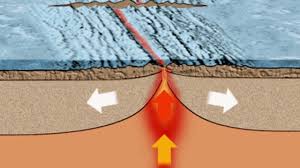
In sea-floor spreading, molten material rises from the mantle and erupts
along the edges of all the continents.
along mid-ocean ridges.
in deep-ocean trenches.
at the north and south poles.
What is the term for the layer of gases surrounding Earth?
Atmosphere
Lithosphere
Hydrosphere
Biosphere
Which process is responsible for the movement of tectonic plates?
Convection currents
Radiation
Conduction
Evaporation
What is the primary cause of ocean tides on Earth?
The Moon's gravitational pull
The Sun's radiation
Earth's rotation
Wind patterns
Which layer of Earth is composed mostly of liquid iron and nickel?
Outer core
Inner core
Mantle
Crust
What is the term for the point on Earth's surface directly above an earthquake's origin?
Epicenter
Focus
Fault
Seismic zone
Which phenomenon is caused by the Earth's tilt and orbit around the Sun?
Seasons
Day and night
Tides
Volcanic eruptions
What is the term for the process by which water vapor turns into liquid water?
Condensation
Evaporation
Sublimation
Transpiration
Which type of rock is formed from the cooling and solidification of magma or lava?
Igneous
Sedimentary
Metamorphic
Basalt

