
NEW
Font size
 Worksheets
Introduction to the Vietnam War
Total questions: 25
Worksheet time: 25mins
Who led the communist revolution in Vietnam?
Nguyen Thi Dinh
Trung Trac
Le Ngoc Han
Ho Chi Minh
Which statement is true:
The Vietnam War was two wars: Vietnam fighting against France, then Vietnam fighting against America.
The Vietnam War was one war: Vietnam fighting against America.
The Vietnam War was three wars: Vietnam fighting against America, France, and China.
The Vietnam War was one war: Vietnam fighting against Laos.
Which of the following countries did Vietnam BEAT from 1940-1980?
United States and Armenia
United States and the Philippines
China and the Soviet Union
Japan, France, the United States, Cambodia, and China
Which country colonized Vietnam for nearly 100 years?
United States
France
Japan
United Kingdom

Why did the government implement a draft during the Vietnam War?
To monitor ethnic groups for espionage activities.
To fund the war by authorizing the sale of government bonds.
To regulate freedom of expression at antiwar demonstrations.
To provide the military with additional man power.
The Gulf of Tonkin Resolution gave the president power to send troops to ______ to protect against further North Vietnamese aggression.
Vietnam
China
Which group was most likely to be drafted in the military
18-25 poor and uneducated men
20-30 college students
19-21 uneducated rich kids
30-40 history teachers
Which president put the US into war with Vietnam?
LBJ
JFK
Nixon
Eisenhower
What was the significance of the Tet Offensive?
It led to the U.S. winning the war
It resulted in a ceasefire
It showed that the Vietcong could strike anywhere and led to a credibility gap
It marked the beginning of the war
What type of warfare was used by the Vietcong against the U.S. during the Vietnam War?
Nuclear warfare
Conventional warfare
Guerrilla warfare
Chemical warfare
What event marked the turning point in the Vietnam War according to the text?
The signing of the Paris Peace Accords
The Tet Offensive
The Fall of Saigon
The My Lai Massacre

Master Sergeant Roy Benavidez rescued wounded soldiers during a firefight in Vietnam. In recognition of the actions described, Master Sergeant Roy Benavidez was —
given an early honorable discharge from U.S. military service
awarded the Congressional Medal of Honor
made an honorary member of the United Nations
awarded the Legion of Honor ribbon
The U.S. got involved in Vietnam because of what foreign policy?
containment
Good Neighbor policy
isolationism
Roosevelt Corollary
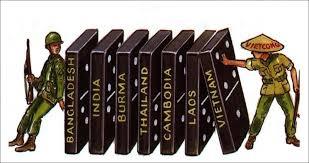
The idea that if South Vietnam fell to communism, other nations would soon follow...
Vietnamization
Communism
Domino Theory
Imperialism
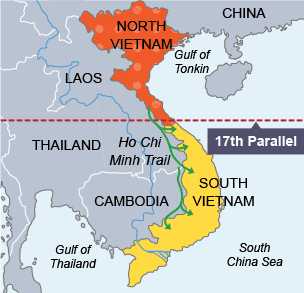
In the 1950s, the United States became involved in the Vietnam War. Why did the United States become involved in this war?
to prevent the collapse of the government of North Vietnam
to stop Vietnam from taking over Hong Kong
to stop the spread of communism to South Vietnam
to prevent attacks against United States shipping

Networks of jungle paths used by N. Vietnam to transport supplies to the Vietcong?
Saigon Route
Bataan Death March
Trail of Tears
Ho Chi Minh Trail
Who were the communists in South Vietnam?
Vietminh
Vietcong
Ho Chi Minhions
What is the idea that if Vietnam fell to communism, the rest of SE Asia would follow?
Domino theory
MAD theory
Containment theory
China Syndrome

He was the communist leader of North Vietnam
Diem
Johnson
Ho Chi Minh
Castro
Vietnam was a colony of what country prior to World War II?
United States
China
Japan
France
Who led the rebellion against France for Vietnam?
Ngo Dihn Diem
Ho Chi Minh
President Kennedy
Sui Chin
What was the primary reason for the United States' involvement in the Vietnam War?
To support French colonial interests
To prevent the spread of communism
To gain control of Vietnam's natural resources
To establish a military base in Southeast Asia
Which event is considered the beginning of the Vietnam War?
The Gulf of Tonkin Incident
The Fall of Saigon
The Tet Offensive
The My Lai Massacre
Who were the main opponents of the United States in the Vietnam War?
The French colonial forces
The North Vietnamese Army and the Vietcong
The Chinese military
The Soviet Union
What was the outcome of the Vietnam War for the United States?
A decisive military victory
A negotiated peace settlement
A withdrawal without victory
An expansion of U.S. influence in Asia

